


Association of matrix metalloproteinase-3 -1171(5A>6A) polymorphism with cancer risk: a meta-analysis of 41 studies
- PMID: 24489939
- PMCID: PMC3906197
- DOI: 10.1371/journal.pone.0087562
Association of matrix metalloproteinase-3 -1171(5A>6A) polymorphism with cancer risk: a meta-analysis of 41 studies
Abstract
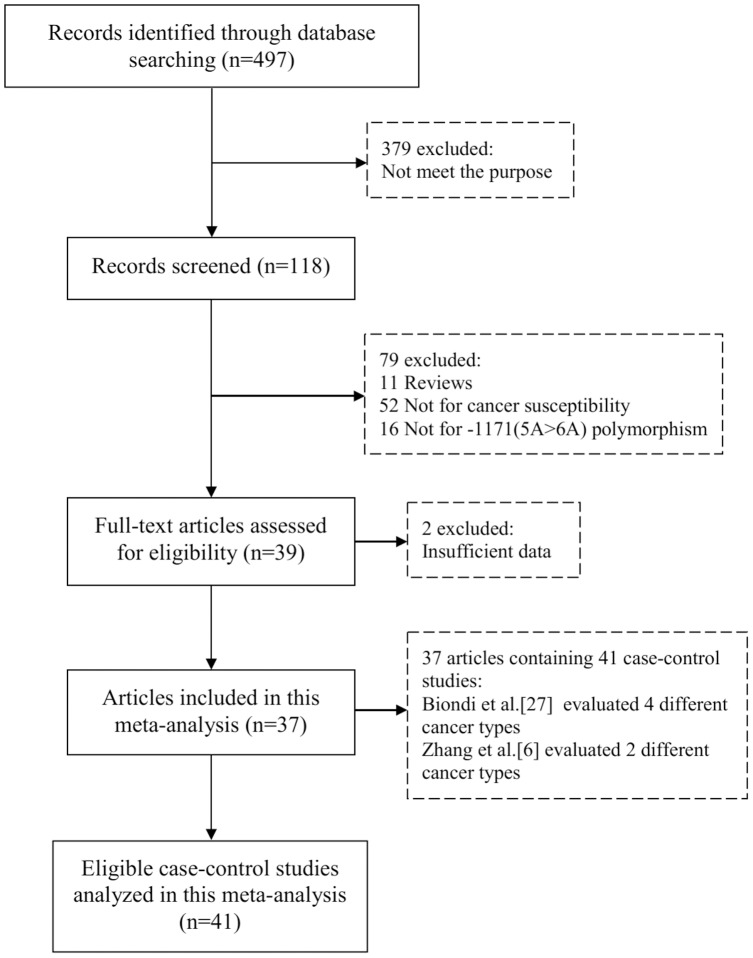
Background and objective: Evidence has shown that matrix metalloproteinases-3 (MMP3) is important for cancer progression. Recent studies about the association between the -1171(5A>6A) polymorphism in MMP3 promoter region and cancer risk have yielded conflicting results.
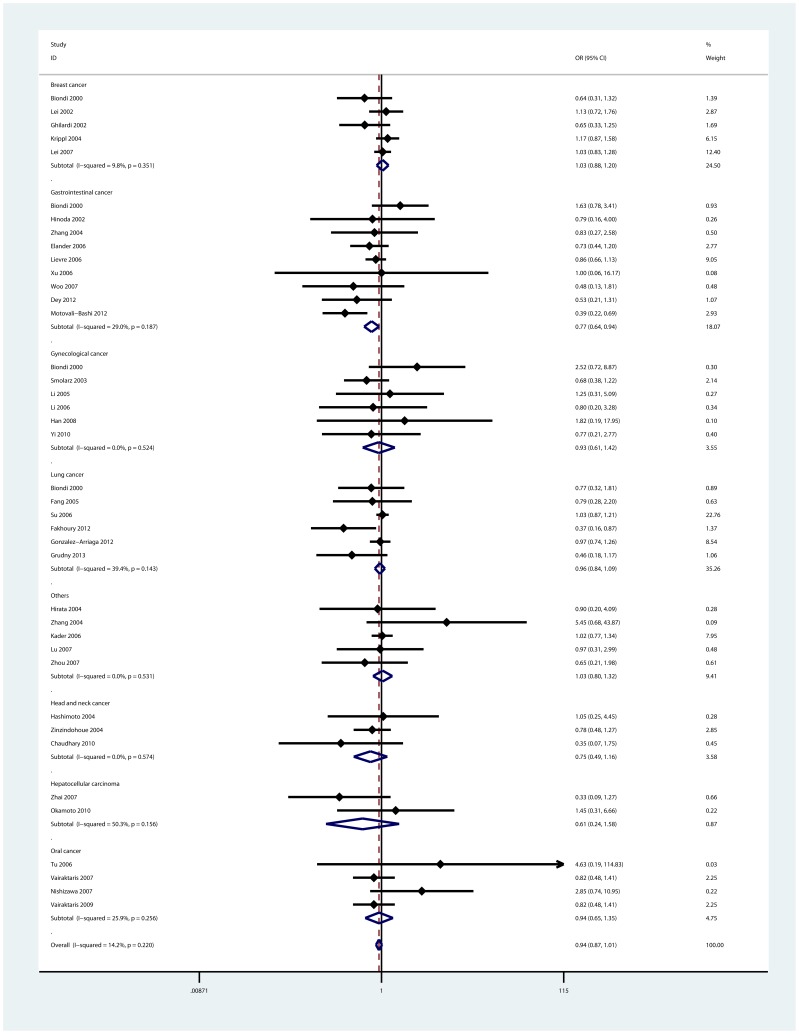
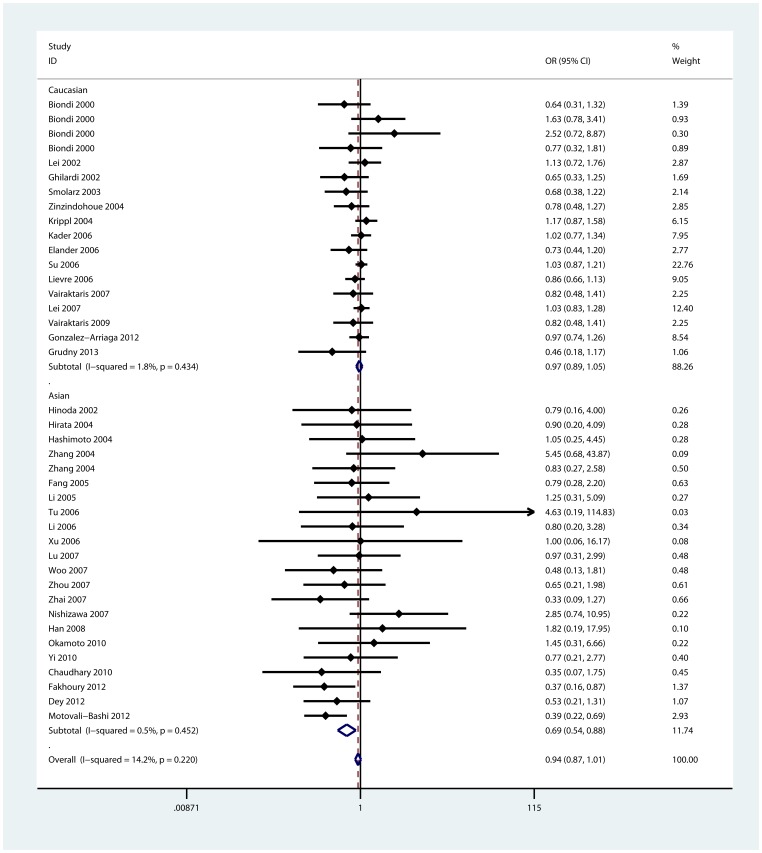
Methodology/principal findings: We performed a meta-analysis of 41 studies including 11112 cases and 11091 controls to determine whether the -1171(5A>6A) polymorphism of MMP3 was associated with cancer risk. We assessed the strength of association and performed sub-group analyses by cancer types, ethnicity, smoking status, genotyping method, source of controls and sample size. The pooled results revealed that no significant association of the -1171(5A>6A) polymorphism with overall cancer risk in any of four models. Further sub-group analysis revealed that individuals with the 6A allele had lower risk of gastrointestinal cancer in two models: heterozygote comparison (6A/5A vs. 5A/5A: OR=0.74, 95%CI: 0.60-0.91; I(2)=1.9%), and dominant model (6A/6A+6A/5A vs. 5A/5A: OR=0.77, 95%CI: 0.64-0.94; I(2)=29.0%). Additionally, the associations were significant in Asian populations for three models: homozygote comparison (6A/6A vs. 5A/5A, OR=0.68, 95%CI: 0.52-0.90; I(2)=26.7%), heterozygote comparison (6A/5A vs. 5A/5A: OR=0.75, 95%CI: 0.58-0.98; I(2)=0.0%), and dominant model (6A/6A+6A/5A vs. 5A/5A: OR=0.69, 95%CI: 0.54-0.88; I(2)=0.5%). It was noteworthy that we had a contrary finding in non-smokers: the variant 6A/6A homozygote might statistically increase cancer risk compared with 6A/5A+5A/5A genotype (OR=1.92, 95%CI: 1.25-2.96; I(2)=72.7%).
Conclusion: This meta-analysis suggests that the -1171(5A>6A) polymorphism in MMP3 promoter region is not associated with overall cancer risk, but it may contribute to decreased cancer risk in Asian population when compared with Caucasian population and significantly reduce the risk of gastrointestinal cancer.
Conflict of interest statement
Figures
References
-
- Basset P, Okada A, Chenard MP, Kannan R, Stoll I, et al. (1997) Matrix metalloproteinases as stromal effectors of human carcinoma progression: therapeutic implications. Matrix Biol 15: 535–541. - PubMed
-
- Johnsen M, Lund LR, Romer J, Almholt K, Dano K (1998) Cancer invasion and tissue remodeling: common themes in proteolytic matrix degradation. Curr Opin Cell Biol 10: 667–671. - PubMed
-
- Curran S, Murray GI (2000) Matrix metalloproteinases: molecular aspects of their roles in tumour invasion and metastasis. European journal of cancer (Oxford, England : 1990) 36: 1621–1630. - PubMed
-
- Massova I, Kotra LP, Fridman R, Mobashery S (1998) Matrix metalloproteinases: structures, evolution, and diversification. FASEB journal : official publication of the Federation of American Societies for Experimental Biology 12: 1075–1095. - PubMed
Publication types
MeSH terms
Substances
LinkOut - more resources
Full Text Sources
Other Literature Sources
Miscellaneous
