. 2014 Feb 3;15(2):R30.
doi: 10.1186/gb-2014-15-2-r30.

Using high-density DNA methylation arrays to profile copy number alterations

Using high-density DNA methylation arrays to profile copy number alterations

Andrew Feber et al. Genome Biol. .

Abstract

The integration of genomic and epigenomic data is an increasingly popular approach for studying the complex mechanisms driving cancer development. We have developed a method for evaluating both methylation and copy number from high-density DNA methylation arrays. Comparing copy number data from Infinium HumanMethylation450 BeadChips and SNP arrays, we demonstrate that Infinium arrays detect copy number alterations with the sensitivity of SNP platforms. These results show that high-density methylation arrays provide a robust and economic platform for detecting copy number and methylation changes in a single experiment. Our method is available in the ChAMP Bioconductor package: http://www.bioconductor.org/packages/2.13/bioc/html/ChAMP.html.


Figures
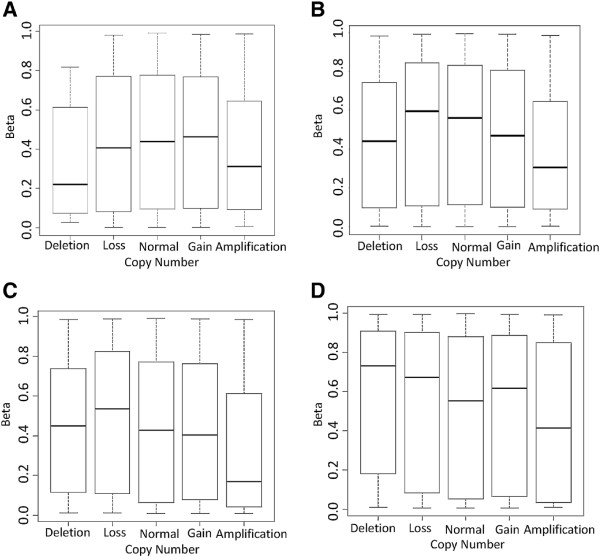
Figure 1
Figure 1
Association of methylation state with copy number. Box plots showing the influence of changing genomic content on methylation state (average beta value) inferred from SNP (CytoSNP and Affymetrix SNP6.0) and Infinium arrays, respectively, for (A) chondrosarcoma, (B) glioblastoma multiforme, (C) bladder cancer and (D) prostate cancer.
Figure 2
Figure 2
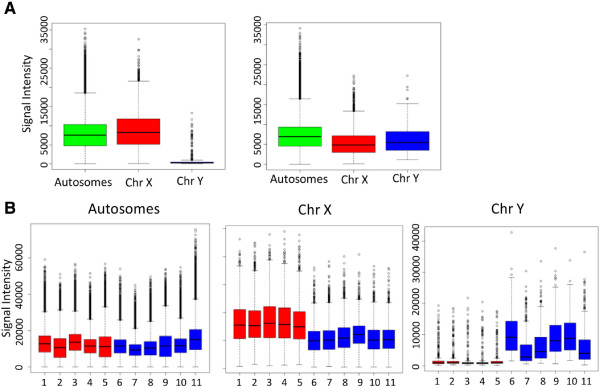
Changes in Infinium probe intensities between sex chromosomes. (A) Box plots of Infinium total signal intensities for autosomes and sex chromosomes for male and female patients (autosome (green) and sex chromosomes (chromosome X (red), chromosome Y (blue)). (B) Box plots of Infinium intensities for autosomes and sex chromosomes for 11 chondrosarcoma samples (females, red; males, blue).
Figure 3
Figure 3
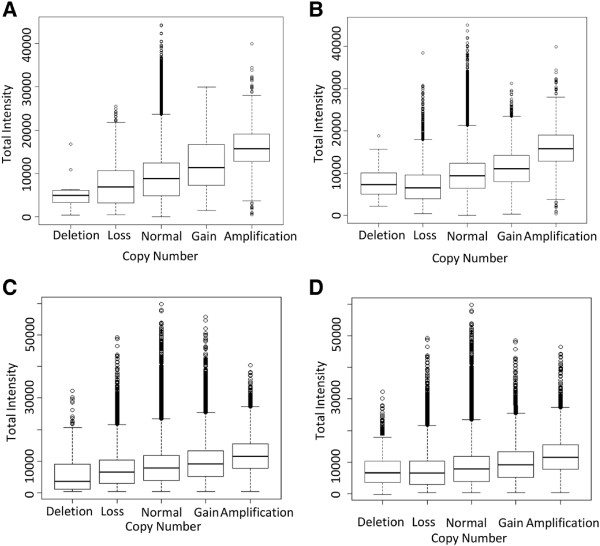
Comparison of Infinium total probe intensity and changing copy number. Box plots showing the association of total probe signal intensity from the Infinium arrays and copy number state inferred from SNP arrays for (A) chondrosarcoma, (B) glioblastoma multiforme, (C) bladder cancer and (D) prostate cancer.
Figure 4
Figure 4
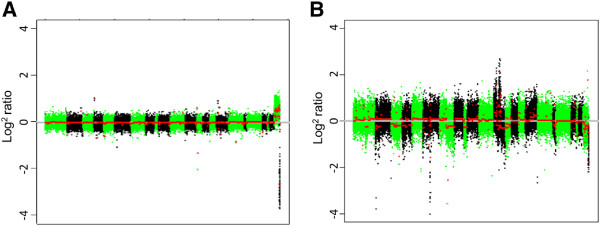
Normal and malignant copy number profiles. (A) CN profile for normal female versus male reference. (B) CN profile for a highly aneuploid cancer genome (versus male reference) derived from the Infinium arrays. Individual chromosomes are shown in green/black and segmented CN is shown in red.
Figure 5
Figure 5
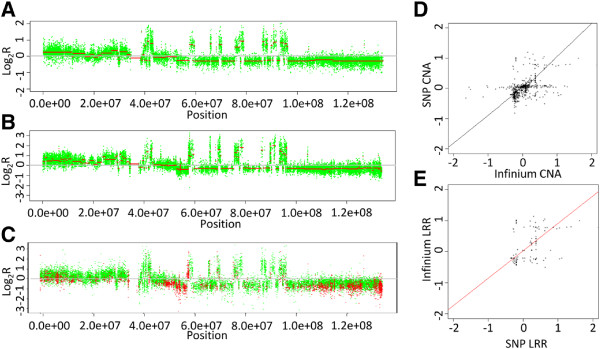
Comparison of Infinium and SNP copy number profiles. CN profiles for chromosome 12 for a single chondrosarcoma sample using (A) Infinium array, (B) CytoSNP and (C) combined Infinium and CytoSNP. (D) Scatter plot showing the correlation between Infinium CN and SNP array CN states from matched samples. (E) Scatter plot of Infinium and SNP array CNA states for chromosome 12 only.
Figure 6
Figure 6
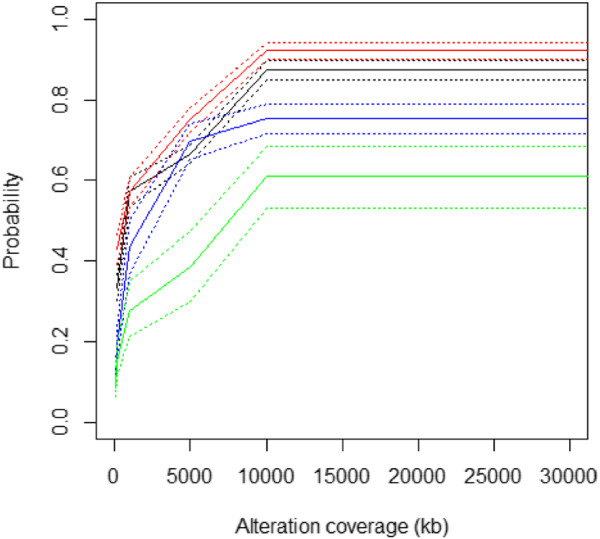
Coverage plots of candidate true positives to assess the sensitivity and specificity of alterations defined by the Infinium arrays. At each alteration threshold (deletion, blue; loss, red; gain, black; amplification, green) we counted the alterations that overlap between matched arrays. The number of overlapping regions (candidate true positives). Dotted lines represent 95% confidence intervals.
Figure 7
Figure 7
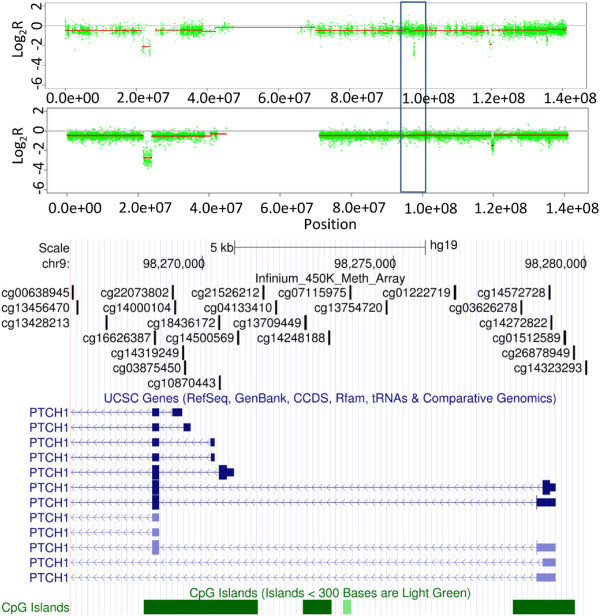
Infinium unique PTCH1 deletion. CN profiles for chromosome 9 for a single chondrosarcoma sample generated from Infinium HumanMethylation450 BeadChip (upper panel) and CytoSNP arrays (middle panel). The Infinium array-specific deletion of PTCH1 is highlighted (blue box).The lower panel shows the genomic organization of the Infinium unique PTCH1 region of deletion and the distribution of probes on the Infinium methylation, CytoSNP and SNP 6.0 arrays.
Figure 8
Figure 8
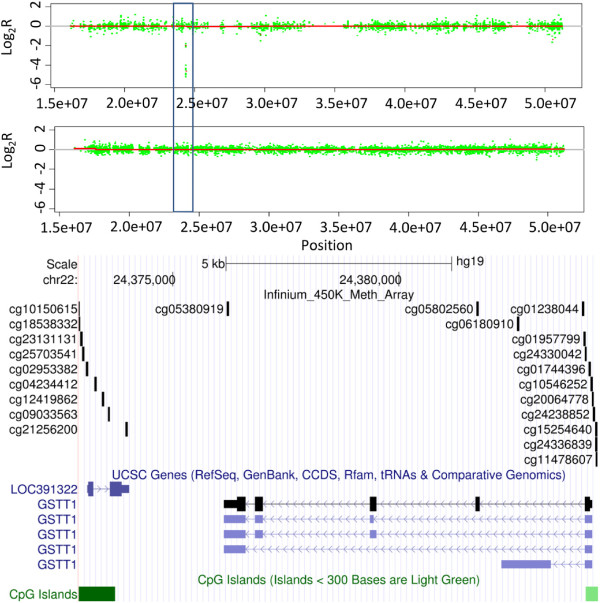
Infinium unique GSTT1 deletion. CN profiles for a proportion of chromosome 22 for a single chondrosarcoma sample generated from Infinium HumanMethylation450 BeadChip (upper panel) and CytoSNP arrays (middle panel). The Infinium array specific deletion of GSTT1 is highlighted (blue box). The lower panel shows the genomic organization of the Infinium unique GSTT1 region of deletion and the distribution of probes on the Infinium methylation, CytoSNP and SNP 6.0 arrays.

References

    1. Feber A, Clark J, Goodwin G, Dodson AR, Smith PH, Fletcher A, Edwards S, Flohr P, Falconer A, Roe T, Kovacs G, Dennis N, Fisher C, Wooster R, Huddart R, Foster CS, Cooper CS. Amplification and overexpression of E2F3 in human bladder cancer. Oncogene. 2004;23:1627–1630. doi: 10.1038/sj.onc.1207274. - DOI - PubMed
    1. Holcomb IN, Young JM, Coleman IM, Salari K, Grove DI, Hsu L, True LD, Roudier MP, Morrissey CM, Higano CS, Nelson PS, Vessella RL, Trask BJ. Comparative analyses of chromosome alterations in soft-tissue metastases within and across patients with castration-resistant prostate cancer. Cancer Res. 2009;69:7793–7802. doi: 10.1158/0008-5472.CAN-08-3810. - DOI - PMC - PubMed
    1. Hammerman PS, Hayes DN, Wilkerson MD, Schultz N, Bose R, Chu A, Collisson EA, Cope L, Creighton CJ, Getz G, Herman JG, Johnson BE, Kucherlapati R, Ladanyi M, Maher CA, Robertson G, Sander C, Shen R, Sinha R, Sivachenko A, Thomas RK, Travis WD, Tsao MS, Weinstein JN, Wigle DA, Baylin SB, Govindan R, Meyerson M. Comprehensive genomic characterization of squamous cell lung cancers. Nature. 2012;489:519–525. doi: 10.1038/nature11404. - DOI - PMC - PubMed
    1. Cancer Genome Atlas N. Comprehensive molecular portraits of human breast tumours. Nature. 2012;490:61–70. doi: 10.1038/nature11412. - DOI - PMC - PubMed
    1. Kallioniemi A, Kallioniemi OP, Waldman FM, Chen LC, Yu LC, Fung YK, Smith HS, Pinkel D, Gray JW. Detection of retinoblastoma gene copy number in metaphase chromosomes and interphase nuclei by fluorescence in situ hybridization. Cytogenet Cell Genet. 1992;60:190–193. - PubMed

Publication types