


Phase I trial of cisplatin, pemetrexed, and imatinib mesylate in chemonaive patients with unresectable malignant pleural mesothelioma
- PMID: 24492162
- PMCID: PMC5080907
- DOI: 10.1016/j.cllc.2013.12.008
Phase I trial of cisplatin, pemetrexed, and imatinib mesylate in chemonaive patients with unresectable malignant pleural mesothelioma
Abstract
Background: We conducted a phase I trial of cisplatin/pemetrexed/imatinib mesylate, an oral platelet-derived growth factor receptor (PDGFR) inhibitor, in chemonaive patients with malignant pleural mesothelioma (MPM).
Methods: A standard 3 + 3 dose-escalating trial was used with the end points of maximum tolerated dose (MTD), response rate, survival, safety/toxicity, and tumor PDGFR levels.
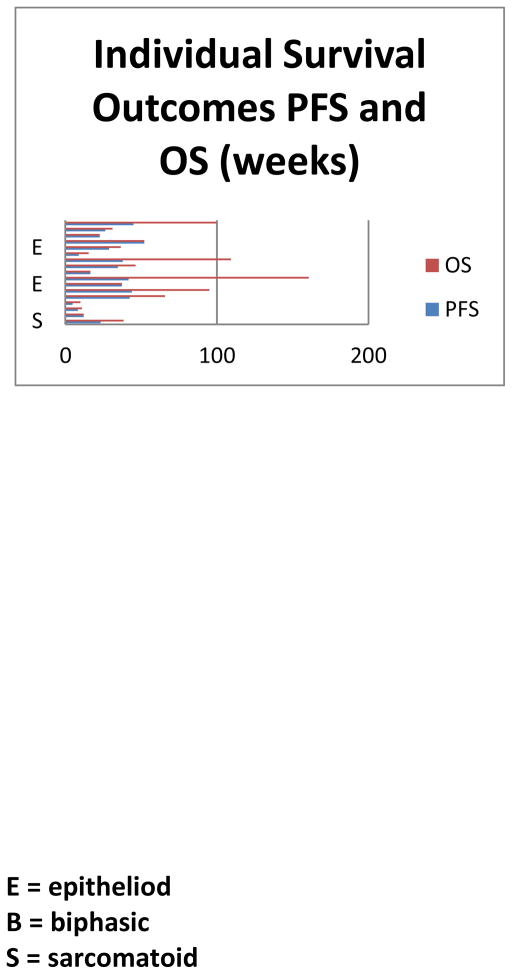
Results: Seventeen patients with MPM were enrolled. The most common (any grade) side effects were nausea, fatigue, hypomagnesemia, and anemia. The MTD was established at dose level 3 (imatinib 600 mg) with a dose-limiting toxicity (DLT) of nausea and vomiting. The median progression-free survival (PFS) was 7.9 months and the median overall survival (OS) was 8.8 months. Patients with a sarcomatoid subtype had worse PFS (P = .01) and OS (P = .009), whereas they had a better Eastern Cooperative Oncology Group performance status (ECOG PS) of 0-1 predicted for improved OS (P = .001) and PFS (P = .013). The 6 patients who completed all 6 treatment cycles had better OS (P = .006); the median PFS was 9.6 months and the OS was 22.4 months. In the translational studies, 14 patients had adequate tumor tissue that could be assessed for immunohistochemical (IHC) analysis and fluorescence in situ hybridization (FISH). Patients with higher than median p-PDGFRα IHC expression had a better OS (P = .013). When assessed as a continuous variable, higher p-PDGFRα in tumor cells correlated with an improved OS (P = .045). None of the other 4 IHC biomarkers were predictive or prognostic for survival. Twelve patients had successful PDGFRB FISH results, but none met the criteria of ≥ 4 copies of the PDGFRB gene; thus a correlation with clinical outcomes could not be done.
Conclusion: The cisplatin/pemetrexed/imatinib mesylate combination had clinical benefit in some patients with MPM but was not well tolerated. Further investigation into alternative antiangiogenic agents, including PDGFRα inhibitors, is warranted.
Keywords: Cisplatin; Imatinib mesylate; Mesothelioma; PDGFR; Pemetrexed.
Copyright © 2014 Elsevier Inc. All rights reserved.
Figures
References
-
- Baas P. Chemotherapy for malignant mesothelioma: from doxorubicin to vinorelbine. Semin Oncol. 2002;29:62–9. - PubMed
-
- Vogelzang NJ, Rusthoven JJ, Symanowski J, et al. Phase III study of pemetrexed in combination with cisplatin versus cisplatin alone in patients with malignant pleural mesothelioma. J Clin Oncol. 2003;21:2636–44. - PubMed
-
- Buchdunger E, Cioffi CL, Law N, et al. Abl protein-tyrosine kinase inhibitor STI571 inhibits in vitro signal transduction mediated by c-kit and platelet-derived growth factor receptors. J Pharmacol Exp Ther. 2000;295:139–45. - PubMed
-
- Savage DG, Antman KH. Imatinib mesylate--a new oral targeted therapy. N Engl J Med. 2002;346:683–93. - PubMed
-
- Pietras K, Sjoblom T, Rubin K, et al. PDGF receptors as cancer drug targets. Cancer Cell. 2003;3:439–43. - PubMed
Publication types
MeSH terms
Substances
Grants and funding
LinkOut - more resources
Full Text Sources
Other Literature Sources
Medical
Miscellaneous
