


CYP2B6 18492T->C polymorphism compromises efavirenz concentration in coinfected HIV and tuberculosis patients carrying CYP2B6 haplotype *1/*1
- PMID: 24492364
- PMCID: PMC4023787
- DOI: 10.1128/AAC.02384-13
CYP2B6 18492T->C polymorphism compromises efavirenz concentration in coinfected HIV and tuberculosis patients carrying CYP2B6 haplotype *1/*1
Abstract
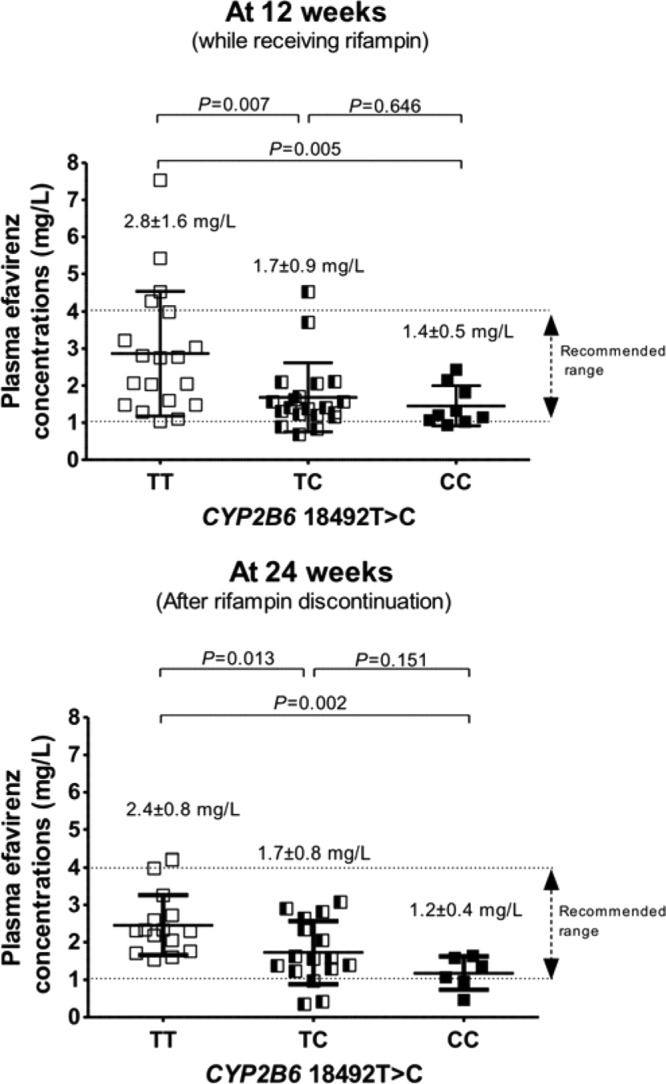
Data regarding the effect of the CYP2B6 18492T→C polymorphism on plasma efavirenz concentrations and 96-week virologic responses in patients coinfected with HIV and tuberculosis (TB) are still unavailable. A total of 139 antiretroviral-naive HIV-infected adults with active TB were prospectively enrolled to receive efavirenz 600 mg-tenofovir 300 mg-lamivudine 300 mg. Eight single nucleotide polymorphisms (SNPs) within CYP2B6 were genotyped. Seven SNPs, including 64C→T, 499C→G, 516G→T, 785A→G, 1375A→G, 1459C→T, and 21563C→T, were included for CYP2B6 haplotype determination. The CYP2B6 18492T→C polymorphism was studied in 48 patients who carried haplotype *1/*1. At 12 and 24 weeks after antiretroviral therapy, plasma efavirenz concentrations at 12 h after dosing were measured. Plasma HIV RNA was monitored every 12 weeks for 96 weeks. Of 48 patients {body weight [mean±standard deviation (SD)], 56±10 kg}, 77% received a rifampin-containing anti-TB regimen. No drug resistance-associated mutation was detected at baseline. The frequencies of the wild type (18492TT) and the heterozygous (18492TC) and homozygous (18492CC) mutants of the CYP2B6 18492T→C polymorphism were 39%, 42%, and 19%, respectively. At 12 weeks, mean (±SD) efavirenz concentrations of patients who carried the 18492TT, 18492TC, and 18492CC mutants were 2.8±1.6, 1.7±0.9, and 1.4±0.5 mg/liter, respectively (P=0.005). At 24 weeks, the efavirenz concentrations of the corresponding groups were 2.4±0.8, 1.7±0.8, and 1.2±0.4 mg/liter, respectively (P=0.003). A low efavirenz concentration was independently associated with 18492T→C (β=-0.937, P=0.004) and high body weight (β=-0.032, P=0.046). At 96 weeks, 19%, 17%, and 28% of patients carrying the 18492TT, 18492TC, and 18492CC mutants, respectively, had plasma HIV RNA levels of >40 copies/ml and developed efavirenz-associated mutations (P=0.254). In summary, the CYP2B6 18492T→C polymorphism compromises efavirenz concentrations in patients who carry CYP2B6 haplotype *1/*1 and are coinfected with HIV and tuberculosis.
Figures
References
-
- Panel on Antiretroviral Guidelines for Adults and Adolescents. 2013. Guidelines for the use of antiretroviral agents in HIV-1-infected adults and adolescents. Department of Health and Human Services, Washington, DC: http://aidsinfo.nih.gov/ContentFiles/AdultandAdolescentGL.pdf Accessed 1 April 2013
-
- Mutlib AE, Chen H, Nemeth GA, Markwalder JA, Seitz SP, Gan LS, Christ DD. 1999. Identification and characterization of efavirenz metabolites by liquid chromatography/mass spectrometry and high field NMR: species differences in the metabolism of efavirenz. Drug Metab. Dispos. 27:1319–1333 - PubMed
-
- Ward BA, Gorski JC, Jones DR, Hall SD, Flockhart DA, Desta Z. 2003. The cytochrome P450 2B6 (CYP2B6) is the main catalyst of efavirenz primary and secondary metabolism: implication for HIV/AIDS therapy and utility of efavirenz as a substrate marker of CYP2B6 catalytic activity. J. Pharmacol. Exp. Ther. 306:287–300. 10.1124/jpet.103.049601 - DOI - PubMed
Publication types
MeSH terms
Substances
LinkOut - more resources
Full Text Sources
Other Literature Sources
Medical
Molecular Biology Databases
