


Vitamin C and E supplementation hampers cellular adaptation to endurance training in humans: a double-blind, randomised, controlled trial
- PMID: 24492839
- PMCID: PMC4001759
- DOI: 10.1113/jphysiol.2013.267419
Vitamin C and E supplementation hampers cellular adaptation to endurance training in humans: a double-blind, randomised, controlled trial
Abstract
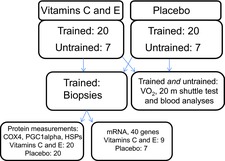
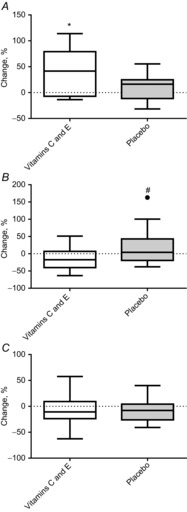
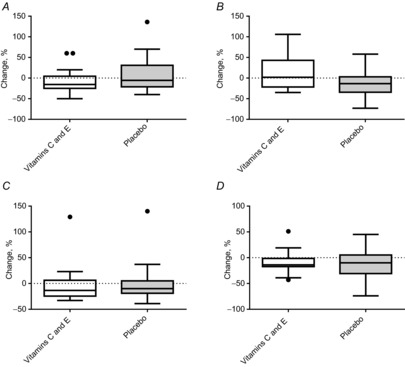
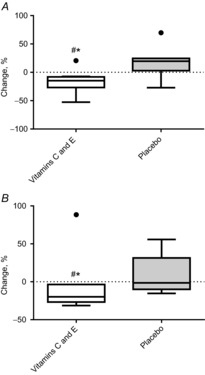
In this double-blind, randomised, controlled trial, we investigated the effects of vitamin C and E supplementation on endurance training adaptations in humans. Fifty-four young men and women were randomly allocated to receive either 1000 mg of vitamin C and 235 mg of vitamin E or a placebo daily for 11 weeks. During supplementation, the participants completed an endurance training programme consisting of three to four sessions per week (primarily of running), divided into high-intensity interval sessions [4-6 × 4-6 min; >90% of maximal heart rate (HRmax)] and steady state continuous sessions (30-60 min; 70-90% of HRmax). Maximal oxygen uptake (VO2 max ), submaximal running and a 20 m shuttle run test were assessed and blood samples and muscle biopsies were collected, before and after the intervention. Participants in the vitamin C and E group increased their VO2 max (mean ± s.d.: 8 ± 5%) and performance in the 20 m shuttle test (10 ± 11%) to the same degree as those in the placebo group (mean ± s.d.: 8 ± 5% and 14 ± 17%, respectively). However, the mitochondrial marker cytochrome c oxidase subunit IV (COX4) and cytosolic peroxisome proliferator-activated receptor-γ coactivator 1 α (PGC-1α) increased in the m. vastus lateralis in the placebo group by 59 ± 97% and 19 ± 51%, respectively, but not in the vitamin C and E group (COX4: -13 ± 54%; PGC-1α: -13 ± 29%; P ≤ 0.03, between groups). Furthermore, mRNA levels of CDC42 and mitogen-activated protein kinase 1 (MAPK1) in the trained muscle were lower in the vitamin C and E group than in the placebo group (P ≤ 0.05). Daily vitamin C and E supplementation attenuated increases in markers of mitochondrial biogenesis following endurance training. However, no clear interactions were detected for improvements in VO2 max and running performance. Consequently, vitamin C and E supplementation hampered cellular adaptations in the exercised muscles, and although this did not translate to the performance tests applied in this study, we advocate caution when considering antioxidant supplementation combined with endurance exercise.
Figures
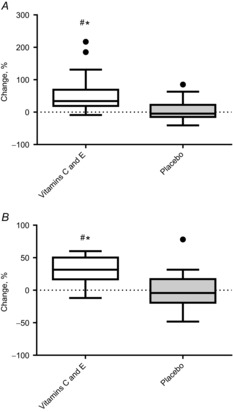
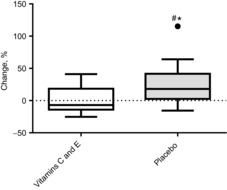
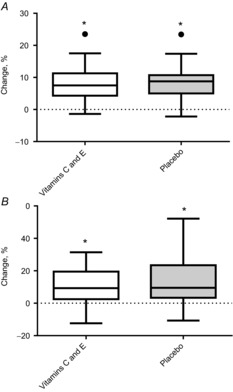
 . B, changes in 20 m shuttle run. Boxplots show maximum–minimum values, 25–75th quartiles, and medians. ●, outliers (Tukey's rule); #, difference between groups; *, within-group changes.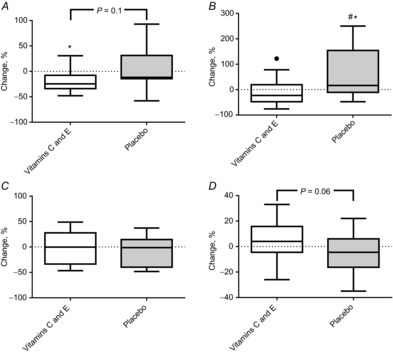
Comment in
-
Antioxidants and exercise: a tale of the complexities of relating signalling processes to physiological function?J Physiol. 2014 Apr 15;592(8):1721-2. doi: 10.1113/jphysiol.2014.272294. J Physiol. 2014. PMID: 24737894 Free PMC article. No abstract available.
-
Don't mess with stress: vitamin supplementation and the role of oxidative stress for aerobic exercise adaptation.J Physiol. 2014 Sep 15;592(18):3951-2. doi: 10.1113/jphysiol.2014.278978. J Physiol. 2014. PMID: 25225257 Free PMC article. No abstract available.
References
-
- Abudu N, Miller JJ, Attaelmannan M, Levinson SS. Vitamins in human arteriosclerosis with emphasis on vitamin C and vitamin E. Clin Chim Acta. 2004;339:11–25. - PubMed
-
- Aguilo A, Tauler P, Sureda A, Cases N, Tur J, Pons A. Antioxidant diet supplementation enhances aerobic performance in amateur sportsmen. J Sports Sci. 2007;25:1203–1210. - PubMed
-
- Anderson LJ, Erceg DN, Schroeder ET. Utility of multifrequency bioelectrical impedance compared with dual-energy x-ray absorptiometry for assessment of total and regional body composition varies between men and women. Nutr Res. 2012;32:479–485. - PubMed
-
- Bastani NE, Gundersen TE, Blomhoff R. Determination of 8-epi PGF2α concentrations as a biomarker of oxidative stress using triple-stage liquid chromatography/tandem mass spectrometry. Rapid Commun Mass Spectrom. 2009;23:2885–2890. - PubMed
Publication types
MeSH terms
Substances
LinkOut - more resources
Full Text Sources
Other Literature Sources
Medical
Miscellaneous
