Review
. 2014 Feb 1;4(2):a014282.
doi: 10.1101/cshperspect.a014282.

Oncogenic mechanisms in Burkitt lymphoma

Affiliations
Review

Oncogenic mechanisms in Burkitt lymphoma

Roland Schmitz et al. Cold Spring Harb Perspect Med. .

Abstract

Burkitt lymphoma is a germinal center B-cell-derived cancer that was instrumental in the identification of MYC as an important human oncogene more than three decades ago. Recently, new genomics technologies have uncovered several additional oncogenic mechanisms that cooperate with MYC to create this highly aggressive cancer. The transcription factor TCF-3 is central to Burkitt lymphoma pathogenesis. TCF-3 is rendered constitutively active in Burkitt lymphoma by two related mechanisms: (1) somatic mutations that inactivate its negative regulator ID3, and (2) somatic mutations in TCF-3 that block the ability of ID3 to bind and interfere with its activity as a transcription factor. TCF-3 is also a master regulator of normal germinal center B-cell differentiation. Within the germinal center, TCF-3 up-regulates genes that are characteristically expressed in the rapidly dividing centroblasts, the putative cell of origin for Burkitt lymphoma, while repressing genes expressed in the less proliferative centrocytes. TCF-3 promotes antigen-independent (tonic) B-cell-receptor signaling in Burkitt lymphoma by transactivating immunoglobulin heavy- and light-chain genes while repressing PTPN6, which encodes the phosphatase SHP-1, a negative regulator of B-cell-receptor signaling. Tonic B-cell-receptor signaling sustains Burkitt lymphoma survival by engaging the PI3 kinase pathway. In addition, TCF-3 promotes cell-cycle progression by transactivating CCND3, encoding a D-type cyclin that regulates the G1-S phase transition. Additionally, CCND3 accumulates oncogenic mutations that stabilize cyclin D3 protein expression and drive proliferation. These new insights into Burkitt lymphoma pathogenesis suggest new therapeutic strategies, which are sorely needed in developing regions of the world where this cancer is endemic.


Figures
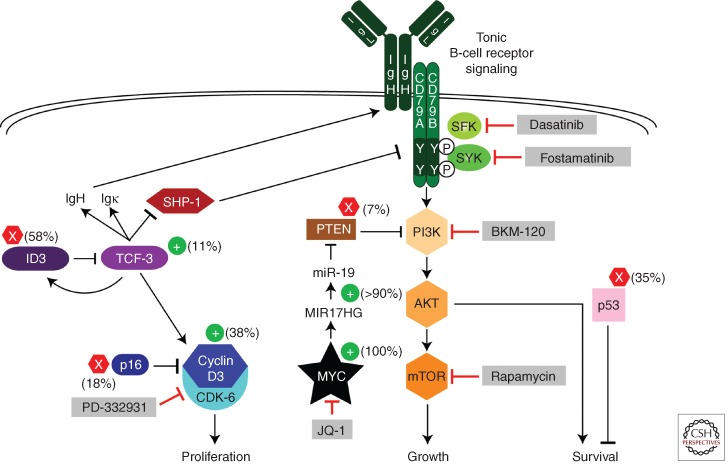
Figure 1.
Figure 1.
Schematic of recurrent oncogenic pathways in Burkitt lymphoma. Shown are pathways that regulate proliferation, growth, and survival of Burkitt lymphomas. Gain-of-function mutations are indicated by + signs and loss-of-function mutations by × signs. (Gray boxes) Potential drugs to block these deregulated pathways. See text for details. (From Schmitz et al. 2012; modified, with permission, from the author.)
Figure 2.
Figure 2.
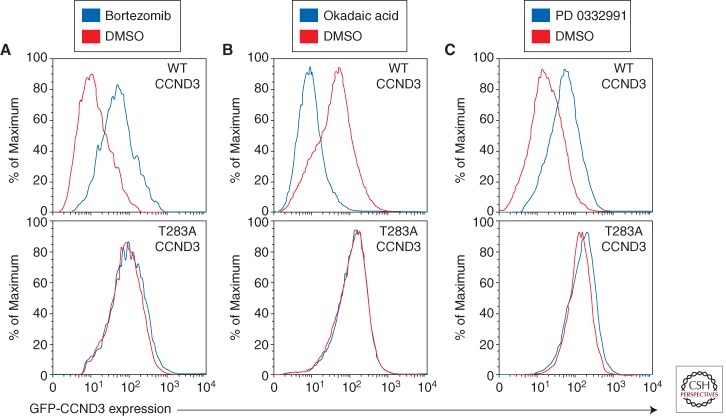
CCND3 mutations cause increased protein stability. FACS analysis of lymphoma cell lines transduced with mutant (T283A) or wild-type GFP-CCND3 fusion proteins (Schmitz et al. 2012). (A) Mutant CCND3 proteins are not degraded by the proteasome. GFP-CCND3 transduced HBL-1 (DLBCL) cells were cultured overnight in the presence of 20 nm the proteasomal inhibitor bortezomib (PS-341) and analyzed by FACS. (B) Mutant CCND3 proteins are not destabilized in response to phosphatase inhibition. Gumbus (BL) cells expressing GFP-CCND3 proteins were treated for 30 min with 750 nm pan-phosphatase inhibitor okadaic acid and analyzed by FACS. (C) The stability of mutant CCND3 proteins is not regulated in the cell cycle. Gumbus (BL) cells expressing GFP-CCND3 isoforms were treated overnight by addition of 1.5 mm the CDK-4/6 inhibitor PD 0332991. FACS analysis indicated stabilization of wild-type but not mutant CCND3 in the G1 phase of the cell cycle.
Figure 3.
Figure 3.
Gene set enrichment analysis of TCF-3 target genes. TCF-3-dependent genes were defined by gene expression profiling in three BL cell lines (BL41, Daudi, and Defauw) following TCF-3 knockdown (day 1 and day 2) or wild-type (wt) ID3 overexpression (day 1 and day 2) (Schmitz et al. 2012). To rank genes based on their TCF-3 dependency, a one-sample RVM t-test model (Wright and Simon 2003) was used to calculate p values against the null hypothesis that the average log-ratio was zero. Kolmogorov-Smirnov curves were generated for centroblast (A) and centrocyte (B) gene signatures (Victora et al. 2012), based on the ordering of BL gene expression data by their one-sided p values. Enrichment results were calculated by comparing the proportion of genes with one-sided p values < 0.01 inside and outside the centroblast and centrocytes signatures.
Figure 4.
Figure 4.
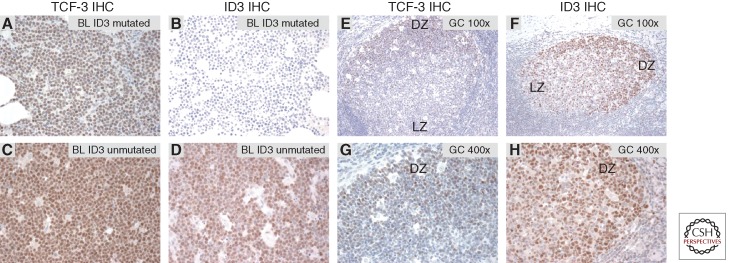
(A–D) TCF-3 and ID3 immunohistochemistry could be used as an additional diagnostic tool for BL. (E–H) TCF-3 and its target gene ID3 are specifically expressed in the dark zone (DZ) of the germinal center. (A–D) Immunohistochemical stainings of BL for TCF-3 (Santa Cruz, SC-349) and ID3 (CalBioReagents, clone 17-3). (A,C) TCF-3 is highly expressed in BL. Burkitt lymphomas harboring ID3 mutations (R28*; L70P) do not express ID3 protein (B), whereas ID3 is detectable in BL without ID3 mutations (D). (E–H) Immunohistochemistry for TCF-3 and ID3 in reactive secondary B follicles. Both TCF-3 and ID3 are predominantly expressed in germinal center centroblasts. Original magnification (E,F) 100×, (G,H) 400×. Dark and light zone distinction was performed based on histology using hematoxylin and eosin staining and immunohistochemistry for KI67. DZ, Dark zone; LZ, light zone.

References

    1. Adams JM, Harris AW, Pinkert CA, Corcoran LM, Alexander WS, Cory S, Palmiter RD, Brinster RL 1985. The c-myc oncogene driven by immunoglobulin enhancers induces lymphoid malignancy in transgenic mice. Nature 318: 533–538 - PubMed
    1. Basso K, Dalla-Favera R 2012. Roles of BCL6 in normal and transformed germinal center B cells. Immunol Rev 247: 172–183 - PubMed
    1. Beck K, Peak MM, Ota T, Nemazee D, Murre C 2009. Distinct roles for E12 and E47 in B cell specification and the sequential rearrangement of immunoglobulin light chain loci. J Exp Med 206: 2271–2284 - PMC - PubMed
    1. Burkitt D 1958. A sarcoma involving the jaws in African children. Br J Surg 46: 218–223 - PubMed
    1. Burkitt DP 1961. Observations on the geography of malignant lymphoma. East Afr Med J 38: 511–514 - PubMed

MeSH terms