


Efficacy, safety, and trends in assisted reproductive technology in Japan-analysis of four-year data from the national registry system
- PMID: 24493386
- PMCID: PMC3969467
- DOI: 10.1007/s10815-014-0181-8
Efficacy, safety, and trends in assisted reproductive technology in Japan-analysis of four-year data from the national registry system
Abstract
Purpose: This study aimed to evaluate the efficacy, safety, and trends in assisted reproductive technology (ART) in Japan.
Methods: Data pertaining to treatment cycles, pregnancy rate, live birth rate, age distribution, single embryo transfer rate, and multiple pregnancy rate were analyzed for patients registered in the national ART registry system of Japan from 2007 to 2010.
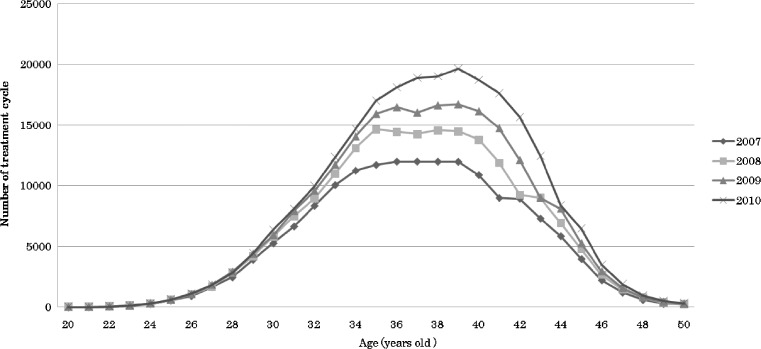
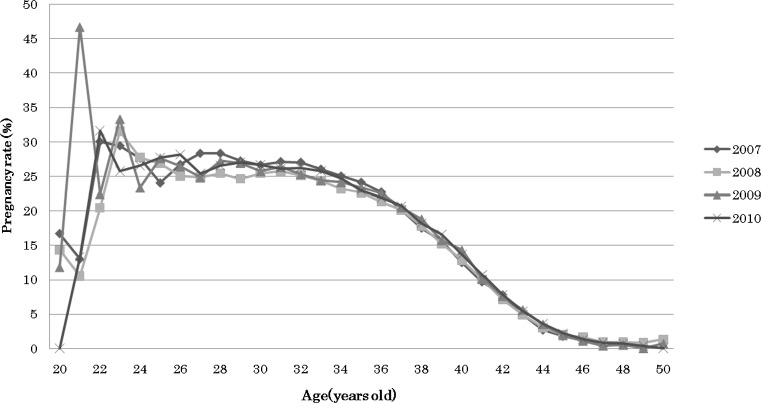
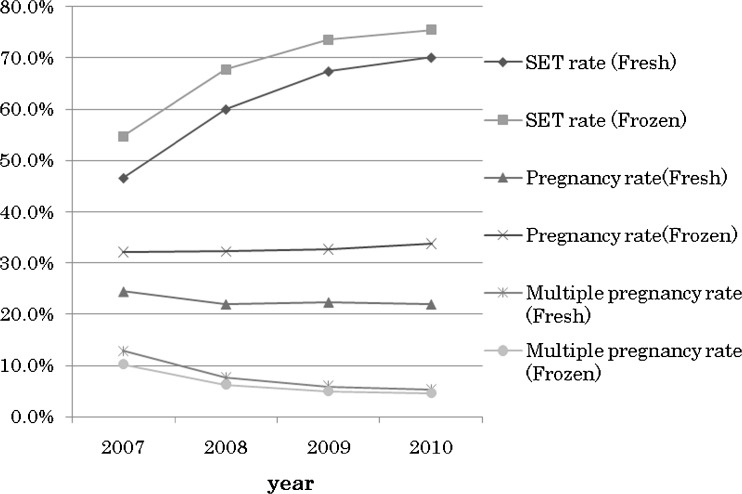
Results: The total number of treatment cycles was 161,164, 190,613, 213,800, and 242,161 in 2007, 2008, 2009, and 2010, respectively. The number of ART treatments administered to patients aged ≥40 years was 31.2 %, 32.1 %, 33.4 %, and 35.7 %, respectively, showing an increasing trend from 2007 to 2010. In each of these years, the total pregnancy rate per embryo transfer was 24.4 %, 21.9 %, 22.3 %, and 21.9 % for fresh cycles, respectively, and 32.0 %, 32.1 %, 32.5 %, and 33.7 % for frozen cycles, respectively. The single embryo transfer rate was 49.9 %, 63.6 %, 70.6 %, and 73.0 %, respectively, showing an increasing trend, while the multiple pregnancy rate was 11.5 %, 6.8 %, 5.3 %, and 4.8 %, respectively, showing a decreasing trend.
Conclusions: From 2007 to 2010 in Japan, the number of ART treatment cycles, number of elderly patients treated, and the single embryo transfer rate increased, while the multiple pregnancy rate decreased. However, the overall pregnancy rate remained stable during the study period.
Figures
References
-
- Steptoe PC, Edwards RG. Birth after the reimplantation of a human embryo. Lancet. 1978;2:312–366. - PubMed
-
- Suzuki M, Hoshi K, Hoshiai H, Saito A, Momono K, Mori R, et al. Pregnancy obtained by in vitro fertilization and embryo transfer. Jpn J Fertil Steril. 1983;28:439–443.
-
- Assisted Reproductive Technology 2007 National Summary Report. In: National Center for Chronic Disease Prevention and Health Promotion. 2007. http://www.cdc.gov/art/ART2007/PDF/COMPLETE_2007_ART.pdf. Accessed 10 Aug 2013.
-
- Assisted Reproductive Technology 2008 National Summary Report. In: National Center for Chronic Disease Prevention and Health Promotion. 2008. http://www.cdc.gov/art/ART2008/PDF/ART_2008_Full.pdf. Accessed 10 August 2013.
-
- Assisted Reproductive Technology 2009 National Summary Report. In: National Center for Chronic Disease Prevention and Health Promotion. 2009. http://www.cdc.gov/art/ART2009/PDF/ART_2009_Full.pdf. Accessed 10 August 2013.
Publication types
MeSH terms
LinkOut - more resources
Full Text Sources
Other Literature Sources
Medical
