. 2014 Jun;13(3):478-86.
doi: 10.1111/acel.12195. Epub 2014 Feb 4.

Smurf2 regulates hematopoietic stem cell self-renewal and aging

Affiliations

Smurf2 regulates hematopoietic stem cell self-renewal and aging

Charusheila Ramkumar et al. Aging Cell. 2014 Jun.

Abstract

The age-dependent decline in the self-renewal capacity of stem cells plays a critical role in aging, but the precise mechanisms underlying this decline are not well understood. By limiting proliferative capacity, senescence is thought to play an important role in age-dependent decline of stem cell self-renewal, although direct evidence supporting this hypothesis is largely lacking. We have previously identified the E3 ubiquitin ligase Smurf2 as a critical regulator of senescence. In this study, we found that mice deficient in Smurf2 had an expanded hematopoietic stem cell (HSC) compartment in bone marrow under normal homeostatic conditions, and this expansion was associated with enhanced proliferation and reduced quiescence of HSCs. Surprisingly, increased cycling and reduced quiescence of HSCs in Smurf2-deficient mice did not lead to premature exhaustion of stem cells. Instead, HSCs in aged Smurf2-deficient mice had a significantly better repopulating capacity than aged wild-type HSCs, suggesting that decline in HSC function with age is Smurf2 dependent. Furthermore, Smurf2-deficient HSCs exhibited elevated long-term self-renewal capacity and diminished exhaustion in serial transplantation. As we found that the expression of Smurf2 was increased with age and in response to regenerative stress during serial transplantation, our findings suggest that Smurf2 plays an important role in regulating HSC self-renewal and aging.

Keywords: Smurf2; aging; hematopoietic stem cells; self-renewal; senescence.


Figures

Figure 1
Figure 1
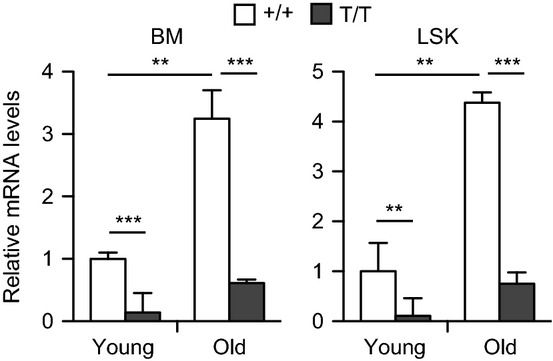
Increased Smurf2 expression in aged mice. Quantitative RT–PCR analysis of Smurf2 expression in bone marrow (BM) and sorted LSK (LinSca1+c-kit++) cells of young (2-month) and old (24-month) wild-type (+/+) and Smurf2T/T (T/T) mice. Relative expression in young wild-type cells was set to be 1 after normalization with β-actin. Error bars are SD of three independent experiments. Student’s t-test is used for statistical analysis. **P < 0.01, ***P < 0.001.
Figure 2
Figure 2
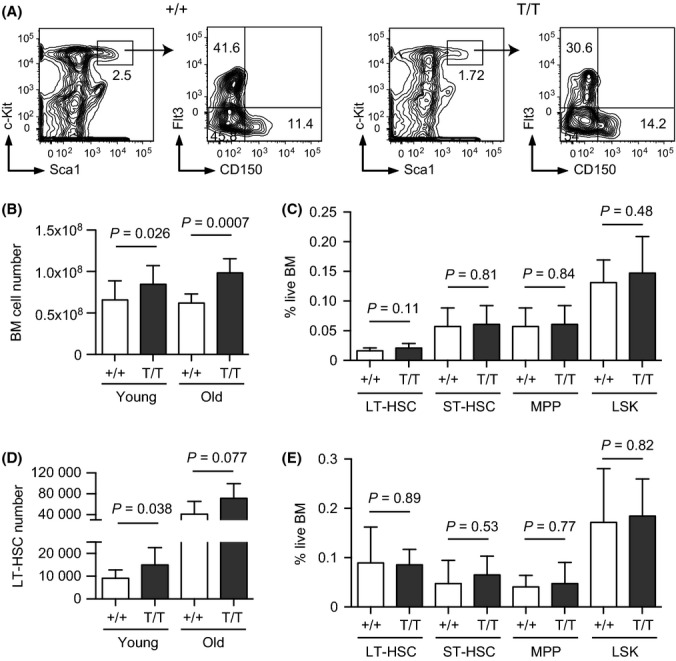
Increased bone marrow (BM) cellularity and expanded long-term hematopoietic stem cell (LT-HSC) population in Smurf2-deficient mice. (A) Representative flow cytometry analysis of HSCs in BM of 2-month-old wild-type (+/+) and Smurf2T/T (T/T) mice. Live lineage-negative (Lin-) cells are gated and displayed for staining of Sca1 and c-Kit (left panels). LSK (LinSca1+c-kit++) population is gated and displayed for staining of CD150 and Flt3 (right panels). LT-HSCs are defined as LinSca1+c-kit++CD150+Flt3, while LinSca1+c-kit++CD150Flt3 and LinSca1+c-kit++CD150Flt3+ are used to enumerate short-term HSCs (ST-HSCs) and multipotent progenitors (MPPs), respectively. (B) Average live BM cell numbers in young (2-month, N = 16) and old (24- to 30-month, N = 7) mice. (C) Frequencies of LT-HSC, ST-HSCs, MPP, and LSK cells as percent of live BM cells in young (2-month-old, N = 11) mice. (D) Average LT-HSC numbers in young (2-month, N = 11) and old (24- to 30-month, N = 6) mice. (E) Frequencies of LT-HSC, ST-HSCs, MPP, and LSK cells as percent of live BM cells in old (24- to 30-month, N = 6) mice. Error bars are SD and Student’s t-test is used for statistical analysis.
Figure 3
Figure 3
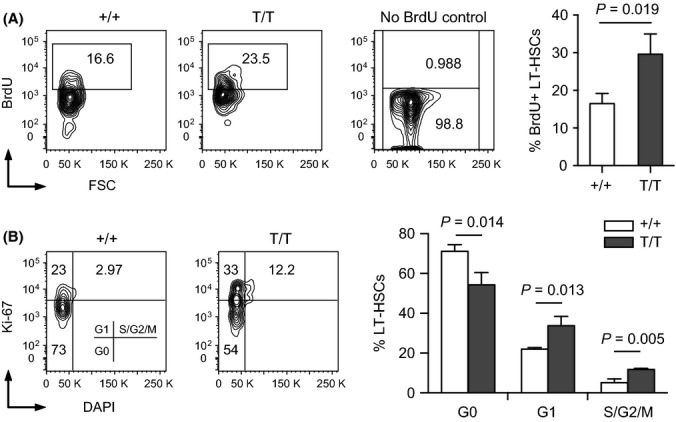
Increased proliferation and decreased quiescence of Smurf2-deficient hematopoietic stem cells (HSCs). (A) Representative BrdU incorporation analysis of HSCs in wild-type (+/+) and Smurf2T/T (T/T) mice. Long-term HSCs (LinSca1+c-kit++CD150+) are gated and displayed for BrdU staining. BM from mice without BrdU injection was stained for BrdU as a control. Average of three independent experiments is shown at right. (B) Representative cell cycle analysis of HSCs in wild-type (+/+) and Smurf2T/T (T/T) mice. Long-term HSCs (LinSca1+c-kit++CD150+) are gated and displayed for staining of Ki-67 and DAPI. Average of three independent experiments is shown at right. Error bars are SD and Student’s t-test is used in statistical analysis.
Figure 4
Figure 4
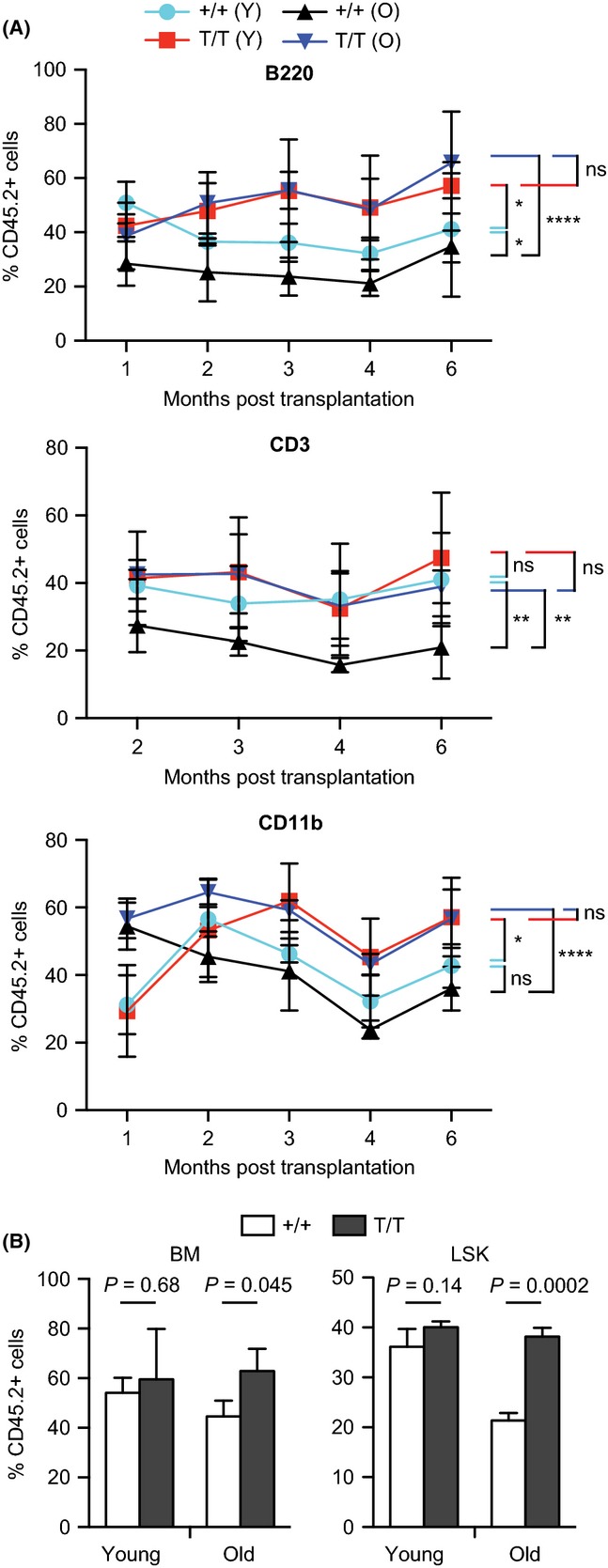
Hematopoietic stem cells (HSCs) in aged Smurf2-deficient mice exhibit enhanced repopulating ability. Donor bone marrow (BM) from wild-type (+/+) or Smurf2T/T (T/T) mice (CD45.2+) mixed at 1:1 ratio with competitor BM of 2-month-old wild-type (CD45.1+/CD45.2+) mice are injected into lethally irradiated recipient mice (CD45.1+). Contribution of donors is determined by CD45 staining. Both young (2-month) and old (24-month) donors were used. (A) Donor (CD45.2+) contributions to B (B220+), T (CD3+), and myeloid (CD11b+) lineages in peripheral blood of recipient mice (N = 4) at indicated time post-BM transplantation. Two-way anova is used for statistical analysis. *P < 0.05, **P < 0.01, ****P < 0.0001, ns: not significant. (B) Donor contribution to BM and LSK (LinSca1+c-kit++) cells in recipient mice (N = 3) at 6 months post-BM transplantation. Error bars are SD. Student’s t-test is used in statistical analysis.
Figure 5
Figure 5
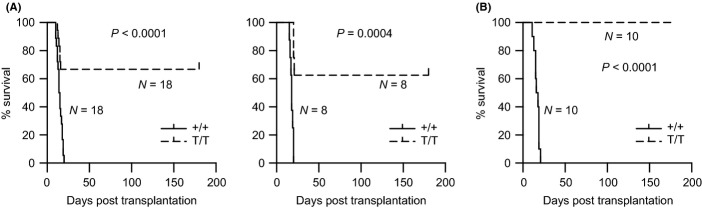
Increased long-term self-renewal capacity and multilineage potential in Smurf2-deficient hematopoietic stem cells (HSCs). Bone marrow (BM) cells of wild-type (+/+) and Smurf2T/T (T/T) mice are used as donors in serial BM transplantation. (A) Kaplan–Meier survival curves of recipient mice receiving BM from 2-month-old donors in the 4th transplantation cycle. Two independent serial transplantation experiments using male (left panel) or female (right panel) donors are shown. (B) Kaplan–Meier survival curves of recipient mice receiving BM from 24-month-old donors in the 4th transplantation cycle. The log-rank test is used for statistical analysis.
Figure 6
Figure 6
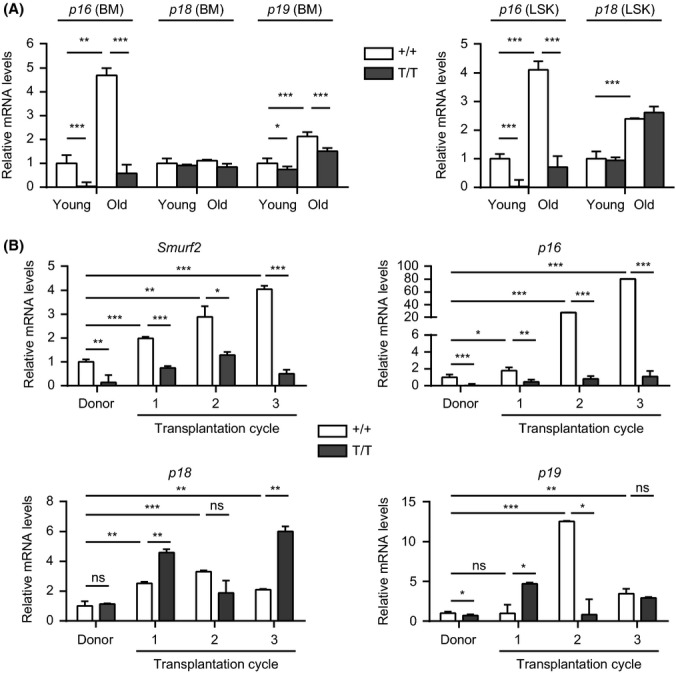
Age or regenerative stress-induced p16 expression is attenuated in Smurf2-deficient mice. (A) Quantitative RT–PCR analysis of gene expression in bone marrow (BM) and sorted LSK (LinSca1+c-kit++) cells of young (2-month) and old (24-month) wild-type (+/+) and Smurf2T/T (T/T) mice. Relative expression in young wild-type cells was set to be 1 after normalization with β-actin. Only P < 0.05 are indicated in pairwise comparison. (B) Quantitative RT–PCR analysis of gene expression in BM of donors and successive recipients in serial transplantation. Relative expression in wild-type donors is set to be 1 after normalization with β-actin. Error bars are calculated from standard deviations of three independent experiments. Student’s t-test is used for statistical analysis. *P < 0.05, **P < 0.01, ***P < 0.001, ns: not significant.

References

    1. Adolfsson J, Borge OJ, Bryder D, Theilgaard-Monch K, Astrand-Grundstrom I, Sitnicka E, Sasaki Y, Jacobsen SE. Upregulation of Flt3 expression within the bone marrow Lin(-)Sca1(+)c-kit(+) stem cell compartment is accompanied by loss of self-renewal capacity. Immunity. 2001;15:659–669. - PubMed
    1. Attema JL, Pronk CJ, Norddahl GL, Nygren JM, Bryder D. Hematopoietic stem cell ageing is uncoupled from p16 INK4A-mediated senescence. Oncogene. 2009;28:2238–2243. - PubMed
    1. Campisi J. Senescent cells, tumor suppression, and organismal aging: good citizens, bad neighbors. Cell. 2005;120:513–522. - PubMed
    1. Chambers SM, Goodell MA. Hematopoietic stem cell aging: wrinkles in stem cell potential. Stem Cell Rev. 2007;3:201–211. - PubMed
    1. Chambers SM, Shaw CA, Gatza C, Fisk CJ, Donehower LA, Goodell MA. Aging hematopoietic stem cells decline in function and exhibit epigenetic dysregulation. PLoS Biol. 2007;5:e201. - PMC - PubMed

Publication types

MeSH terms

Substances