


Identification of ligand-target pairs from combined libraries of small molecules and unpurified protein targets in cell lysates
- PMID: 24495225
- PMCID: PMC3985698
- DOI: 10.1021/ja412934t
Identification of ligand-target pairs from combined libraries of small molecules and unpurified protein targets in cell lysates
Abstract
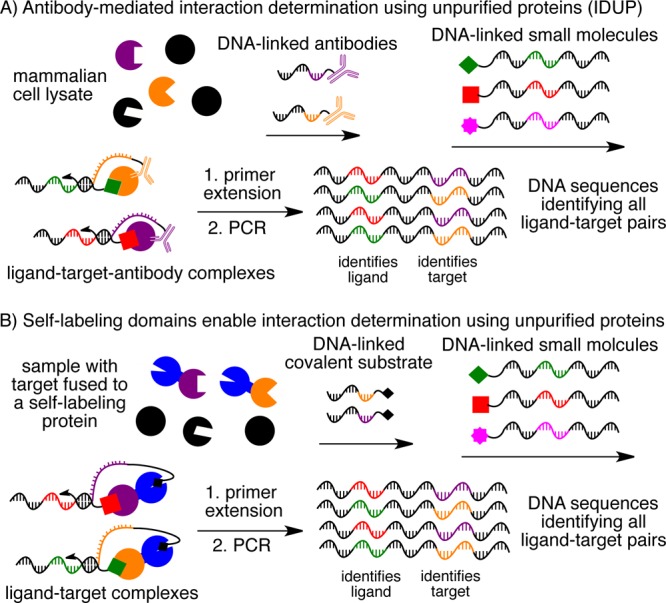
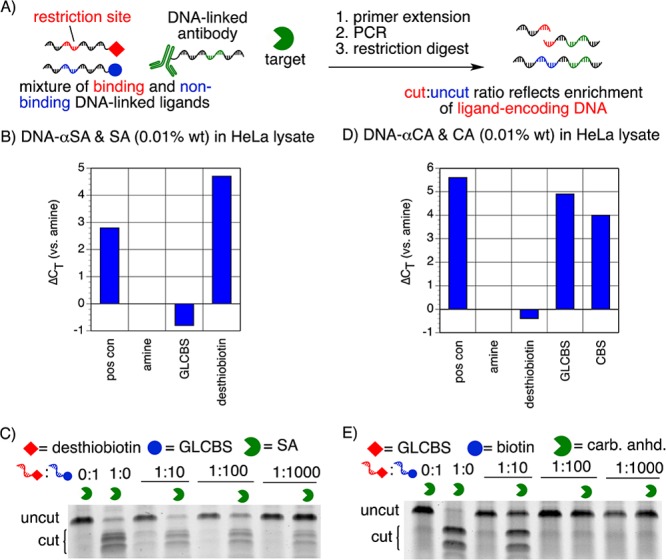
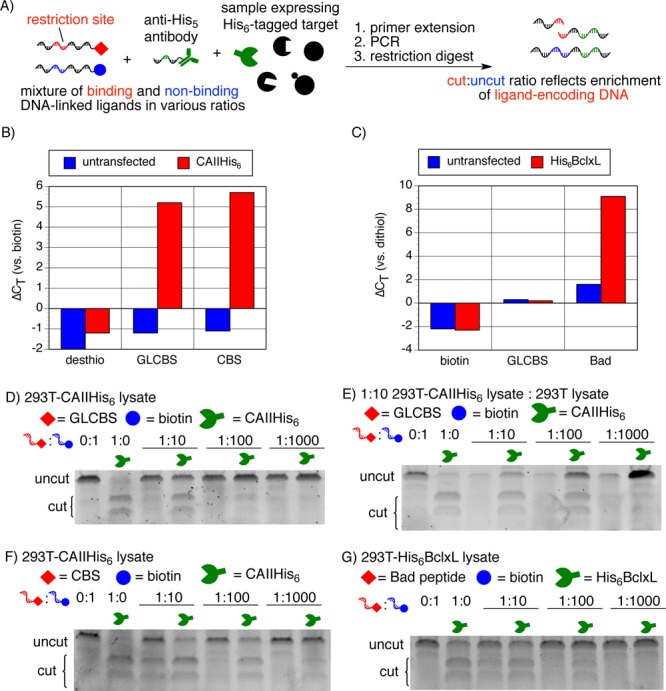
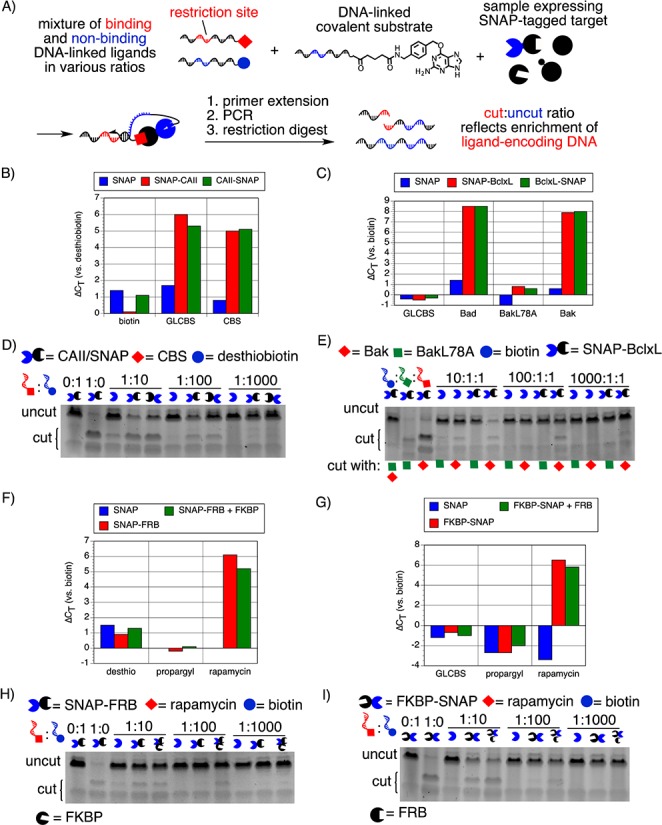
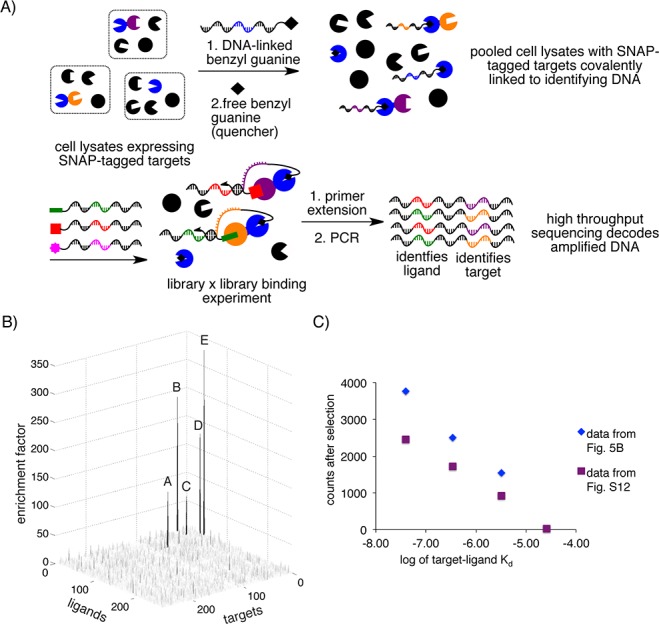
We describe the development and validation of interaction determination using unpurified proteins (IDUP), a method that selectively amplifies DNA sequences identifying ligand+target pairs from a mixture of DNA-linked small molecules and unpurified protein targets in cell lysates. By operating in cell lysates, IDUP preserves native post-translational modifications and interactions with endogenous binding partners, thereby enabling the study of difficult-to-purify targets and increasing the potential biological relevance of detected interactions compared with methods that require purified proteins. In IDUP, target proteins are associated with DNA oligonucleotide tags either non-covalently using a DNA-linked antibody or covalently using a SNAP-tag. Ligand-target binding promotes hybridization of a self-priming hairpin that is extended by a DNA polymerase to create a DNA strand that contains sequences identifying both the target and its ligand. These sequences encoding ligand+target pairs are selectively amplified by PCR and revealed by high-throughput DNA sequencing. IDUP can respond to the effect of affinity-modulating adaptor proteins in cell lysates that would be absent in ligand screening or selection methods using a purified protein target. This capability was exemplified by the 100-fold amplification of DNA sequences encoding FRB+rapamycin or FKBP+rapamycin in samples overexpressing both FRB and FKBP (FRB·rapamycin+FKBP, Kd ≈ 100 fM; FKBP·rapamycin+FRB, Kd = 12 nM). In contrast, these sequences were amplified 10-fold less efficiently in samples overexpressing either FRB or FKBP alone (rapamycin+FKBP, Kd ≈ 0.2 nM; rapamcyin+FRB, Kd = 26 μM). Finally, IDUP was used to process a model library of DNA-linked small molecules and a model library of cell lysates expressing SNAP-target fusions combined in a single sample. In this library×library experiment, IDUP resulted in enrichment of sequences corresponding to five known ligand+target pairs ranging in binding affinity from Kd = 0.2 nM to 3.2 μM out of 67,858 possible combinations, with no false positive signals enriched to the same extent as that of any of the bona fide ligand+target pairs.
Figures
References
-
- Buller F.; Steiner M.; Frey K.; Mircsof D.; Scheuermann J.; Kalisch M.; Buhlmann P.; Supuran C. T.; Neri D. ACS Chem. Biol. 2011, 6, 336. - PubMed
- Kleiner R. E.; Dumelin C. E.; Tiu G. C.; Sakurai K.; Liu D. R. J. Am. Chem. Soc. 2010, 132, 11779. - PMC - PubMed
- Clark M. A.; Acharya R. A.; Arico-Muendel C. C.; Belyanskaya S. L.; Benjamin D. R.; Carlson N. R.; Centrella P. A.; Chiu C. H.; Creaser S. P.; Cuozzo J. W.; Davie C. P.; Ding Y.; Franklin G. J.; Franzen K. D.; Gefter M. L.; Hale S. P.; Hansen N. J. V.; Israel D. I.; Jiang J.; Kavarana M. J.; Kelley M. S.; Kollmann C. S.; Li F.; Lind K.; Mataruse S.; Medeiros P. F.; Messer J. A.; Myers P.; O’keefe H.; Oliff M. C.; Rise C. E.; Satz A. L.; Skinner S. R.; Svendsen J. L.; Tang L.; Van Vloten K.; Wagner R. W.; Yao G.; Zhao B.; Morgan B. A.. Nat. Chem. Biol. 2009, 5, 647. - PubMed
- Wrenn S. J.; Weisinger R. M.; Halpin D. R.; Harbury P. B. J. Am. Chem. Soc. 2007, 129, 13137. - PMC - PubMed
Publication types
MeSH terms
Substances
Grants and funding
LinkOut - more resources
Full Text Sources
Other Literature Sources
