


Performance criteria for verbal autopsy-based systems to estimate national causes of death: development and application to the Indian Million Death Study
- PMID: 24495287
- PMCID: PMC3912490
- DOI: 10.1186/1741-7015-12-21
Performance criteria for verbal autopsy-based systems to estimate national causes of death: development and application to the Indian Million Death Study
Abstract
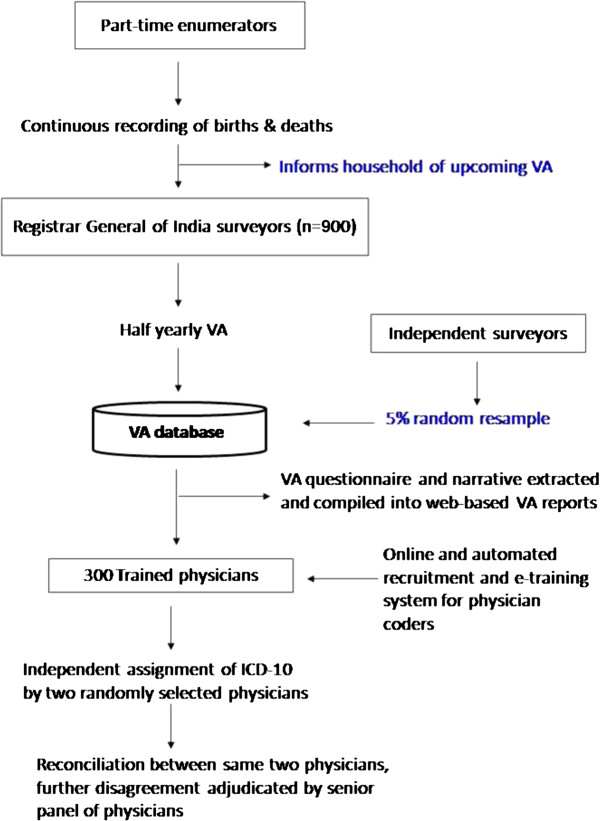
Background: Verbal autopsy (VA) has been proposed to determine the cause of death (COD) distributions in settings where most deaths occur without medical attention or certification. We develop performance criteria for VA-based COD systems and apply these to the Registrar General of India's ongoing, nationally-representative Indian Million Death Study (MDS).
Methods: Performance criteria include a low ill-defined proportion of deaths before old age; reproducibility, including consistency of COD distributions with independent resampling; differences in COD distribution of hospital, home, urban or rural deaths; age-, sex- and time-specific plausibility of specific diseases; stability and repeatability of dual physician coding; and the ability of the mortality classification system to capture a wide range of conditions.
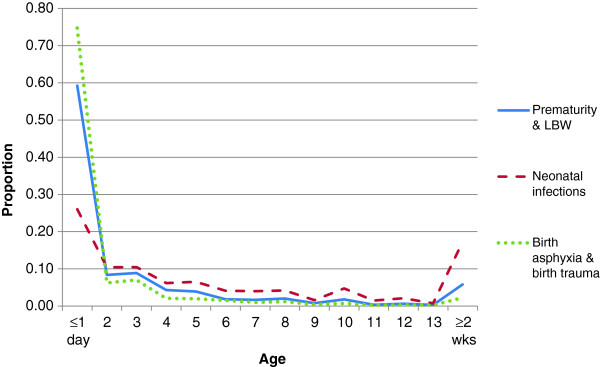
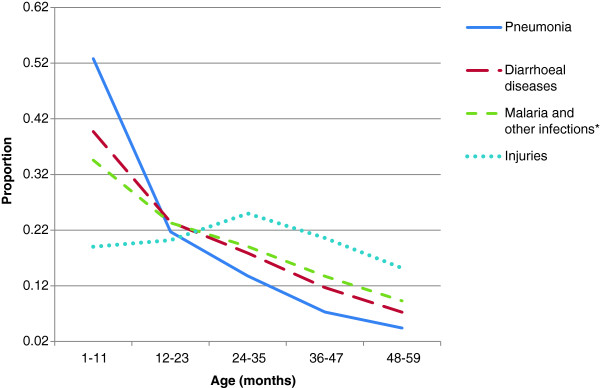
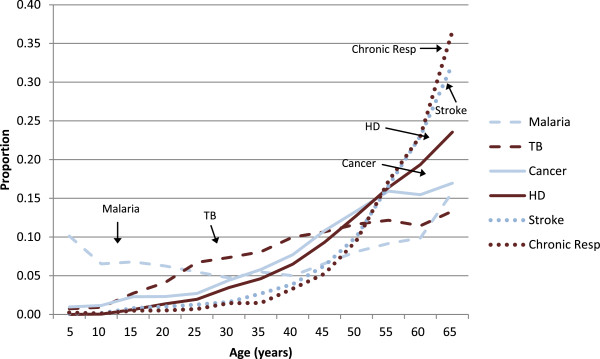
Results: The introduction of the MDS in India reduced the proportion of ill-defined deaths before age 70 years from 13% to 4%. The cause-specific mortality fractions (CSMFs) at ages 5 to 69 years for independently resampled deaths and the MDS were very similar across 19 disease categories. By contrast, CSMFs at these ages differed between hospital and home deaths and between urban and rural deaths. Thus, reliance mostly on urban or hospital data can distort national estimates of CODs. Age-, sex- and time-specific patterns for various diseases were plausible. Initial physician agreement on COD occurred about two-thirds of the time. The MDS COD classification system was able to capture more eligible records than alternative classification systems. By these metrics, the Indian MDS performs well for deaths prior to age 70 years. The key implication for low- and middle-income countries where medical certification of death remains uncommon is to implement COD surveys that randomly sample all deaths, use simple but high-quality field work with built-in resampling, and use electronic rather than paper systems to expedite field work and coding.
Conclusions: Simple criteria can evaluate the performance of VA-based COD systems. Despite the misclassification of VA, the MDS demonstrates that national surveys of CODs using VA are an order of magnitude better than the limited COD data previously available.
Figures
References
-
- Jha P. Counting the dead is one of the world’s best investments to reduce premature mortality. Hypothesis. 2012;10:e3. doi:10.5779/hypothesis.v5710i5771.5254.
Publication types
MeSH terms
Grants and funding
LinkOut - more resources
Full Text Sources
Other Literature Sources
Research Materials
Miscellaneous
