


A point-based tool to predict conversion from mild cognitive impairment to probable Alzheimer's disease
- PMID: 24495339
- PMCID: PMC4119093
- DOI: 10.1016/j.jalz.2013.12.014
A point-based tool to predict conversion from mild cognitive impairment to probable Alzheimer's disease
Abstract
Background: Our objective in this study was to develop a point-based tool to predict conversion from amnestic mild cognitive impairment (MCI) to probable Alzheimer's disease (AD).
Methods: Subjects were participants in the first part of the Alzheimer's Disease Neuroimaging Initiative. Cox proportional hazards models were used to identify factors associated with development of AD, and a point score was created from predictors in the final model.
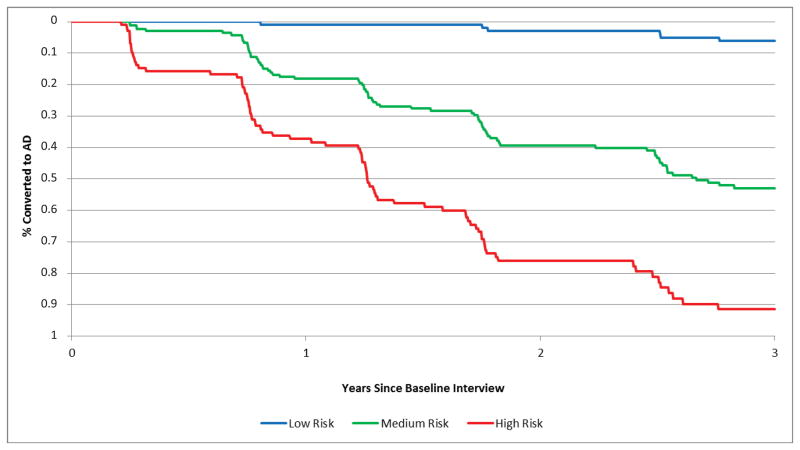
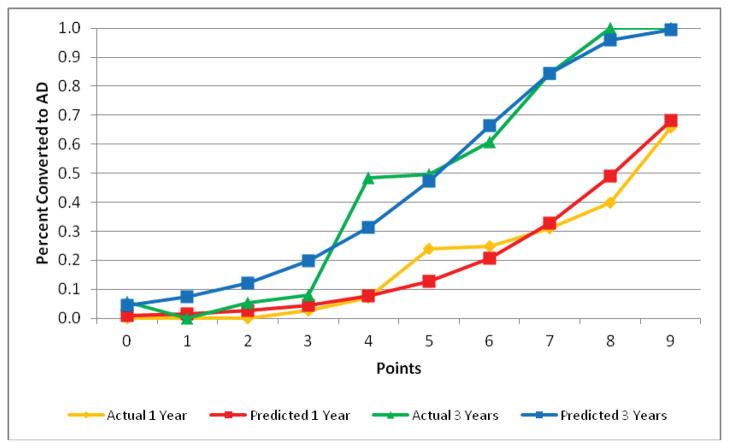
Results: The final point score could range from 0 to 9 (mean 4.8) and included: the Functional Assessment Questionnaire (2‒3 points); magnetic resonance imaging (MRI) middle temporal cortical thinning (1 point); MRI hippocampal subcortical volume (1 point); Alzheimer's Disease Cognitive Scale-cognitive subscale (2‒3 points); and the Clock Test (1 point). Prognostic accuracy was good (Harrell's c = 0.78; 95% CI 0.75, 0.81); 3-year conversion rates were 6% (0‒3 points), 53% (4‒6 points), and 91% (7‒9 points).
Conclusions: A point-based risk score combining functional dependence, cerebral MRI measures, and neuropsychological test scores provided good accuracy for prediction of conversion from amnestic MCI to AD.
Keywords: Aged; Alzheimer's disease; Disease progression; Human; Magnetic resonance imaging; Mild cognitive impairment; Neuropsychological tests; Prognostic modeling; Risk factors.
Copyright © 2014 The Alzheimer's Association. All rights reserved.
Conflict of interest statement
Figures
References
-
- Petersen RC, Smith GE, Waring SC, Ivnik RJ, Tangalos EG, Kokmen E. Mild cognitive impairment: clinical characterization and outcome. Archives of neurology. 1999;56:303–308. - PubMed
-
- Yaffe K, Petersen RC, Lindquist K, Kramer J, Miller B. Subtype of mild cognitive impairment and progression to dementia and death. Dementia and geriatric cognitive disorders. 2006;22:312–319. - PubMed
-
- Sperling RA, Aisen PS, Beckett LA, et al. Toward defining the preclinical stages of Alzheimer’s disease: recommendations from the National Institute on Aging-Alzheimer’s Association workgroups on diagnostic guidelines for Alzheimer’s disease. Alzheimer’s & dementia: the journal of the Alzheimer’s Association. 2011;7:280–292. - PMC - PubMed
-
- Albert MS, DeKosky ST, Dickson D, et al. The diagnosis of mild cognitive impairment due to Alzheimer’s disease: recommendations from the National Institute on Aging-Alzheimer’s Association workgroups on diagnostic guidelines for Alzheimer’s disease. Alzheimer’s & dementia: the journal of the Alzheimer’s Association. 2011;7:270–279. - PMC - PubMed
Publication types
MeSH terms
Substances
Grants and funding
LinkOut - more resources
Full Text Sources
Other Literature Sources
Medical
