


Dissecting childhood asthma with nasal transcriptomics distinguishes subphenotypes of disease
- PMID: 24495433
- PMCID: PMC4043390
- DOI: 10.1016/j.jaci.2013.11.025
Dissecting childhood asthma with nasal transcriptomics distinguishes subphenotypes of disease
Erratum in
- J Allergy Clin Immunol. 2014 Nov;134(5):1217
Abstract
Background: Bronchial airway expression profiling has identified inflammatory subphenotypes of asthma, but the invasiveness of this technique has limited its application to childhood asthma.
Objectives: We sought to determine whether the nasal transcriptome can proxy expression changes in the lung airway transcriptome in asthmatic patients. We also sought to determine whether the nasal transcriptome can distinguish subphenotypes of asthma.
Methods: Whole-transcriptome RNA sequencing was performed on nasal airway brushings from 10 control subjects and 10 asthmatic subjects, which were compared with established bronchial and small-airway transcriptomes. Targeted RNA sequencing nasal expression analysis was used to profile 105 genes in 50 asthmatic subjects and 50 control subjects for differential expression and clustering analyses.
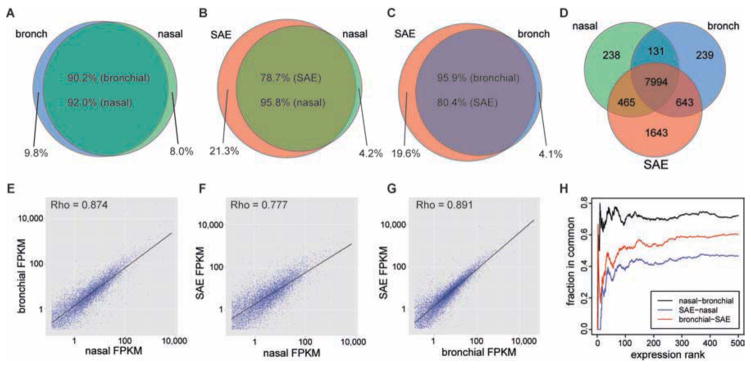
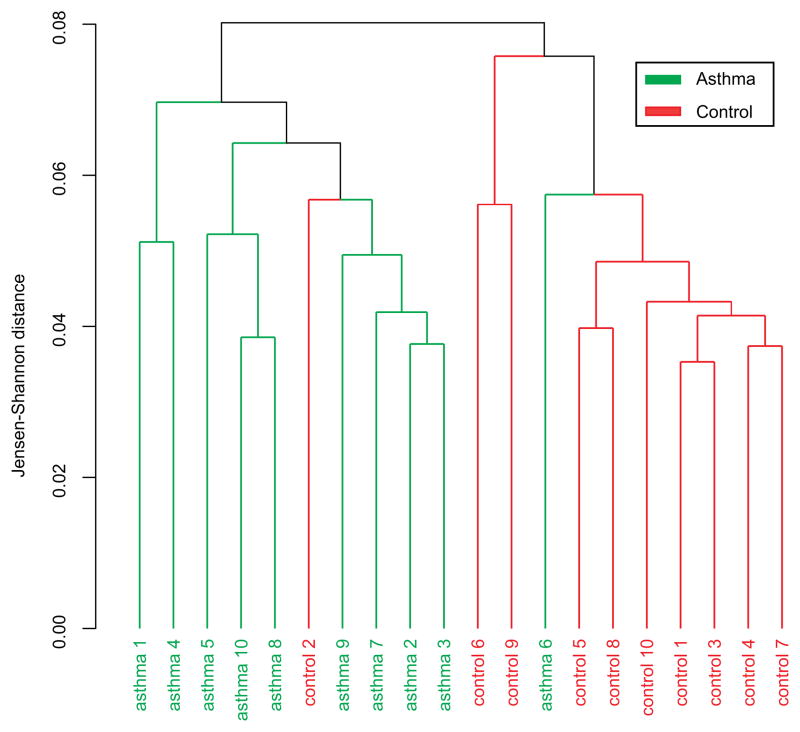
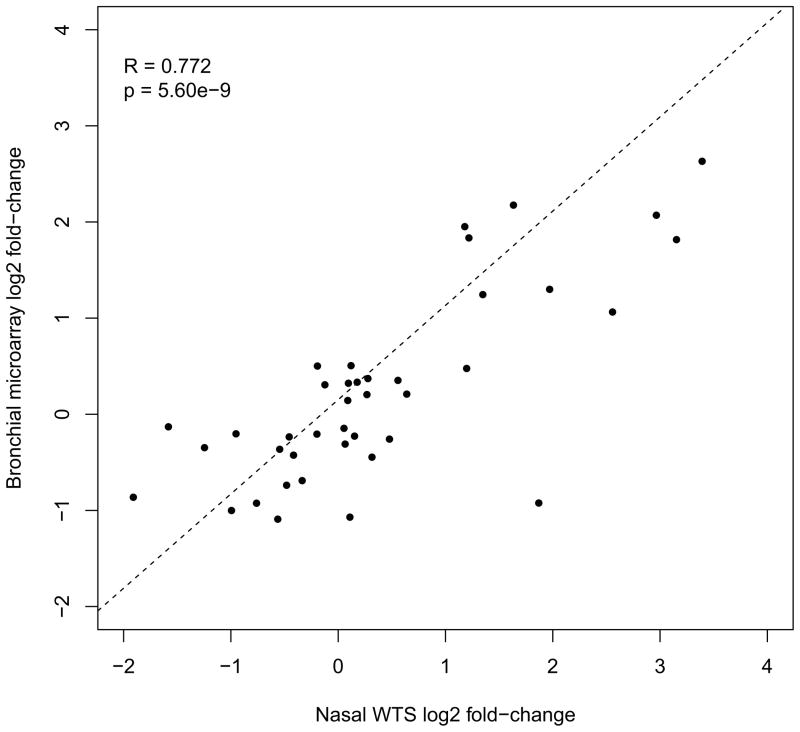
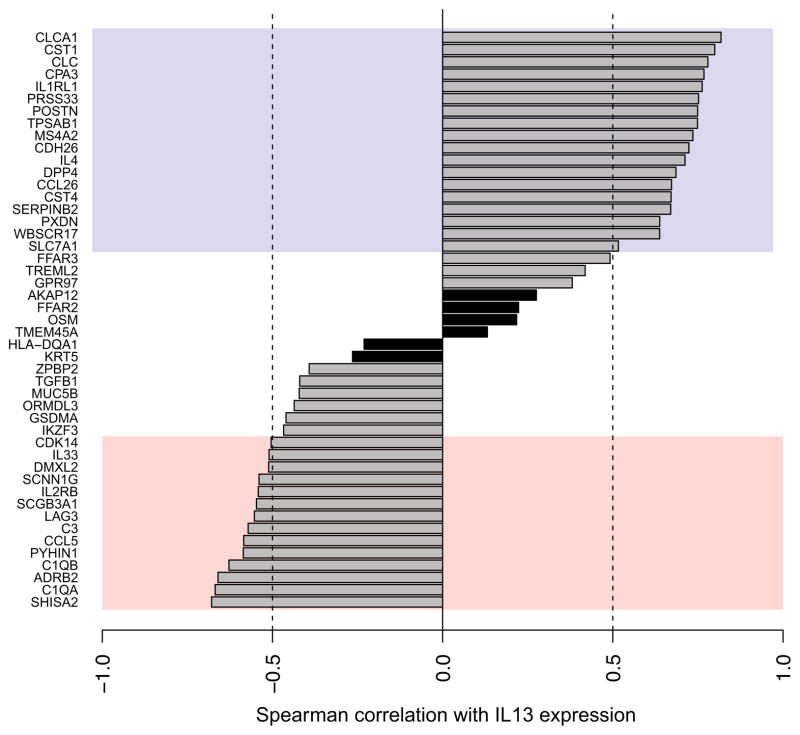
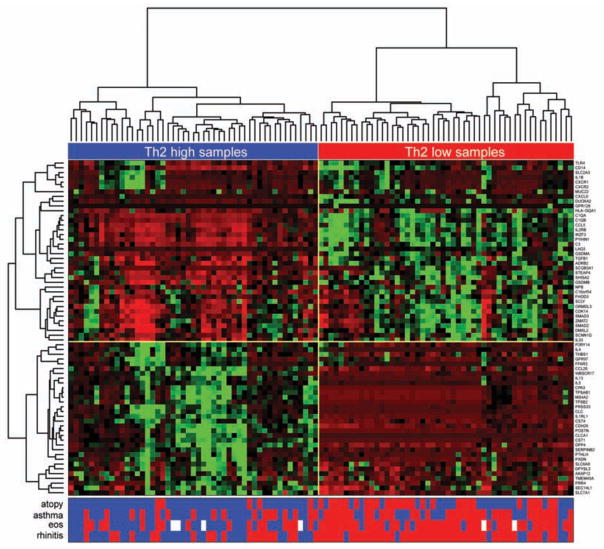
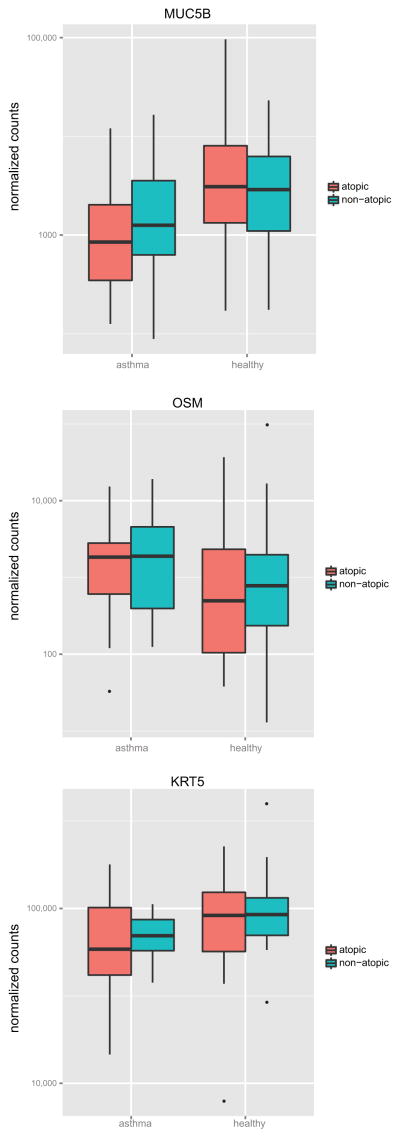
Results: We found 90.2% overlap in expressed genes and strong correlation in gene expression (ρ = .87) between the nasal and bronchial transcriptomes. Previously observed asthmatic bronchial differential expression was strongly correlated with asthmatic nasal differential expression (ρ = 0.77, P = 5.6 × 10(-9)). Clustering analysis identified TH2-high and TH2-low subjects differentiated by expression of 70 genes, including IL13, IL5, periostin (POSTN), calcium-activated chloride channel regulator 1 (CLCA1), and serpin peptidase inhibitor, clade B (SERPINB2). TH2-high subjects were more likely to have atopy (odds ratio, 10.3; P = 3.5 × 10(-6)), atopic asthma (odds ratio, 32.6; P = 6.9 × 10(-7)), high blood eosinophil counts (odds ratio, 9.1; P = 2.6 × 10(-6)), and rhinitis (odds ratio, 8.3; P = 4.1 × 10(-6)) compared with TH2-low subjects. Nasal IL13 expression levels were 3.9-fold higher in asthmatic participants who experienced an asthma exacerbation in the past year (P = .01). Several differentially expressed nasal genes were specific to asthma and independent of atopic status.
Conclusion: Nasal airway gene expression profiles largely recapitulate expression profiles in the lung airways. Nasal expression profiling can be used to identify subjects with IL13-driven asthma and a TH2-skewed systemic immune response.
Keywords: Nasal airway epithelium; T(H)2; asthma; bronchial airway epithelium; transcriptome.
Copyright © 2014 American Academy of Allergy, Asthma & Immunology. Published by Mosby, Inc. All rights reserved.
Figures
References
-
- Prevention CfDCa, editor. National Health Interview Survey 2004–2011. National Center for Health Statistics;
-
- Corren J, Lemanske RF, Hanania NA, Korenblat PE, Parsey MV, Arron JR, et al. Lebrikizumab treatment in adults with asthma. N Engl J Med. 2011;365:1088–1098. - PubMed
-
- Wenzel S, Ford L, Pearlman D, Spector S, Sher L, Skobieranda F, et al. Dupilumab in persistent asthma with elevated eosinophil levels. N Engl J Med. 2013;368:2455–2466. - PubMed
Publication types
MeSH terms
Substances
Grants and funding
- HL104608/HL/NHLBI NIH HHS/United States
- R01 AI079139/AI/NIAID NIH HHS/United States
- R01 HL078885/HL/NHLBI NIH HHS/United States
- HL078885/HL/NHLBI NIH HHS/United States
- U19 AI077439/AI/NIAID NIH HHS/United States
- AI079139/AI/NIAID NIH HHS/United States
- HL079055/HL/NHLBI NIH HHS/United States
- R01 HL088133/HL/NHLBI NIH HHS/United States
- T32 GM007175/GM/NIGMS NIH HHS/United States
- K23 HL111636/HL/NHLBI NIH HHS/United States
- R01 ES015794/ES/NIEHS NIH HHS/United States
- R01 AI061774/AI/NIAID NIH HHS/United States
- AI077439/AI/NIAID NIH HHS/United States
- R25 CA113710/CA/NCI NIH HHS/United States
- K12 HL090147/HL/NHLBI NIH HHS/United States
- ES015794/ES/NIEHS NIH HHS/United States
- AI061774/AI/NIAID NIH HHS/United States
- T32 GM007546/GM/NIGMS NIH HHS/United States
- P60MD006902/MD/NIMHD NIH HHS/United States
- R01 HL104608/HL/NHLBI NIH HHS/United States
- CA113710/CA/NCI NIH HHS/United States
- DK064695/DK/NIDDK NIH HHS/United States
- R01 HL079055/HL/NHLBI NIH HHS/United States
- P60 MD006902/MD/NIMHD NIH HHS/United States
- R01 DK064695/DK/NIDDK NIH HHS/United States
- R01 HL117004/HL/NHLBI NIH HHS/United States
- T32 CA113710/CA/NCI NIH HHS/United States
- HL088133/HL/NHLBI NIH HHS/United States
- K12HL090147/HL/NHLBI NIH HHS/United States
LinkOut - more resources
Full Text Sources
Other Literature Sources
Medical
Molecular Biology Databases
Miscellaneous
