


Liver regeneration
- PMID: 24495569
- PMCID: PMC3976740
- DOI: 10.1016/j.trsl.2014.01.005
Liver regeneration
Abstract
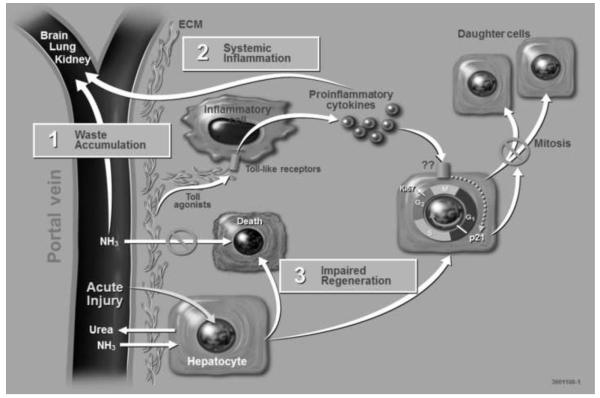
The liver is unique in its ability to regenerate in response to injury. A number of evolutionary safeguards have allowed the liver to continue to perform its complex functions despite significant injury. Increased understanding of the regenerative process has significant benefit in the treatment of liver failure. Furthermore, understanding of liver regeneration may shed light on the development of cancer within the cirrhotic liver. This review provides an overview of the models of study currently used in liver regeneration, the molecular basis of liver regeneration, and the role of liver progenitor cells in regeneration of the liver. Specific focus is placed on clinical applications of current knowledge in liver regeneration, including small-for-size liver transplant. Furthermore, cutting-edge topics in liver regeneration, including in vivo animal models for xenogeneic human hepatocyte expansion and the use of decellularized liver matrices as a 3-dimensional scaffold for liver repopulation, are proposed. Unfortunately, despite 50 years of intense study, many gaps remain in the scientific understanding of liver regeneration.
Copyright © 2014 Mosby, Inc. All rights reserved.
Figures
References
-
- Farber JL, Gerson RJ. Mechanisms of cell injury with hepatotoxic chemicals. Pharmacological reviews. 1984;36(2 Suppl):71S–75S. - PubMed
-
- Matsuo T, Yamaguchi S, Mitsui S, et al. Control Mechanism of the Circadian Clock for Timing of Cell Division in Vivo. Science. 2003;302(5643):255–259. - PubMed
-
- Schibler U. Liver Regeneration Clocks On. Science. 2003;302(5643):234–235. - PubMed
Publication types
MeSH terms
Grants and funding
LinkOut - more resources
Full Text Sources
Other Literature Sources
