


What are the most important infectious diseases among those ≥65 years: a comprehensive analysis on notifiable diseases, Norway, 1993-2011
- PMID: 24495775
- PMCID: PMC3923236
- DOI: 10.1186/1471-2334-14-57
What are the most important infectious diseases among those ≥65 years: a comprehensive analysis on notifiable diseases, Norway, 1993-2011
Abstract
Background: As the population ages, the burden on the healthcare system might increase and require changed public health priorities. As infections are often more severe at older age, we rank notifiable infectious diseases (ID) and describe trends of ID among the general population aged ≥65 years in Norway in order to inform public health priorities for the aging population.
Methods: We included all eligible cases of the 58 IDs notified between 1993 and 2011 (n = 223,758; 12% ≥65 years) and determined annual notification rates as the number of notified cases divided by the number of inhabitants of the corresponding year. We ranked diseases using their average annual notification rate for 2007-2011. Trends in notification rates from 1993 onwards were determined with a non-parametric test for trend. Using notification rate ratios (NRR), we compared results in those aged ≥65 years to those aged 20-64 years.
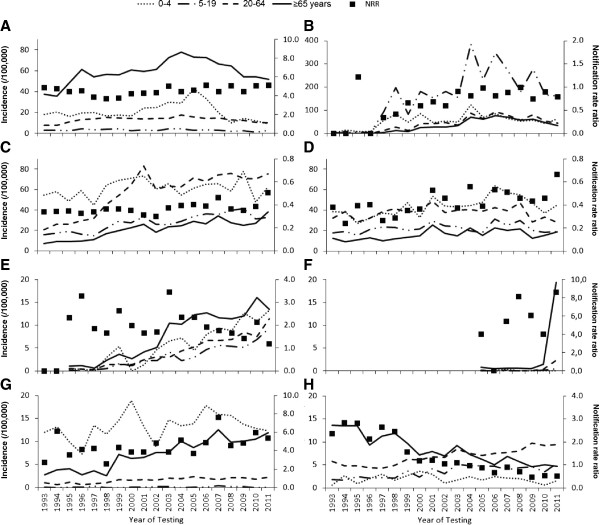
Results: Invasive pneumococcal disease was the most common ID among the population ≥65 years (notification rate 58/100,000), followed by pertussis (54/100,000) and campylobacteriosis (30/100,000). Most ID notification rates did not change over time, though the notification rate of symptomatic MRSA infections increased from 1/100,000 in 1995 (first year of notification) to 14/100,000 in 2011.Overall, fewer cases were notified among the population ≥65 years compared to 20-64 year olds (NRR = 0.73). The NRR of each of the invasive bacterial diseases and antibiotic-resistant infections were above 1.5 (i.e. more common in ≥65), while the NRR of each food- and waterborne disease, blood-borne disease/STI and (non-invasive) vaccine preventable disease was below 1.
Conclusions: Based on our results, we emphasise the importance of focusing public health efforts for those ≥65 years on preventing invasive bacterial infections. This can be achieved by increasing pneumococcal and influenza vaccine uptake, and risk communication including encouraging those aged ≥65 years and their caretakers to seek healthcare at signs of systemic infection. Furthermore, good compliance to infection control measures, screening of the at-risk population, and careful use of antibiotics may prevent further increase in antibiotic-resistant infections.
Figures
References
-
- Statistics Norway. An aging society. 2009. http://www.ssb.no/norge_en/bef_en.pdf.
Publication types
MeSH terms
Substances
LinkOut - more resources
Full Text Sources
Other Literature Sources
Medical
Research Materials
