. 2014 May 1;306(9):E1013-24.
doi: 10.1152/ajpendo.00553.2013. Epub 2014 Feb 4.

Impact of embryo number and maternal undernutrition around the time of conception on insulin signaling and gluconeogenic factors and microRNAs in the liver of fetal sheep

Affiliations

Impact of embryo number and maternal undernutrition around the time of conception on insulin signaling and gluconeogenic factors and microRNAs in the liver of fetal sheep

Shervi Lie et al. Am J Physiol Endocrinol Metab. .

Abstract

This study aimed to determine whether exposure of the oocyte and/or embryo to maternal undernutrition results in the later programming of insulin action in the liver and factors regulating gluconeogenesis. To do this, we collect livers from singleton and twin fetal sheep that were exposed to periconceptional (PCUN; -60 to 7 days) or preimplantation (PIUN; 0-7 days) undernutrition at 136-138 days of gestation (term = 150 days). The mRNA and protein abundance of insulin signaling and gluconeogenic factors were then quantified using qRT-PCR and Western blotting, respectively, and global microRNA expression was quantified using deep sequencing methodology. We found that hepatic PEPCK-C mRNA (P < 0.01) and protein abundance and the protein abundance of IRS-1 (P < 0.01), p110β (P < 0.05), PTEN (P < 0.05), CREB (P < 0.01), and pCREB (Ser(133); P < 0.05) were decreased in the PCUN and PIUN singletons. In contrast, hepatic protein abundance of IRS-1 (P < 0.01), p85 (P < 0.01), p110β (P < 0.001), PTEN (P < 0.01), Akt2 (P < 0.01), p-Akt (Ser(473); P < 0.01), and p-FOXO-1 (Thr24) (P < 0.01) was increased in twins. There was a decrease in PEPCK-C mRNA (P < 0.01) but, paradoxically, an increase in PEPCK-C protein (P < 0.001) in twins. Both PCUN and PIUN altered the hepatic expression of 23 specific microRNAs. We propose that the differential impact of maternal undernutrition in the presence of one or two embryos on mRNAs and proteins involved in the insulin signaling and gluconeogenesis is explained by changes in the expression of a suite of specific candidate microRNAs.

Keywords: epigenetic; fetus; nutrition; pregnancy.


Figures
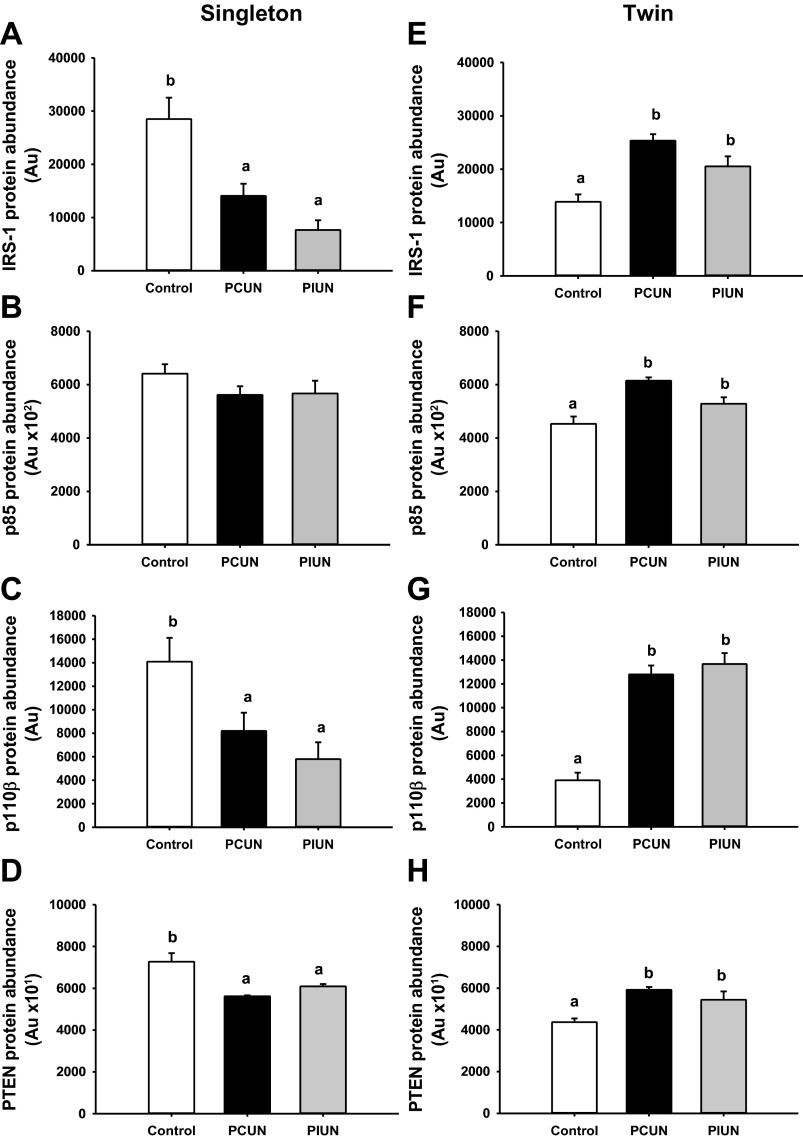
Fig. 1.
Fig. 1.
Protein abundance of insulin receptor substrate (IRS-1), phosphatidylinositol 3-kinase (PI3K; p85), PI3K (p110β), and phosphatase and tensin homolog (PTEN) in singleton and twin fetuses in late gestation. Abundance of IRS-1, p110β, and PTEN protein was lower in singletons (A, C, and D), and abundance of IRS-1, p85, p110β, and PTEN protein was higher in twins (E, F, G, and H) in the periconceptional undernutrition (PCUN) and preimplantation undernutrition (PIUN) groups compared with controls. p85 protein abundance was not different in singletons in either treatment group (B). Different letters denote significant differences between treatment groups.
Fig. 2.
Fig. 2.
Protein abundance of Akt2, phosphorylated Akt at Ser473, forkhead box protein O1 (FOXO-1), and phosphorylated FOXO-1 at Thr24 in singleton and twin fetuses in late gestation. A: Akt2 protein abundance tended to be lower (P = 0.06) in the PCUN and PIUN groups compared with controls in singletons. B, C, and D: the protein abundances of phosphorylated Akt (Ser473), FOXO-1, and phosphorylated FOXO-1 (Thr24) were not different in either treatment group in singletons. E, F, and H: the protein abundances of Akt2, phosphorylated Akt (Ser473), and phosphorylated FOXO-1 (Thr24) were higher in the PCUN and PIUN groups compared with controls in twins. G: FOXO-1 protein abundance was decreased only in PIUN group compared with controls in twins. Different letters denote significant differences between treatment groups.
Fig. 3.
Fig. 3.
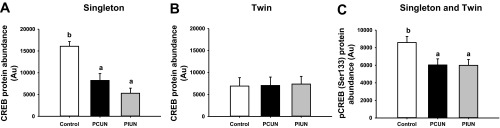
Protein abundance of cAMP response element-binding protein (CREB) and phosphorylated CREB at Ser133 in singleton and twin fetuses in late gestation. A and B: CREB protein abundance was lower in the PCUN and PIUN groups compared with controls in singletons (A), but there was no difference in either treatment groups in twins (B). C: the protein abundance of phosphorylated CREB (Ser133) was lower in the PCUN and PIUN groups compared with controls in singletons and twins. Different letters denote significant differences between treatment groups.
Fig. 4.
Fig. 4.
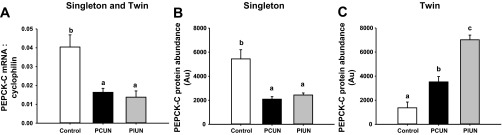
mRNA expression and protein abundance of phosphoenolpyruvate carboxykinase cytosolic isoform (PEPCK-C) in singleton and twin fetuses in late gestation. A: PEPCK-C mRNA expression was lower in the PCUN and PIUN groups compared with controls in singletons and twins. B and C: protein abundance of PEPCK-C was lower in singletons (B) and higher in twins (C) in the PCUN and PIUN groups compared with controls. Different letters denote significant differences between treatment groups.
Fig. 5.
Fig. 5.
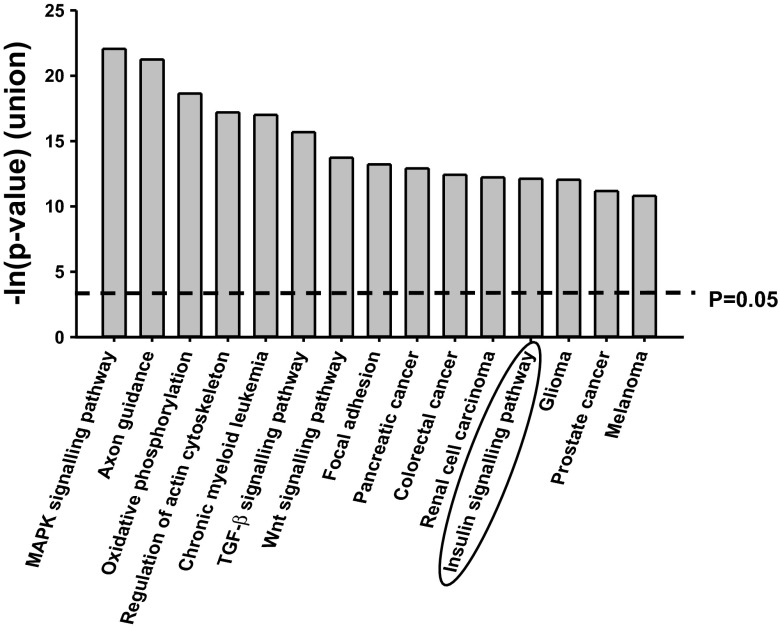
Kyoto Encyclopedia of Genes and Genomes (KEGG) pathways associated with the 23 candidate microRNAs (miRs) defined by target scan multiple miR analysis. The 23 candidate miRs found to have altered expression in singleton and twin fetuses in late gestation were associated with MAPK signaling, axon guidance, oxidative phosphorylation, regulation of actin cytoskeleton, TGFβ signaling, Wnt signaling, focal adhesion, a number of cancers, and, more importantly, insulin signaling.
Fig. 6.
Fig. 6.
A summary diagram that shows the impact of PCUN and PIUN on hepatic insulin-signaling molecules and gluconeogenic factors in singleton and twin fetuses.

References

    1. Baffy G, Brunt EM, Caldwell SH. Hepatocellular carcinoma in non-alcoholic fatty liver disease: an emerging menace. J Hepatol 56: 1384–1391, 2012 - PubMed
    1. Barker DJ. The fetal and infant origins of adult disease. BMJ 301: 1111, 1990 - PMC - PubMed
    1. Bartel DP. MicroRNAs: genomics, biogenesis, mechanism, and function. Cell 116: 281–297, 2004 - PubMed
    1. Chakravarty K, Cassuto H, Reshef L, Hanson RW. Factors that control the tissue-specific transcription of the gene for phosphoenolpyruvate carboxykinase-C. Crit Rev Biochem Mol Biol 40: 129–154, 2005 - PubMed
    1. Cheung O, Puri P, Eicken C, Contos MJ, Mirshahi F, Maher JW, Kellum JM, Min H, Luketic VA, Sanyal AJ. Nonalcoholic steatohepatitis is associated with altered hepatic microRNA expression. Hepatology 48: 1810–1820, 2008 - PMC - PubMed

Publication types