. 2014 Sep;7(5):1068-78.
doi: 10.1038/mi.2013.123. Epub 2014 Feb 5.

Blockade of IL-33 release and suppression of type 2 innate lymphoid cell responses by helminth secreted products in airway allergy

Affiliations
Free PMC article

Blockade of IL-33 release and suppression of type 2 innate lymphoid cell responses by helminth secreted products in airway allergy

H J McSorley et al. Mucosal Immunol. 2014 Sep.
Free PMC article

Abstract

Helminth parasites such as the nematode Heligmosomoides polygyrus strongly inhibit T helper type 2 (Th2) allergy, as well as colitis and autoimmunity. Here, we show that the soluble excretory/secretory products of H. polygyrus (HES) potently suppress inflammation induced by allergens from the common fungus Alternaria alternata. Alternaria extract, when administered to mice intranasally with ovalbumin (OVA) protein, induces a rapid (1-48 h) innate response while also priming an OVA-specific Th2 response that can be evoked 14 days later by intranasal administration of OVA alone. In this model, HES coadministration with Alternaria/OVA suppressed early IL-33 release, innate lymphoid cell (ILC) production of IL-4, IL-5, and IL-13, and localized eosinophilia. Upon OVA challenge, type 2 ILC (ILC2)/Th2 cytokine production and eosinophilia were diminished in HES-treated mice. HES administration 6 h before Alternaria blocked the allergic response, and its suppressive activity was abolished by heat treatment. Administration of recombinant IL-33 at sensitization with Alternaria/OVA/HES abrogated HES suppression of OVA-specific responses at challenge, indicating that suppression of early Alternaria-induced IL-33 release could be central to the anti-allergic effects of HES. Thus, this helminth parasite targets IL-33 production as part of its armory of suppressive effects, forestalling the development of the type 2 immune response to infection and allergic sensitization.


Figures
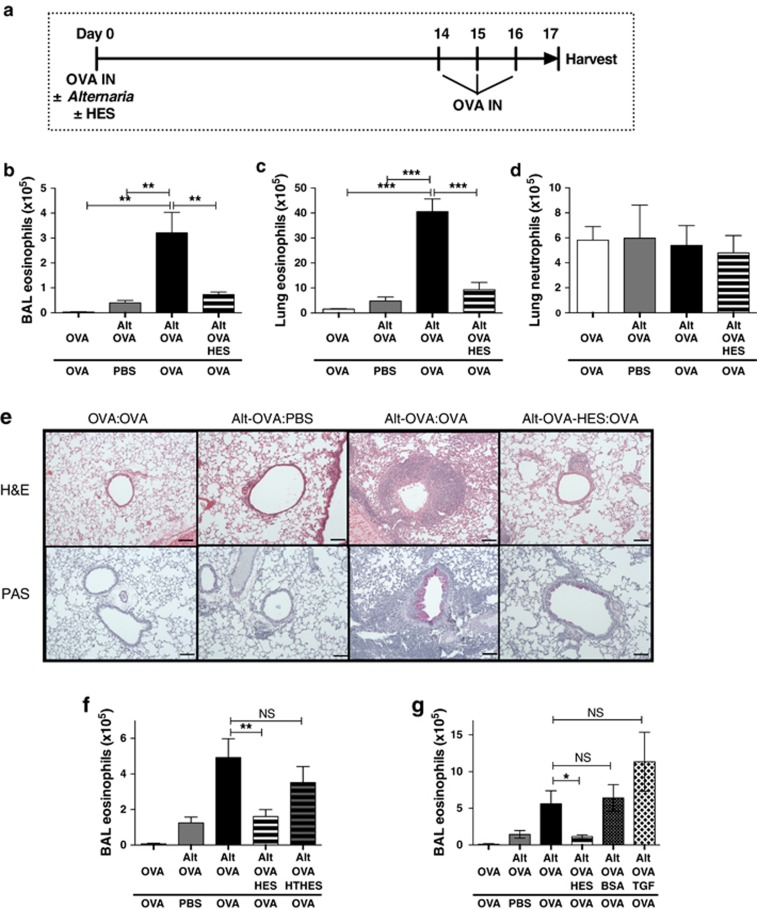
Figure 1
Figure 1
Alternaria-induced allergic inflammation to ovalbumin (OVA) challenge is suppressed by H. polygyrus excretory-secretory (HES) products. (a) Schematic of the Alternaria model: OVA protein (20 μg) was administered to BALB/c mice intranasally, with or without 50 μg Alternaria extract and 10 μg HES. Two weeks later, mice were challenged by intranasal (IN) administration of 20 μg OVA or phosphate-buffered saline (PBS) for 3 days, and samples taken at day 17. (b) Numbers of SiglecF+CD11c eosinophils in bronchoalveolar lavage (BAL) fluid determined by flow cytometry. (c, d) Lung cell suspensions were analyzed by flow cytometry for eosinophils (as in panel b) and neutrophils (GR1hiCD11bhiSiglecfCD11c). (e) Formalin-fixed lungs were sectioned and stained by Hemotoxylin and Eosin (H&E) or Periodic Acid Schiff (PAS). Representative sections are presented, scale bar=100 μm. (f) HES was heat treated at 95 °C for 20 min (HT-HES) before administration, and numbers of BAL SiglecF+CD11c eosinophils counted. (g) BAL eosinophils from mice treated with Alternaria, OVA, and HES as described in panel a, or with 4 ng rTGF-β (TGF), or 10 μg Bovine Serum Albumin (BSA) as indicated. Data in panels bd are representative of five repeat experiments, 3–5 per mice group, in panel f are pooled from two repeat experiments, total n=7 per group, and in panel g are representative of two repeat experiments with four mice per group. ***P<0.001, **P<0.01, *P<0.05, and NS, not significant.
Figure 2
Figure 2
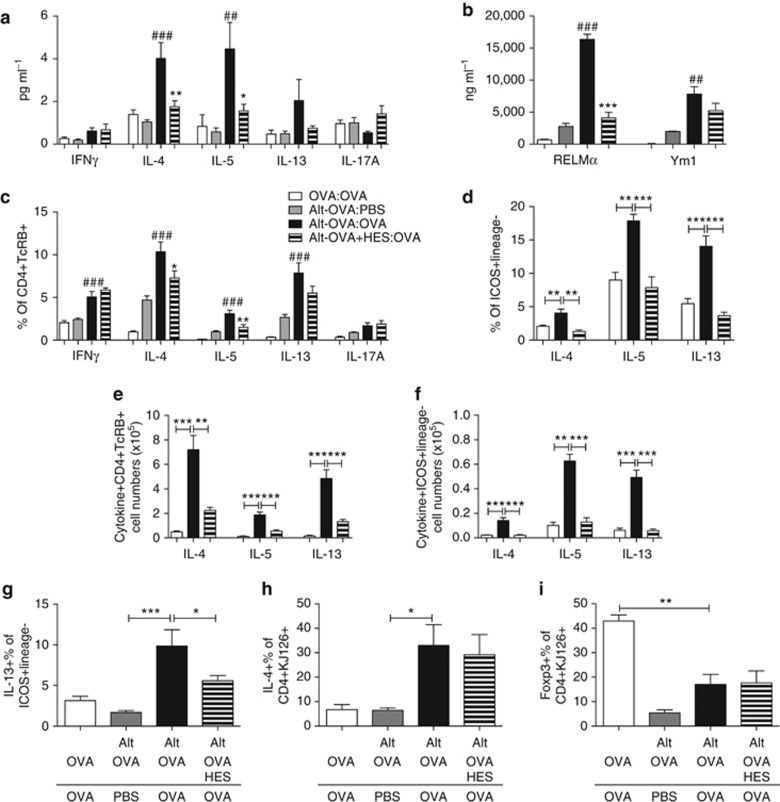
Suppression of innate and adaptive type 2 responsiveness by HES. Following Alternaria-OVA sensitization and challenge, BAL fluids, lungs, and draining lymph nodes were collected; in some experiments (gi), 1 × 10⁶ DO11.10 OVA-specific T cells were transferred to mice before sensitization. Fluids were assayed for soluble cytokines and markers, and cells stained for cytokines and Foxp3. (a) Cytokines in cell-free BAL supernatant measured by cytometric bead array. (b) Type 2 myeloid cell response markers in BAL measured by ELISA. (cf) Intracellular cytokine-positive proportions (c, d) and absolute numbers (e, f) of lung CD4+TCRβ+ T cells (c, e) and ICOS+Lineage innate lymphoid cells (d, f). Lung tissue cells were cultured in Phorbol Myristate Acetate (PMA)/Ionomycin for 4 h in the presence of Brefeldin A, before staining for surface markers and intracellular cytokines. (g) Intracellular IL-13 expression by ICOS+Lineage lung cells. (h) Intracellular IL-4 within DO11.10 OVA-specific T cells from the draining lymph nodes co-staining with the clonotypic marker KJ126. (i) Intracellular Foxp3 expression in the draining lymph node CD4+KJ126+ T-cell population. Results are representative or pooled from at least two repeat experiments with 3–5 mice per group. Unless otherwise indicated differences are not significant. ***P<0.01, **P<0.01, and *P<0.05. #indicates significance when comparing Alt-OVA:PBS and Alt-OVA:OVA groups, * indicates significance when comparing Alt-OVA:OVA and Alt-OVA-HES:OVA groups in panels ac, or as indicated by bars in panels dj. BAL, bronchoalveolar lavage; HES, H. polygyrus excretory-secretory; OVA, ovalbumin; PBS, phosphate-buffered saline.
Figure 3
Figure 3
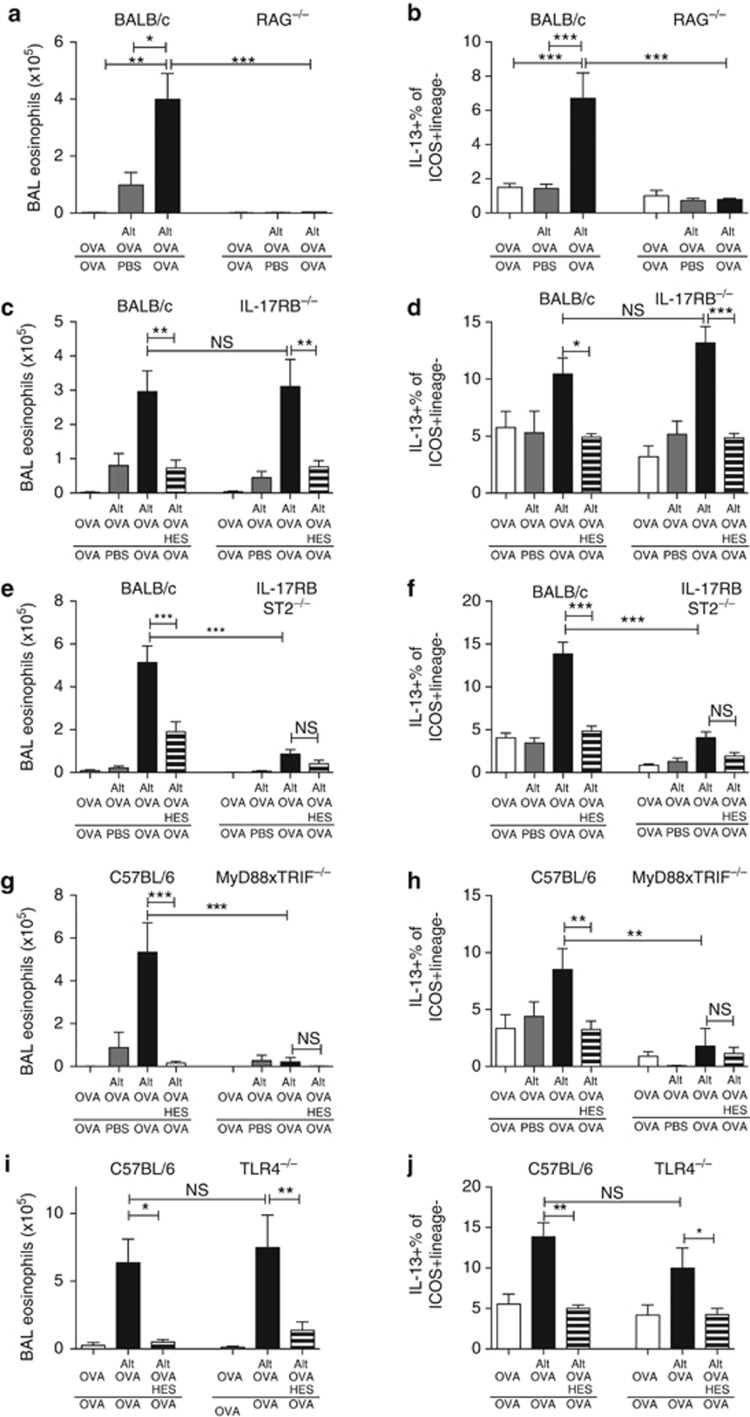
Alternaria-induced allergic reactivity is dependent on both innate and adaptive immune compartments in an IL-25-independent manner. The response to Alternaria-OVA administration was tested in mice deficient in recombinase-activating gene (RAG)-2 (a, b), IL-17RB (c, d), IL-17RBxST2 (e, f), MyD88xTRIF (g, h), or TLR4 (i, j) and their congenic wild-type strains; bronchoalveolar lavage (BAL) fluids were assayed for SiglecF+CD11c eosinophils (a, c, e, g, and i) and lung cell populations for intracellular IL-13 staining within the ICOS+Lineage subset (b, d, f, h, and j). Unless otherwise indicated differences are not significant. ***P<0.01, **P<0.01, and *P<0.05. OVA, ovalbumin.
Figure 4
Figure 4
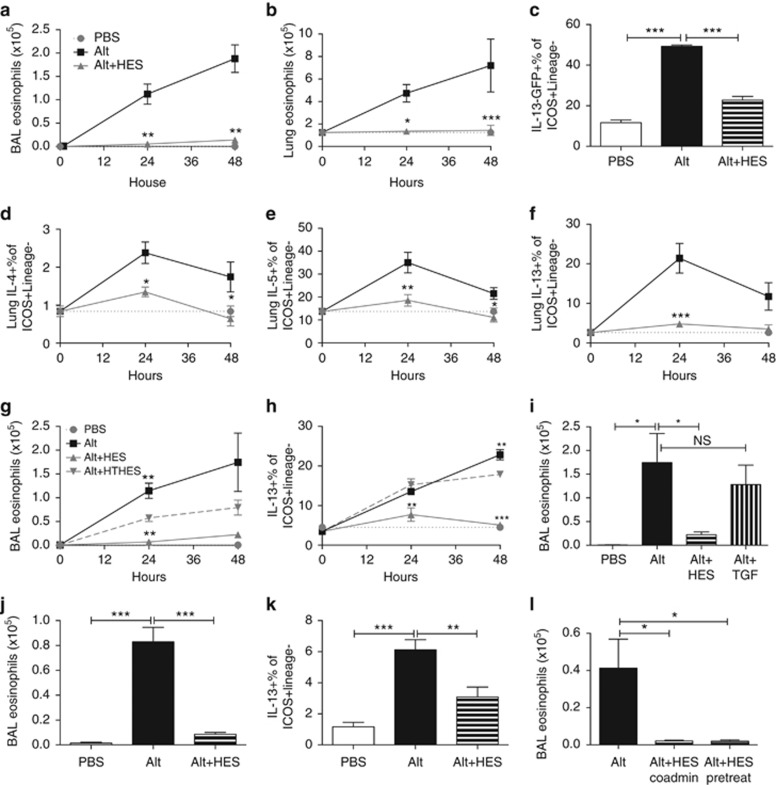
Alternaria induces a rapid innate eosinophilia and type 2 innate lymphoid cell (ILC2) response which is suppressed by HES. Alternaria, without OVA, was administered intranasally to BALB/c mice (a, b, dh, and l), IL-13-GFP reporter mice (c), or recombinase-activating gene (RAG)-2-deficient mice (j, k) in the presence or absence of HES, and samples harvested 24 or 48 h later. (a, b) Bronchoalveolar lavage (BAL) (a) and lung (b) eosinophils measured 24 and 48 h after administration of Alternaria with or without HES. (c) Expression of IL-13-GFP in reporter mice 48 h following administration of Alternaria with or without HES, measured in lung ICOS+Lineage cells. (df) Lung ICOS+Lineage cell expression of IL-4 (d), IL-5 (e), or IL-13 (f), measured by intracellular staining. (g, h) BAL eosinophils (g) and intracellular IL-13+ proportion of ICOS+Lineage cells (h) measured at 24 and 48 h following administration of Alternaria with or without HES or heat-treated HES (HT-HES). Significance shown are compared with the Alternaria+HT-HES group (i) BALB/c mice were treated with Alternaria with or without HES or 4 ng recombinant mammalian TGF-β, and BAL eosinophils measured by flow cytometry. (j, k) BAL eosinophils (j) and IL-13 expression by innate lymphoid cell (ILCs) (k) were measured 48 h after administration of Alternaria with or without HES to RAG-deficient mice. (l) BAL eosinophils 48 h after administration of HES with, or 6 h before, Alternaria exposure. Results are representative or pooled from at least two repeat experiments, 3–5 mice per group. Unless otherwise indicated differences are not significant. ***P<0.01, **P<0.01, *P<0.05. HES, H. polygyrus excretory-secretory; OVA, ovalbumin.
Figure 5
Figure 5
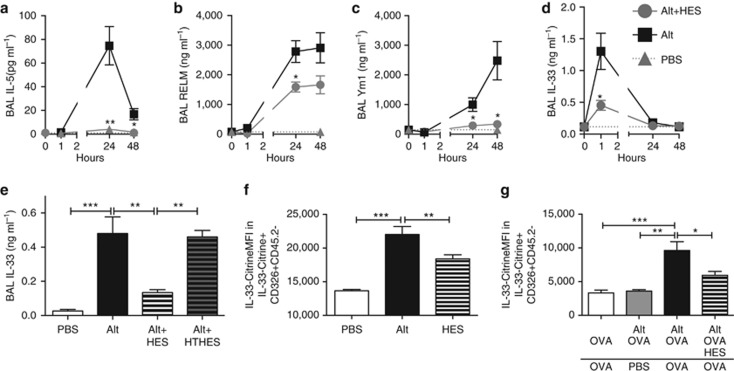
HES strongly suppresses early IL-33 production. (ad) At 1, 24, and 48 h after Alternaria administration with or without HES, cell-free bronchoalveolar lavage (BAL) fluid was tested for levels of IL-5 (a), RELM-α (b), Ym1 (c), and IL-33 (d). Significance compares Alternaria level to Alternaria+HES level. (e) Alternaria, HES, and heat-treated HES (HT-HES) were administered to BALB/c mice and 1 h later levels of IL-33 in cell-free BAL fluid were measured. (f) Mean fluorescence intensity (MFI) of IL-33-Citrine within CD326+CD45.2 epithelial cells 12 h after Alternaria±HES administration. (g) MFI of IL-33-Citrine within CD326+CD45.2 epithelial cells 12 h after the final OVA administration in the Alternaria/OVA model shown in Figure 1a. Results are pooled from two repeat experiments, 3–5 mice per group. Unless otherwise indicated differences are not significant. ***P<0.01, **P<0.01, *P<0.05. HES, H. polygyrus excretory-secretory; OVA, ovalbumin.
Figure 6
Figure 6
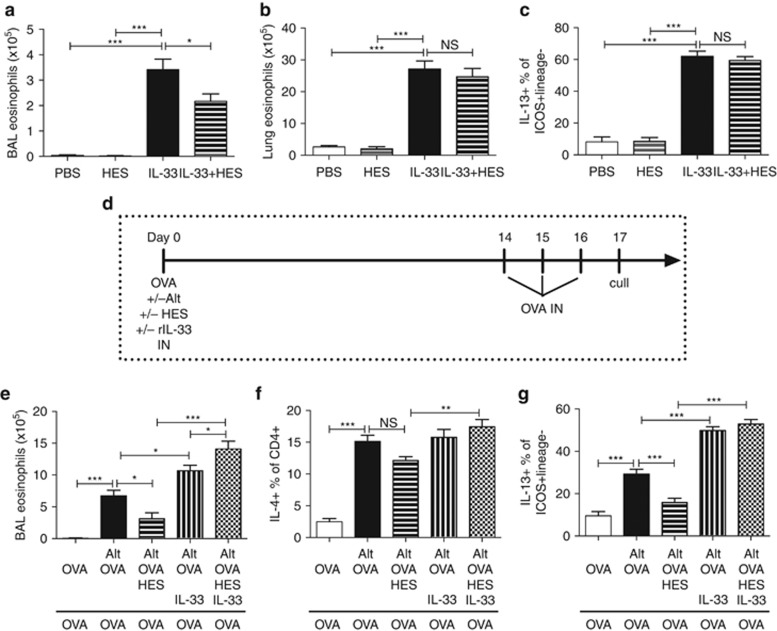
Exogenous IL-33 can circumvent HES-mediated suppression in vivo. (ac) Responses in mice given recombinant IL-33 in the presence or absence of HES. Recombinase-activating gene (RAG)-2 deficient mice received 200 ng per day IL-33±5 μg per day HES for 3 days, and samples harvested on day 4. Numbers of bronchoalveolar lavage (BAL) (a) or lung tissue (b) eosinophils were assessed, together with lung ICOS+Lineage intracellular IL-13 staining (c). (dg) HES suppression is overridden by exogenous IL-33. Mice receiving 200 ng per mouse IL-33, Alternaria extract, OVA, and/or HES as shown in (d), and SiglecF+CD11c BAL eosinophils (e), IL-4 expression within lung CD4+ cells (f), and intracellular IL-13 expression among lung ICOS+Lineage cells (g) were assessed. Unless otherwise indicated differences are not significant. ***P<0.01, **P<0.01, *P<0.05, NS=not significant. Results are pooled from two repeat experiments, 3–5 mice per group. Unless otherwise indicated differences are not significant. ***P<0.01, **P<0.01, *P<0.05. HES, H. polygyrus excretory-secretory; OVA, ovalbumin.

References

    1. Eder W., Ege M.J., von Mutius E. The asthma epidemic. N. Engl. J. Med. 2006;355:2226–2235. - PubMed
    1. Yazdanbakhsh M., Kremsner P.G., van Ree R. Allergy, parasites, and the hygiene hypothesis. Science. 2002;296:490–494. - PubMed
    1. Fleming J., Fabry Z. The hygiene hypothesis and multiple sclerosis. Ann. Neurol. 2007;61:85–89. - PubMed
    1. McSorley H.J., Maizels R.M. Helminth infections and host immune regulation. Clin. Microbiol. Rev. 2012;25:585–608. - PMC - PubMed
    1. Fanta C.H. Asthma. N. Engl. J. Med. 2009;360:1002–1014. - PubMed

Publication types

MeSH terms