. 2014 Feb 4;5(1):e01003-13.
doi: 10.1128/mBio.01003-13.

Differential locus expansion distinguishes Toxoplasmatinae species and closely related strains of Toxoplasma gondii

Affiliations

Differential locus expansion distinguishes Toxoplasmatinae species and closely related strains of Toxoplasma gondii

Yaw Adomako-Ankomah et al. mBio. .

Abstract

Toxoplasma gondii is a human obligate intracellular parasite that has infected over 20% of the world population and has a vast intermediate host range compared to those of its nearest relatives Neospora caninum and Hammondia hammondi. While these 3 species have highly syntenic genomes (80 to 99%), in this study we examined and compared species-specific structural variations, specifically at loci that have undergone local (i.e., tandem) duplication and expansion. To do so, we used genomic sequence coverage analysis to identify and curate T. gondii and N. caninum loci that have undergone duplication and expansion (expanded loci [ELs]). The 53 T. gondii ELs are significantly enriched for genes with predicted signal sequences and single-exon genes and genes that are developmentally regulated at the transcriptional level. We validated 24 T. gondii ELs using comparative genomic hybridization; these data suggested significant copy number variation at these loci. High-molecular-weight Southern blotting for 3 T. gondii ELs revealed that copy number varies across T. gondii lineages and also between members of the same clonal lineage. Using similar methods, we identified 64 N. caninum ELs which were significantly enriched genes belonging to the SAG-related surface (SRS) antigen family. Moreover, there is significantly less overlap (30%) between the expanded gene sets in T. gondii and N. caninum than would be predicted by overall genomic synteny (81%). Consistent with this finding, only 59% of queried T. gondii ELs are similarly duplicated/expanded in H. hammondi despite over 99% genomic synteny between these species.

Importance: Gene duplication, expansion, and diversification are a basis for phenotypic differences both within and between species. This study represents the first characterization of both the extent and degree of overlap in gene duplication and locus expansion across multiple apicomplexan parasite species. The most important finding of this study is that the locus duplications/expansions are quantitatively and qualitatively distinct, despite the high degree of genetic relatedness between the species. Given that these differential expansions are prominent species-specific genetic differences, they may also contribute to some of the more striking phenotypic differences between these species. More broadly, this work is important in providing further support for the idea that postspeciation selection events may have a dramatic impact on locus structure and copy number that overshadows selection on single-copy genes.


Figures
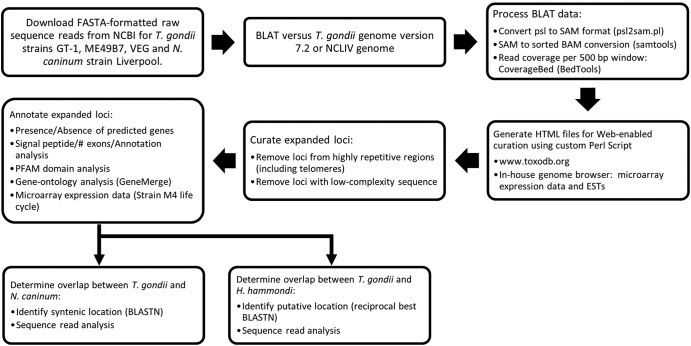
FIG 1
FIG 1
Flow chart depicting the pipeline used to identify, curate, and annotate expanded loci in Toxoplasma gondii, Neospora caninum, and Hammondia hammondi. ESTs, expressed sequence tags.
FIG 2
FIG 2
(A) Normalized sequence coverage plot of chromosome Ib for three T. gondii strains (GT1, ME49B7, and VEG). Coverage data for each 500-bp window were normalized to the average coverage for the entire chromosome for each strain. The locations of EL2 and EL3 (the expanded loci identified on chromosome Ib) and the predicted right arm telomere are indicated. (B) Detailed view of normalized sequence read coverage for EL2 for each of the three T. gondii strains, showing potential variation in copy number indicated by the read plot. Strains are color coded as in panel A.
FIG 3
FIG 3
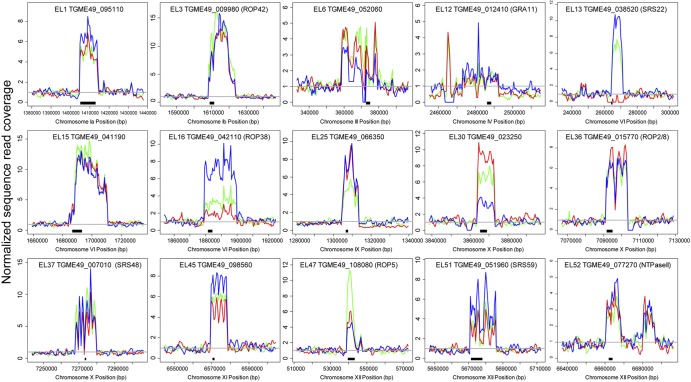
Sequence coverage plot for 15 expanded loci in three strain types of T. gondii. Data are normalized to the read coverage in the leftmost 20 kb flanking the expanded locus, and the gray line indicates normalized sequence coverage of 1. Black bars beneath each plot indicate the location of one of the predicted T. gondii isoforms. Information for each locus can be found in Table 1.
FIG 4
FIG 4
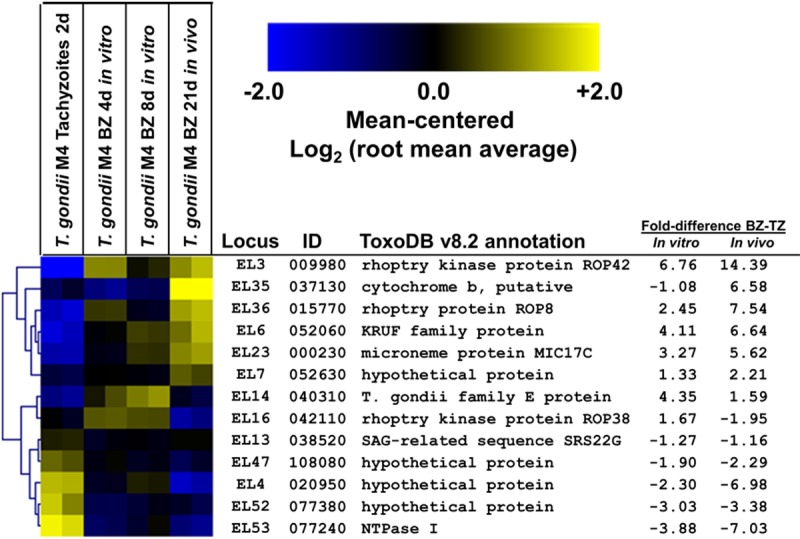
Expression profile for 13 expanded loci in tachyzoites and bradyzoites of T. gondii strain M4 (GEO database accession number GSE32427), showing an increase or decrease of transcript abundance during the tachyzoite-to-bradyzoite transition in vitro and/or in vivo.
FIG 5
FIG 5
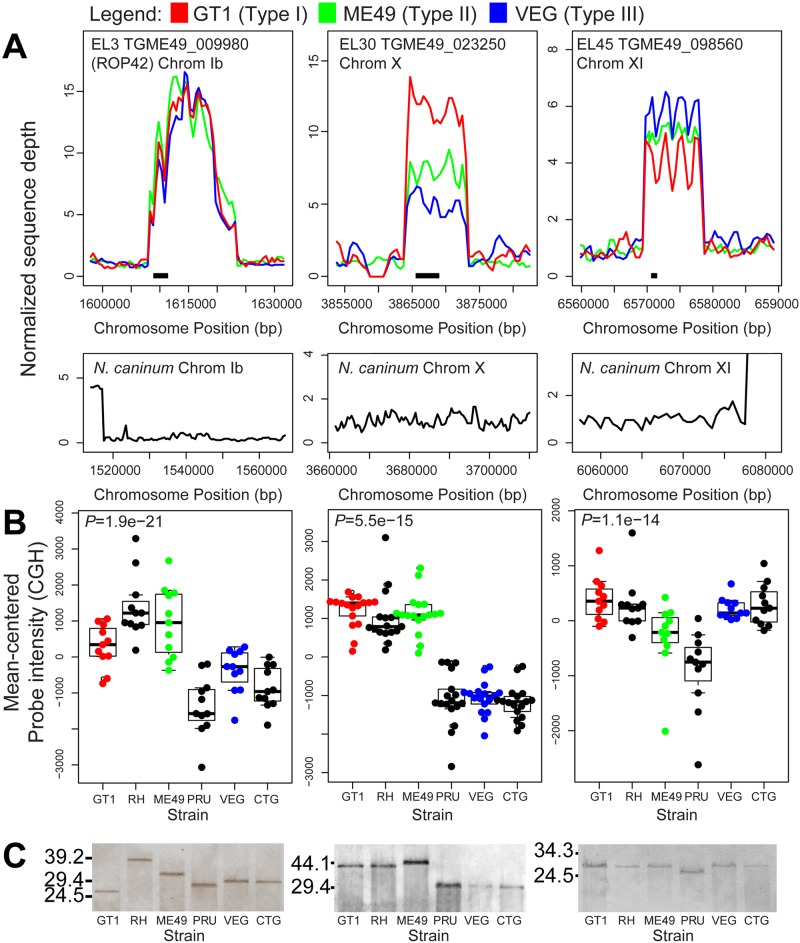
Sequence read, comparative genomic hybridization, and Southern blot analysis for EL3, EL30, and EL45. (A) Sequence read analysis for three strains of T. gondii (top) and N. caninum Liverpool (bottom). Data for each strain and locus are normalized to the read coverage in the 20 kb flanking the expanded locus to the left. (B) Comparative genomic hybridization (CGH) across 6 T. gondii strains, 2 from each of the 3 canonical lineages. Only microarray probes with perfect matches in GT1, ME49, and VEG were used in the calculations. Boxes span the first and third quartiles and contain the median value for all useful probes. P values for significant differences in hybridization intensity compared to the single-copy gene AMA1 (gray horizontal line) are at the top of the graph, and individual values are shown in the bee swarm plots. (C) Southern blots for 6 T. gondii strains using DNA digested with restriction enzymes predicted to cut outside the repeat locus. Restriction enzymes were BspEI, BglI, and NotI, respectively. A similar blot for the single-copy gene AMA1 can be found in the supplemental material. Numbers at left are molecular masses in kilobases.
FIG 6
FIG 6
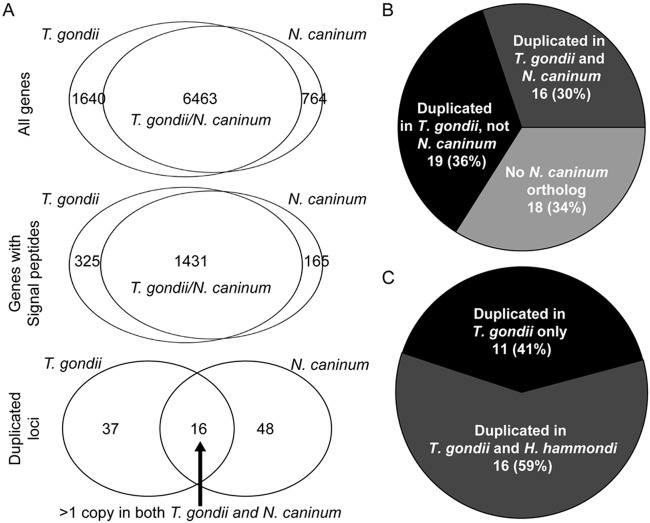
(A) Overall genomic synteny between T. gondii and N. caninum predicted genes. (Top) All predicted genes; (middle) all predicted genes with predicted signal peptides; (bottom) expanded loci (53 for T. gondii and 64 for N. caninum). The top 2 Venn diagrams are based on gene-by-gene synteny, while the bottom panel for expanded loci is based on whether the locus is expanded in both N. caninum and T. gondii (16 loci) or whether it is absent or present as a single copy in one species (37 and 48 for T. gondii and N. caninum, respectively). (B) Presence and expanded state of all 53 T. gondii expanded loci compared to N. caninum. Eighteen of the 53 T. gondii loci do not have a syntenic ortholog in N. caninum, a significant enrichment compared to the entire genome. (C) Comparison of the expanded state of T. gondii loci for which a clear ortholog was identified in H. hammondi HhCatGer041. Of the 27 loci, 11 are uniquely expanded in T. gondii compared to H. hammondi, while we estimated that H. hammondi has at least 2 predicted copies for the remaining 16 loci.

References

    1. Lélu M, Villena I, Dardé ML, Aubert D, Geers R, Dupuis E, Marnef F, Poulle ML, Gotteland C, Dumètre A, Gilot-Fromont E. 2012. Quantitative estimation of the viability of Toxoplasma gondii oocysts in soil. Appl. Environ. Microbiol. 78:5127–5132. 10.1128/AEM.00246-12 - DOI - PMC - PubMed
    1. de Moura L, Bahia-Oliveira LM, Wada MY, Jones JL, Tuboi SH, Carmo EH, Ramalho WM, Camargo NJ, Trevisan R, Graça RM, da Silva AJ, Moura I, Dubey JP, Garrett DO. 2006. Waterborne toxoplasmosis, Brazil, from field to gene. Emerg. Infect. Dis. 12:326–329. 10.3201/eid1202.041115 - DOI - PMC - PubMed
    1. Dardé ML. 2008. Toxoplasma gondii, “new” genotypes and virulence. Parasite 15:366–371. 10.1051/parasite/2008153366 - DOI - PubMed
    1. Dubey JP, Graham DH, Dahl E, Hilali M, El-Ghaysh A, Sreekumar C, Kwok OC, Shen SK, Lehmann T. 2003. Isolation and molecular characterization of Toxoplasma gondii from chickens and ducks from Egypt. Vet. Parasitol. 114:89–95. 10.1016/S0304-4017(03)00133-X - DOI - PubMed
    1. Maines TR, Jayaraman A, Belser JA, Wadford DA, Pappas C, Zeng H, Gustin KM, Pearce MB, Viswanathan K, Shriver ZH, Raman R, Cox NJ, Sasisekharan R, Katz JM, Tumpey TM. 2009. Transmission and pathogenesis of swine-origin 2009 A(H1N1) influenza viruses in ferrets and mice. Science 325:484–487. 10.1126/science.1177238 - DOI - PMC - PubMed

Publication types