


The RDoC framework: facilitating transition from ICD/DSM to dimensional approaches that integrate neuroscience and psychopathology
- PMID: 24497240
- PMCID: PMC3918011
- DOI: 10.1002/wps.20087
The RDoC framework: facilitating transition from ICD/DSM to dimensional approaches that integrate neuroscience and psychopathology
Abstract
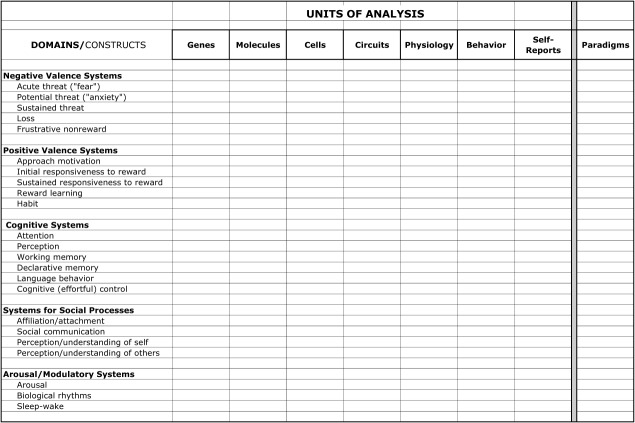
In 2008, the National Institute of Mental Health (NIMH) included in its new Strategic Plan the following aim: "Develop, for research purposes, new ways of classifying mental disorders based on dimensions of observable behavior and neurobiological measures". The implementation of this aim was named the Research Domain Criteria project, or RDoC. RDoC is a programmatic initiative that will fund grants, contracts, early-phase trials, and similar activities for the purpose of generating studies to build a research literature that can inform future versions of psychiatric nosologies based upon neuroscience and behavioral science rather than descriptive phenomenology. RDoC departs markedly from the DSM and ICD processes, in which extensive workgroup meetings generate final and finely-honed sets of diagnoses that are modified in field tests only if problems with clinical utility arise. Rather, in keeping with its provenance as an experimental system, the RDoC provides a framework for conducting research in terms of fundamental circuit-based behavioral dimensions that cut across traditional diagnostic categories. While an important aim of the project is to validate particular dimensions as useful for eventual clinical work, an equally important goal is to provide information and experience about how to conceive and implement such an alternative approach to future diagnostic practices that can harness genetics and neuroscience in the service of more effective treatment and prevention. This paper summarizes the rationale for the RDoC project, its essential features, and potential methods of transitioning from DSM/ICD categories to dimensionally-oriented designs in research studies.
Keywords: DSM-5; NIMH; Psychiatric diagnosis; RDoC; Research Domain Criteria; translational research.
Copyright © 2014 World Psychiatric Association.
References
-
- Insel TR. Transforming diagnosis http://www.nimh.nih.gov.
-
- Insel TR, Lieberman JA. DSM-5 and RDoC: shared interests http://www.nimh.nih.gov.
-
- Belluck P, Carey B. Psychiatry's guide is out of touch with science, experts say. New York: Times; 2013. May 6 http://www.nytimes.com.
LinkOut - more resources
Full Text Sources
Other Literature Sources
