


Associations between serum-intact parathyroid hormone, serum 25-hydroxyvitamin D, oral vitamin D analogs and metabolic syndrome in peritoneal dialysis patients: a multi-center cross-sectional study
- PMID: 24497582
- PMCID: PMC4079492
- DOI: 10.3747/pdi.2013.00001
Associations between serum-intact parathyroid hormone, serum 25-hydroxyvitamin D, oral vitamin D analogs and metabolic syndrome in peritoneal dialysis patients: a multi-center cross-sectional study
Abstract
Introduction: Although previous studies have suggested associations between serum intact parathyroid hormone (iPTH), 25-hydroxyvitamin D (25(OH)D) and metabolic syndrome (MS) in the general population, these associations are still uncharacterized in peritoneal dialysis (PD) patients.
Methods: In total, 837 prevalent PD patients from 5 centers in China were enrolled between April 1, 2011 and November 1, 2011. The demographic data, biochemical parameters and medical records were collected, except for serum 25(OH)D which was measured in 347 of 837 patients. The definition of MS was modified from National Cholesterol Education Program Third Adult Treatment Panel (NCEP-ATPIII).
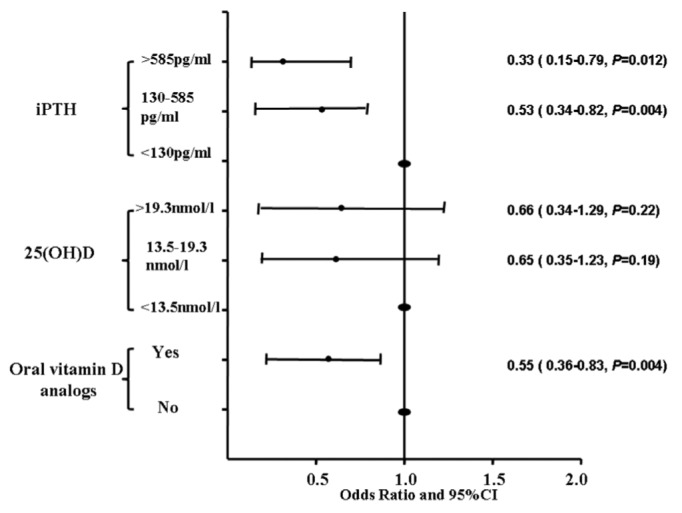
Results: 55.4% of 837 patients were found to have MS. The median concentration of iPTH, 25(OH)D and doses of oral vitamin D analogs for participants with MS was significantly lower than those without MS. The iPTH, 25(OH)D values and doses of vitamin D analogs were all associated with one or more components of MS. After multivariate adjustment, low serum iPTH values and oral vitamin D analogs, rather than serum 25(OH)D, were significantly associated with the presence of MS, abnormal fasting blood glucose (FBG) and high-density lipoprotein cholesterol (HDL-C). Compared to iPTH < 130 pg/mL, iPTH 130-585 pg/mL and > 585 pg/mL were associated with a lower risk of MS with adjusted odds ratio (OR) of 0.59 and 0.33, respectively. Taking vitamin D analogs was also associated with a lower risk of MS with adjusted OR of 0.55.
Conclusions: Serum iPTH and the use of active vitamin D supplements rather than serum 25(OH)D were independently associated with the presence of MS in patients on PD.
Keywords: Metabolic syndrome; parathyroid hormone; peritoneal dialysis; vitamin D.
Copyright © 2014 International Society for Peritoneal Dialysis.
Figures
Comment in
-
Confounded complexity: vitamin d, parathyroid hormone, and metabolic syndrome in peritoneal dialysis.Perit Dial Int. 2014 Jun;34(4):333-7. doi: 10.3747/Pdi.2014.00005. Perit Dial Int. 2014. PMID: 24991048 Free PMC article. No abstract available.
References
-
- Kurella M, Lo JC, Chertow GM. Metabolic syndrome and the risk for chronic kidney disease among nondiabetic adults. J Am Soc Nephrol 2005; 16:2134–40 - PubMed
-
- Tanaka H, Shiohira Y, Uezu Y, Higa A, Iseki K. Metabolic syndrome and chronic kidney disease in Okinawa, Japan. Kidney Int 2006; 69:369–74 - PubMed
-
- Laaksonen DE, Lakka HM, Niskanen LK, Kaplan GA, Salonen JT, Lakka TA. Metabolic syndrome and development of diabetes mellitus: application and validation of recently suggested definitions of the metabolic syndrome in a prospective cohort study. Am J Epidemiol 2002; 156:1070–7 - PubMed
-
- Ninomiya JK, L’Italien G, Criqui MH, Whyte JL, Gamst A, Chen RS. Association of the metabolic syndrome with history of myocardial infarction and stroke in the Third National Health and Nutrition Examination Survey. Circulation 2004; 109:42–6 - PubMed
-
- Lakka HM, Laaksonen DE, Lakka TA, Niskanen LK, Kumpusalo E, Tuomilehto J, Salonen JT. The metabolic syndrome and total and cardiovascular disease mortality in middle-aged men. JAMA 2002; 288:2709–16 - PubMed
Publication types
MeSH terms
Substances
LinkOut - more resources
Full Text Sources
Other Literature Sources
Medical
Miscellaneous
