Evaluation of a 3D system based on a high-quality flat screen and polarized glasses for use by surgical assistants during robotic surgery
- PMID: 24497675
- PMCID: PMC3897045
- DOI: 10.4103/0970-1591.124199
Evaluation of a 3D system based on a high-quality flat screen and polarized glasses for use by surgical assistants during robotic surgery
Abstract
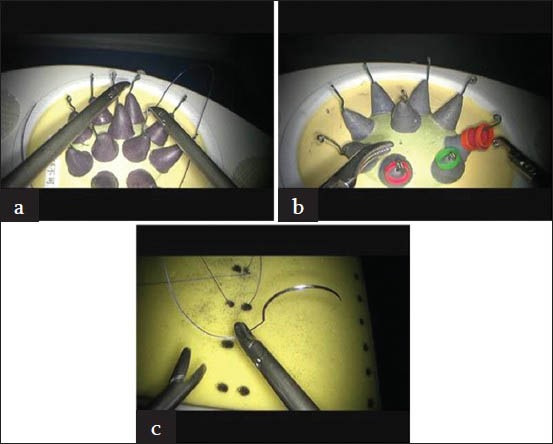
Introduction: One of the main benefits of robotic surgery is the surgeon's three-dimensional (3D) vision system. The purpose of this study is to evaluate the efficacy of 3D vision using a flat screen and polarized glasses for surgical skills during robotic surgeries.
Materials and methods: In an experimental model, six surgeons performed three surgical tasks with laparoscopic devices using a standard 2D and a flat-screen 3D model with polarized glasses. Performance times were compared between two-dimensional (2D) and 3D vision for each task. The surgeons also graded the efficiency of the 3D system, on a subjective scale of 0-100.
Results: Performance times for task 1 (seven holes) and 2 (elastic bands) were significantly reduced by 84% and 56% using 3D compared with a 2D system and experienced surgeons performed all three tasks faster in 3D than 2D. The surgeons reported the polarized glasses were comfortable to wear and direct vision was seldom affected.
Conclusions: The use of 3D visualization seems to improve the efficiency of surgical skills during robotic surgery and reduce performance time for characteristic surgical procedure tasks.
Keywords: Experimental model; surgical skill; three-dimensional vision.
Conflict of interest statement
Figures

References
-
- Wagner OJ, Hagen M, Kurmann A, Horgan S, Candinas D, Vorburger SA. Three-dimensional vision enhances task performance independently of the surgical method. Surg Endosc. 2012;26:2961–8. - PubMed
-
- Kural AR, Atug F, Tufek I, Akpinar H. Robot-assisted partial nephrectomy versus laparoscopic partial nephrectomy: Comparison of outcomes. J Endourol. 2009;23:1491–7. - PubMed
-
- Karim O, Mayer E, Kucheria R, Hrouda D, Vale J. Technique for urethral eversion and vesico-urethral anastomosis: Application to robot-assisted laparoscopic prostatectomy. BJU Int. 2010;105:284–7. - PubMed
-
- Tan GY, El Douaihy Y, Te AE, Tewari AK. Scientific and technical advances in continence recovery following radical prostatectomy. Expert Rev Med Devices. 2009;6:431–53. - PubMed
-
- Blake R, Levinson E. Spatial properties of binocular neurones in the human visual system. Exp Brain Res. 1977;27:221–32. - PubMed
LinkOut - more resources
Full Text Sources
Other Literature Sources