Review
doi: 10.1371/journal.ppat.1003859.
eCollection 2014 Jan.
Human and plant fungal pathogens: the role of secondary metabolites
Affiliations
- PMID: 24497825
- PMCID: PMC3907374
- DOI: 10.1371/journal.ppat.1003859
Item in Clipboard
Review
Human and plant fungal pathogens: the role of secondary metabolites
PLoS Pathog.
.
No abstract available
Conflict of interest statement
The authors have declared that no competing interests exist.
Figures
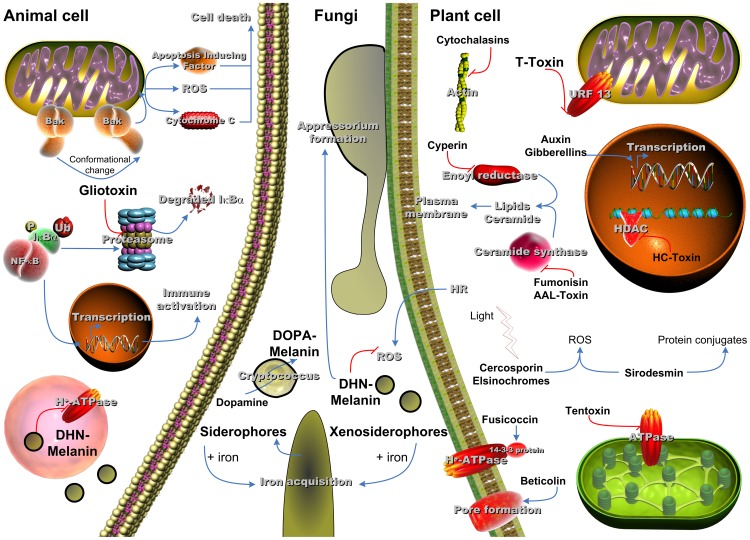
Animal cell: Gliotoxin acts on the mitochondrial protein Bak, which leads to apoptosis and inhibits the activation of NFκB through blocking proteasomal activity; DHN-melanin from A. fumigatus inhibits vH+-ATPase activity and therefore acidification of the phagolysosome, which counteracts killing of the conidia. Fungi: Siderophores are released by the fungus to ensure iron availability; DHN-melanin from plant pathogens is crucial for appressorium formation and counteracting reactive oxygen species (ROS) produced by the plant through hypersensitive response (HR) to prevent the spread of fungal infection; DOPA-melanin produced by C. neoformans from external precursors is an important part of the fungal capsule. Plant cell: Cytochalasins block cytokinesis; T-Toxin inhibits mitochondrial energy production; Fumonisin, AAL-Toxin, and Cyperin affect the membrane integrity; Auxin and Gibberellins act as phytohormones and alter transcription activity; HC-Toxin inhibits histone deacetylase; after light-driven activation both Cercosporin and Elsinochromes produce ROS, which damage the cell; Sirodesmin induces ROS and the formation of protein-conjugates; Tentoxin inhibits chloroplastidial energy production; Fusicoccin mediates irreversible stomata opening; Beticolin forms pores in the membrane and leads to leakage of the cell.
References
-
- Brakhage AA (2013) Regulation of fungal secondary metabolism. Nat Rev Microbiol 11: 21–32. - PubMed
-
- McDonagh A, Fedorova ND, Crabtree J, Yu Y, Kim S, et al. (2008) Sub-telomere directed gene expression during initiation of invasive aspergillosis. PLoS Pathog 4: e1000154 doi:10.1371/journal.ppat.1000154 - DOI - PMC - PubMed
Publication types
MeSH terms
LinkOut - more resources
Full Text Sources
Other Literature Sources
Medical