. 2014 Jan 30;9(1):e86999.
doi: 10.1371/journal.pone.0086999. eCollection 2014.

Genetic structure of avian influenza viruses from ducks of the Atlantic flyway of North America

Affiliations

Genetic structure of avian influenza viruses from ducks of the Atlantic flyway of North America

Yanyan Huang et al. PLoS One. .

Abstract

Wild birds, including waterfowl such as ducks, are reservoir hosts of influenza A viruses. Despite the increased number of avian influenza virus (AIV) genome sequences available, our understanding of AIV genetic structure and transmission through space and time in waterfowl in North America is still limited. In particular, AIVs in ducks of the Atlantic flyway of North America have not been thoroughly investigated. To begin to address this gap, we analyzed 109 AIV genome sequences from ducks in the Atlantic flyway to determine their genetic structure and to document the extent of gene flow in the context of sequences from other locations and other avian and mammalian host groups. The analyses included 25 AIVs from ducks from Newfoundland, Canada, from 2008-2011 and 84 available reference duck AIVs from the Atlantic flyway from 2006-2011. A vast diversity of viral genes and genomes was identified in the 109 viruses. The genetic structure differed amongst the 8 viral segments with predominant single lineages found for the PB2, PB1 and M segments, increased diversity found for the PA, NP and NS segments (2, 3 and 3 lineages, respectively), and the highest diversity found for the HA and NA segments (12 and 9 lineages, respectively). Identification of inter-hemispheric transmissions was rare with only 2% of the genes of Eurasian origin. Virus transmission between ducks and other bird groups was investigated, with 57.3% of the genes having highly similar (≥99% nucleotide identity) genes detected in birds other than ducks. Transmission between North American flyways has been frequent and 75.8% of the genes were highly similar to genes found in other North American flyways. However, the duck AIV genes did display spatial distribution bias, which was demonstrated by the different population sizes of specific viral genes in one or two neighbouring flyways compared to more distant flyways.


Conflict of interest statement

Competing Interests: The authors have declared that no competing interests exist.

Figures

Figure 1
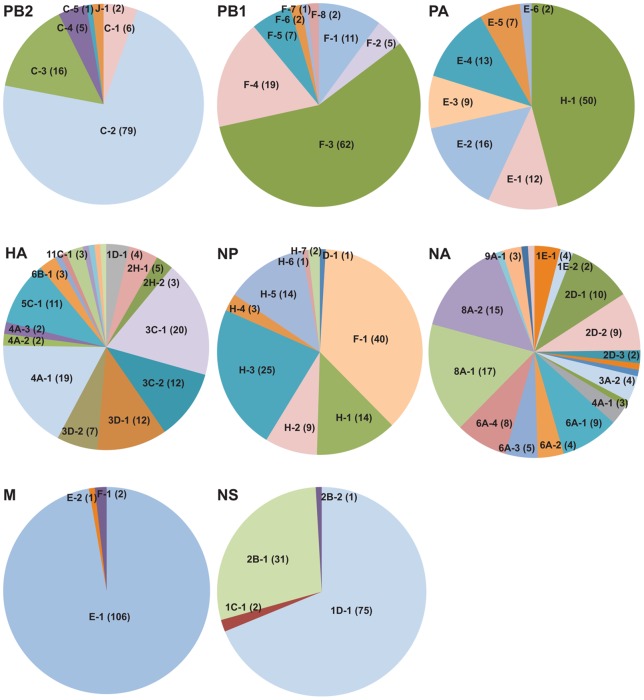
Figure 1. Genetic structure of the gene lineages and sub-lineages of the Atlantic flyway duck AIVs.
The numbers of genes in each detected sub-lineage for each of the segments of the 109 Atlantic flyway duck AIVs are shown in the pie charts. AIV genes with ≥95% nucleotide identity by pairwise distance analysis were assigned in a sub-lineage. For the HA genes, sub-lineages 7F-1, 7F-2, 11C-2, 12A-1, 13A-1 and 16D-1 were each detected once and are not labelled. Similarly for the NA genes, sub-lineages 2G-1, 3A-1, 3D-1, 8A-3, 9A-2 and 9A-3 were each detected once and are not labelled.
Figure 2
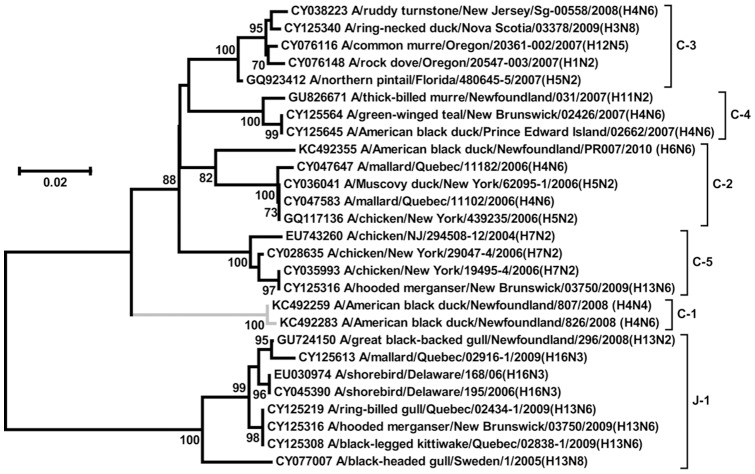
Figure 2. Detection of Atlantic flyway duck AIV PB2 gene sub-lineages in non-duck host species.
The phylogenetic tree contains representative sequences from the Atlantic flyway duck AIVs for each of the 6 PB2 sub-lineages, with sub-lineages indicated on the right. The 5 sub-lineages (C-2 through C-5 and J-1) that contained genes detected from non-duck host species are displayed with black branches. The sub-lineage C1, which did not contain genes from non-duck host species, is displayed with grey branches. The neighbour-joining tree was constructed with MEGA 5 and support values based on 1000 bootstrap replicates are shown as percentages where ≥70%. The scale bar indicates nucleotide substitutions per site.
Figure 3
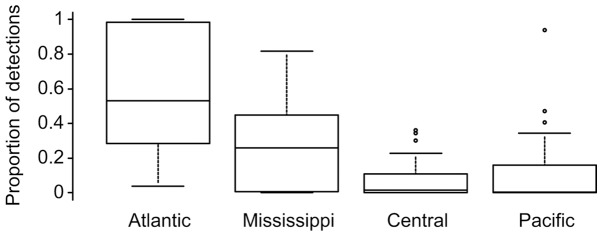
Figure 3. Spatial distribution of detections of the Atlantic flyway duck AIV sub-lineages in North American flyways.
The box plots show the proportions of detections in each of the flyways for the gene sub-lineages that were identified in the 2006–2011 Atlantic flyway duck AIVs. The solid line in the box is the median. The top and bottom of the box are the first and third quartiles, respectively. The upper and lower horizontal lines represent 1.5X the difference between the first and third quartiles and any values falling outside of those are plotted as points. The detailed results for the each segment are provided in Figure S5.
Figure 4
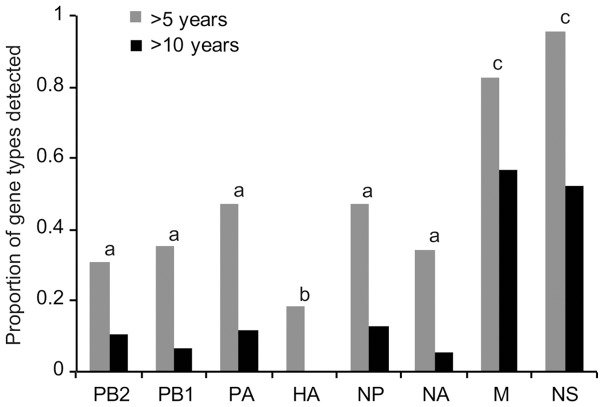
Figure 4. Perpetuation of Atlantic flyway duck AIV gene types across time.
The proportions of gene types identified in the Atlantic flyway viruses that were detected for >5 and >10 years in North America are shown for each segment. There were significant differences among the proportions for the HA, M and NS segments relative to the other segments for >5 years (χ2 = 53.1, df = 7, P<0.0001) and >10 years (χ2 = 66.5, df = 7, P<0.0001). Statistically different proportions for the segments are indicated with different letters (a, b and c).

References

    1. Dugan VG, Chen R, Spiro DJ, Sengamalay N, Zaborsky J, et al. (2008) The evolutionary genetics and emergence of avian influenza viruses in wild birds. PLoS Pathog 4: e1000076. - PMC - PubMed
    1. Olsen B, Munster VJ, Wallensten A, Waldenstrom J, Osterhaus ADME, et al. (2006) Global patterns of influenza A virus in wild birds. Science 312: 384–388. - PubMed
    1. Webster RG, Bean WJ, Gorman OT, Chambers TM, Kawaoka Y (1992) Evolution and ecology of influenza A viruses. Microbiol Rev 56: 152–179. - PMC - PubMed
    1. Gonzalez-Reiche AS, Perez DR (2012) Where do avian influenza viruses meet in the Americas? Avian Dis 56: 1025–1033. - PubMed
    1. Pereda AJ, Uhart M, Perez AA, Zaccagnini ME, La Sala L, et al. (2008) Avian influenza virus isolated in wild waterfowl in Argentina: Evidence of a potentially unique phylogenetic lineage in South America. Virology 378: 363–370. - PMC - PubMed

Publication types