. 2014 Feb 3;9(2):e87695.
doi: 10.1371/journal.pone.0087695. eCollection 2014.

Plasmodium falciparum Rab5B is an N-terminally myristoylated Rab GTPase that is targeted to the parasite's plasma and food vacuole membranes

Affiliations

Plasmodium falciparum Rab5B is an N-terminally myristoylated Rab GTPase that is targeted to the parasite's plasma and food vacuole membranes

Carinne Ndjembo Ezougou et al. PLoS One. .

Abstract

Plasmodium falciparum (Pf) has a family of 11 Rab GTPases to regulate its vesicular transport. However, PfRab5B is unique in lacking a C-terminal geranyl-geranylation motif, while having N-terminal palmitoylation and myristoylation motifs. We show that the N-terminal glycine is required for PfRab5B myristoylation in vitro and when an N-terminal PfRab5B fragment possessing both acylation motifs is fused to GFP and expressed in transgenic P. falciparum parasites, the chimeric PfRab5B protein localizes to the plasma membrane. Upon substitution of the modified glycine by alanine the staining becomes diffuse and GFP is found in soluble subcellular fractions. Immuno-electron microscopy shows endogenous PfRab5B decorating the parasite's plasma and food vacuole membranes. Using reverse genetics rab5b couldn't be deleted from the haploid genome of asexual blood stage P. berghei parasites. The failure of PbRab5A or PbRab5C to complement for loss of PbRab5B function indicates non-overlapping roles for the three Plasmodium Rab5s, with PfRab5B involved in trafficking MSP1 to the food vacuole membrane and CK1 to the plasma membrane. We discuss similarities between Plasmodium Rab5B and Arabidopsis thaliana ARA6, a similarly unusual Rab5-like GTPase of plants.


Conflict of interest statement

Competing Interests: The corresponding author Gordon Langsley is an Academic Editor at PLoS One. This does not alter the authors' adherence to all the PLOS ONE policies on sharing data and materials. All other authors declare that they have no competing interests.

Figures

Figure 1
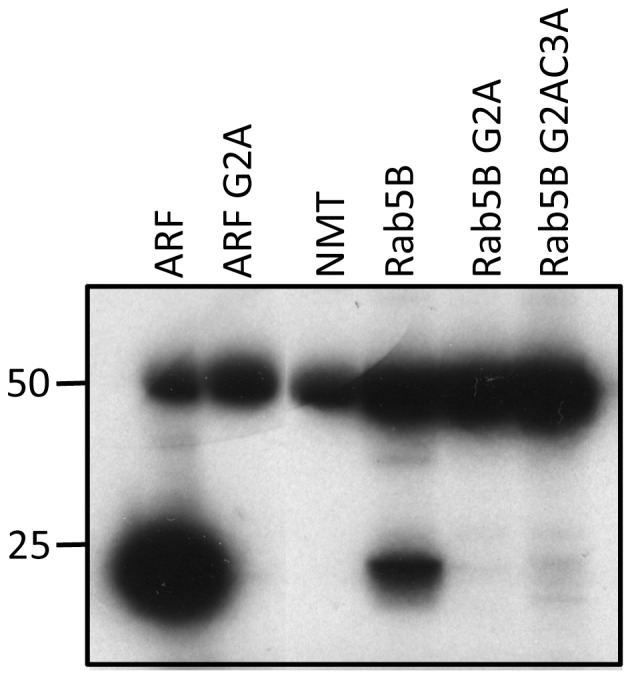
Figure 1. Recombinant PfRab5B is N-myristoylated by PfNMT in vitro.
PfRab5B and the G2A and G2AC3A variants were incubated with [3H]-myristoyl CoA in the presence of N-myristoyl transferase. Recombinant ARF and ARFG2A were treated in the same way, acting as controls. N-myristoylation was detected by the incorporation of radiolabel into the substrate following SDS-PAGE and fluorography and the upper band at 50 kDa is due to label binding to PfNMT. Both PfRab5B and ARF migrated with mobility slightly faster than the 25 kDa molecular mass marker. No incorporation was detected if the N-terminal glycine residue of either protein was replaced with alanine (G2A).
Figure 2
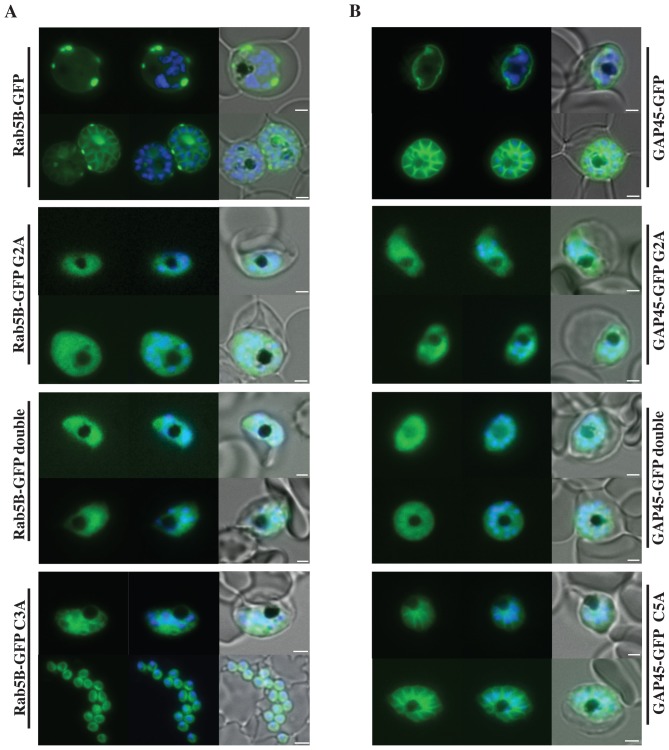
Figure 2. Localisation of PfRab5B-GFP fusion proteins in P. falciparum.
Parasites were transfected with constructs expressing the N-terminal 28 amino acids of PfRab5B or 29 amino acids of PfGAP45 fused to GFP under a schizont stage-specific promoter (msp3 5′UTR region). Localisation of PfRab5B28-GFP (A) and GAP4529-GFP fusions (B) as well as myristoylation (G2A) and palmitoylation-deficient fusions (C3A in PfRab5B28-GFP and C5A in GAP4529-GFP) were investigated. The first image in a series corresponds to GFP fluorescence, the second a merge of GFP fluorescence with nuclear DAPI stain, and the third a merge of GFP fluorescence, DAPI and bright field images. Size bars are 2 µm.
Figure 3
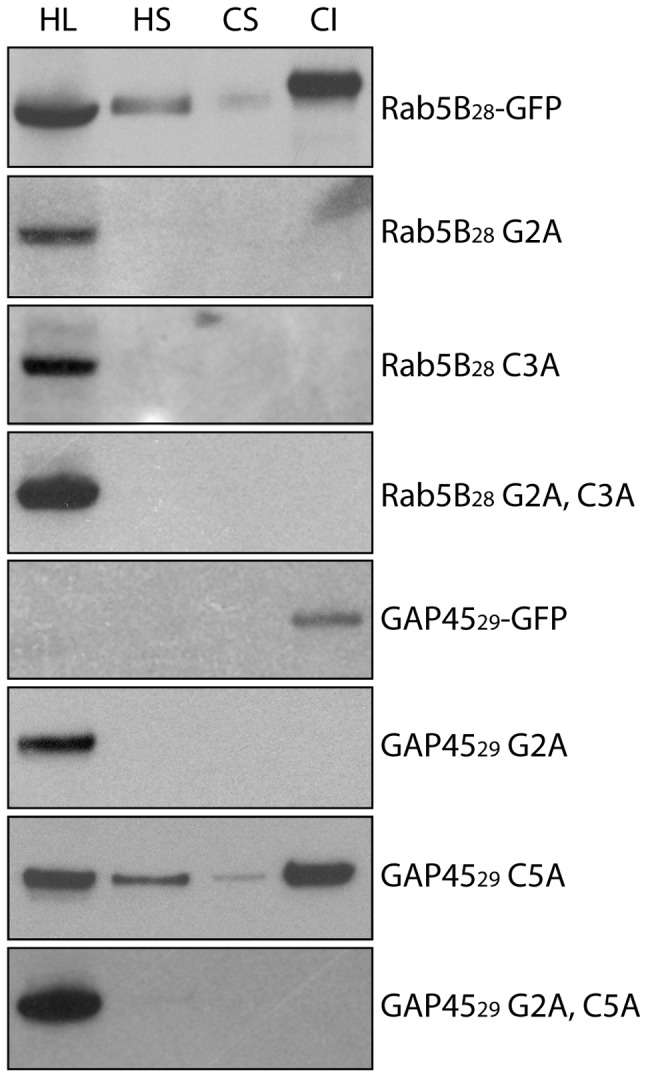
Figure 3. Subcellular fractionation of PfRab5B and GAP45 GFP chimeras.
When fused to GFP, the first 28 amino acids of PfRab5B confer a partial membrane association to the fusion protein. PfRab5B28-GFP is found to varying degrees in the four fractions studied. Substitution of glycine at position two with alanine (PfRab5B28 G2A) results in loss of all membrane association, as does substitution of cysteine at position three (PfRab5B28 C3A). A known myristoylated and palmitoylated protein, GAP4529-GFP is found exclusively in membrane fractions and a G2A substitution results in an entirely soluble protein (GAP4529 G2A). A substitution of cysteine at position five causes a reduction in the proportion of protein associated with membranes (GAP4529 C5A). Double substitutions of glycine and cysteine result in a cytosolic protein for both PfRab5B28 and GAP4529 GFP fusion proteins. HL: hypotonic lysis buffer supernatant, HS: high salt buffer supernatant, CS: carbonate buffer supernatant, CI: carbonate buffer insoluble.
Figure 4
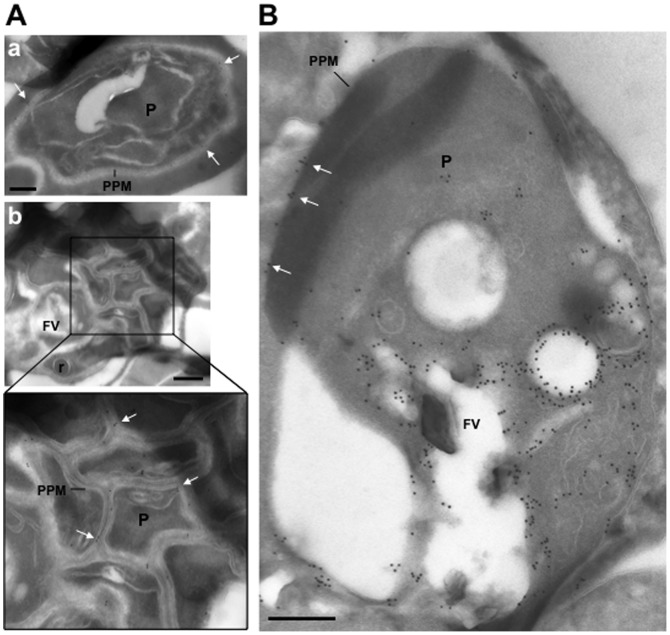
Figure 4. Ultrastructural detection of PfRab5b in P. falciparum-infected RBC.
Immuno-electron microscopy of schizonts (A) and a large trophozoite (B) of P. falciparum labelled with specific anti-PfRab5B antibodies, revealing the presence of gold particles both on the food vacuole (FV) and the parasite plasma membrane (PPM, white arrows) in trophozoites and exclusively on parasite plasma membrane for late stages. P, parasite; r, rhoptry. Scale bars, 150 nm.
Figure 5
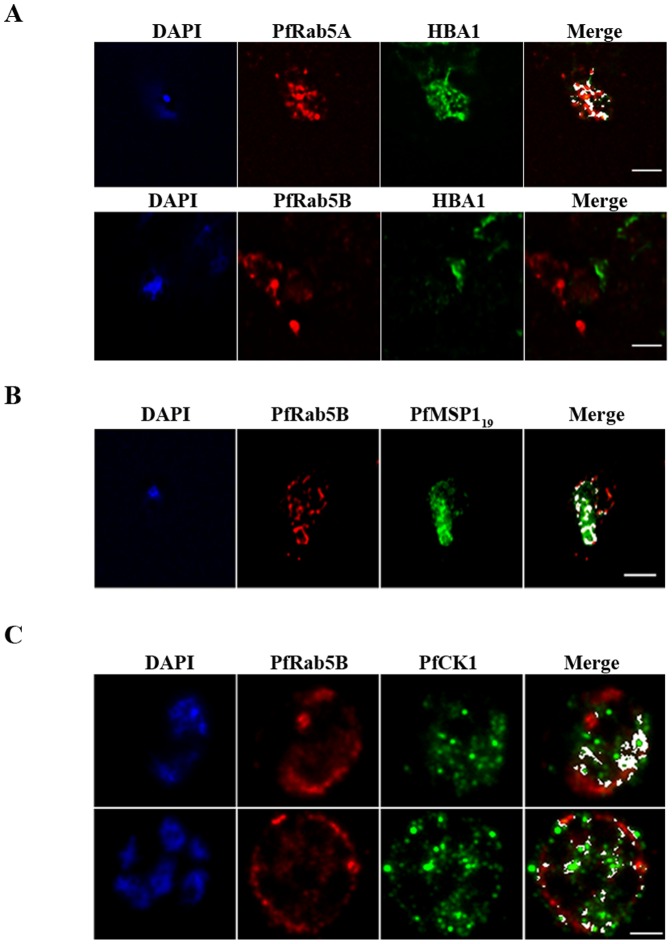
Figure 5. PfRab5B colocalises with PfMSP1 and PfCK1, but not with haemoglobin.
(A) PfRab5A colocalises with haemoglobin (HBA1) containing vesicles (r = 0.724), unlike PfRab5B (r = 0.081; n = 3). (B) PfRab5B colocalises to differing degrees (r = 0.849; n = 3) with the C-terminal 19 kDa fragment of PfMSP1 on structures close to the food vacuole and the parasite nucleus shown in blue by DAPI staining. (C) PfRab5B colocalises with PfCK1 on intracellular structures (r = 0.615; n = 3) and at the parasite plasma membrane (r = 0.475; n = 3). Areas of colocalistaion are shown in white and used to calculate Pearson's r coefficients. Scale bars, 2 µm.

References

    1. White NJ, Pukrittayakamee S, Hien TT, Faiz MA, Mokuolu OA, et al. (2013) Malaria. Lancet - PubMed
    1. de Castro FA, Ward GE, Jambou R, Attal G, Mayau V, et al. (1996) Identification of a family of Rab G-proteins in Plasmodium falciparum and a detailed characterisation of pfrab6. Mol Biochem Parasitol 80: 77–88. - PubMed
    1. Ward GE, Tilney LG, Langsley G (1997) Rab GTPases and the unusual secretory pathway of plasmodium. Parasitol Today 13: 57–62. - PubMed
    1. Langsley G, van Noort V, Carret C, Meissner M, de Villiers EP, et al. (2008) Comparative genomics of the Rab protein family in Apicomplexan parasites. Microbes Infect 10: 462–470. - PMC - PubMed
    1. Zerial M, McBride H (2001) Rab proteins as membrane organizers. Nat Rev Mol Cell Biol 2: 107–117. - PubMed

Publication types

MeSH terms