


Efficacy of mometasone furoate and fluticasone furoate on persistent allergic rhinoconjunctivitis
- PMID: 24498516
- PMCID: PMC3911800
- DOI: 10.2500/ar.2013.4.0065
Efficacy of mometasone furoate and fluticasone furoate on persistent allergic rhinoconjunctivitis
Abstract
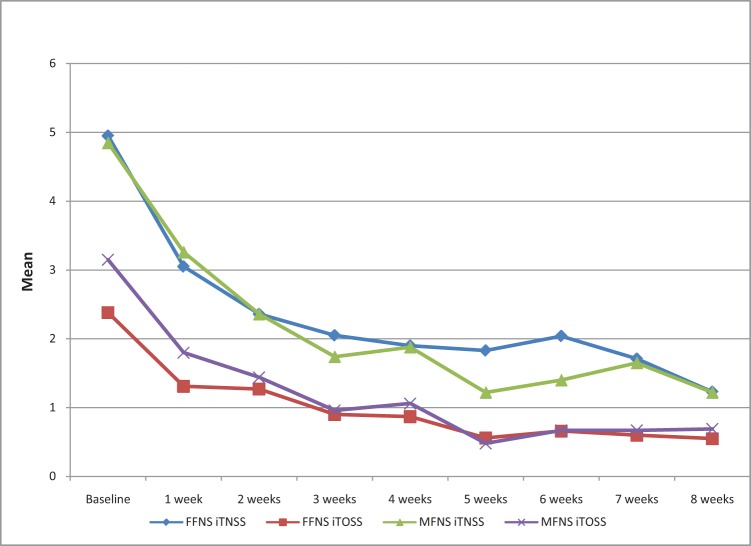
Allergic rhinoconjunctivitis denotes both nasal and ocular manifestation of allergy, which may be solely treated with intranasal steroid. This study compares the efficacy of mometasone furoate nasal spray (NS) and fluticasone furoate NS in treatment of allergic rhinoconjunctivitis. The secondary objective is to study the severity of baseline ocular symptoms in allergic rhinoconjunctivitis. Seventy-eight patients with allergic rhinoconjunctivitis were assessed subjectively and objectively using twice-daily symptom scores for nasal (reflective total nasal symptom score [rTNSS] and instantaneous TNSS [iTNSS]) and ocular (reflective total ocular symptom score [rTOSS] and instantaneous TOSS [iTOSS]) symptoms, rhinoconjunctivitis quality-of-life questionnaires (RQOLQs), and acoustic rhinometry. All measurements were taken at baseline and at 4 and 8 weeks of treatment. Sixty-three patients who were randomized into the mometasone furoate group (n = 36) and the fluticasone furoate group (n = 27) completed the study. Seventy-six percent of patients had mild ocular symptoms, 20.5% had moderate symptoms, and only 2.6% had severe symptoms at baseline based on the iTOSS; 65.1% had mild nasal symptoms and 3% had severe nasal symptoms. There was significant reduction in the symptom scores after 1 week (p < 0.05). Both groups had significant improvement in RQOLQ scores after 1 month, which further improved at 2 months (p < 0.05). The nasal dimensions also improved in both groups (p < 0.05) but there was no statistically significant difference between groups. Both mometasone furoate and fluticasone furoate are effective as single-modality treatment of allergic rhinoconjunctivitis. The majority of patients manifest mild ocular symptoms that may be solely treated with intranasal steroids.
Keywords: Allergic rhinoconjunctivitis; fluticasone furoate; intranasal steroids; mometasone furoate; ocular symptoms; perennial allergic rhinitis.
Conflict of interest statement
The authors have no conflicts of interest to declare pertaining to this article
Figures
References
-
- Bousquet J, van Cauwenberge P, Khaltaev N, et al. Allergic rhinitis and its impact on asthma. J Allergy Clin Immunol 108:S147–S334, 2001 - PubMed
-
- Ng ML, Warlow RS, Chrishanthan N, et al. Preliminary criteria for the defnition of allergic rhinitis: A systematic evaluation of clinical parameters in a disease cohort (I). Clin Exp Allergy 30:1314–1331, 2000 - PubMed
-
- Wallace DV, Dykewicz MS, Bernstein DI, et al. The diagnosis and management of rhinitis: An updated practice parameter. J Allergy Clin Immunol 122:S1–-S84, 2008 - PubMed
-
- Brunton SA, Fromer LM. Treatment options on management of perennial allergic rhinitis with focus on intranasal corticosteroid. South Med J 100:701–708, 2007 - PubMed
LinkOut - more resources
Full Text Sources
Other Literature Sources
Medical
Miscellaneous
