Review
. 2013 Nov 1;2(11):e26468.
doi: 10.4161/onci.26468. Epub 2013 Oct 21.

Role of lymphocytes in liver cancer

Affiliations
Review

Role of lymphocytes in liver cancer

Jana C Mossanen et al. Oncoimmunology. .

Abstract

Hepatocellular carcinoma (HCC) typically occurs in patients with chronic inflammatory liver diseases, such as viral hepatitis or (non-)alcoholic steatohepatitis. Inflammation appears indeed as a crucial factor in hepatocarcinogenesis. Nevertheless, sophisticated animal models and studies of human samples revealed that the HCC also elicits antitumor immune responses. Patrolling and infiltrating lymphocytes (e.g., NKT and T cells, respectively) can exert decisive functions in the transition from chronic hepatic inflammation to cancer as well as in antitumor immune responses. An improved understanding of the cellular and molecular mechanisms whereby inflammation promotes or restricts hepatocarcinogenesis will open new avenues for therapeutic approaches to liver cancer.

Keywords: DEN; HCC; NKT cells; hepatocellular carcinoma; liver fibrosis.


Figures
None
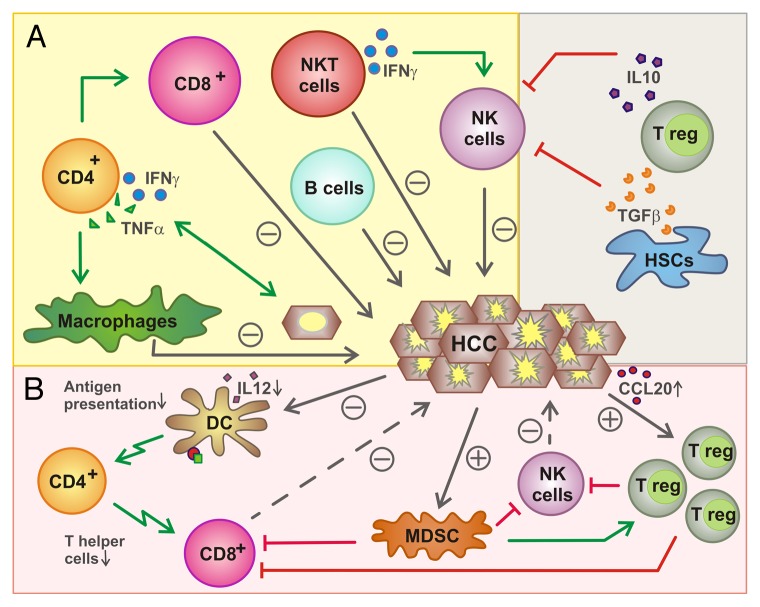
Figure 1. Functions of lymphocytes in liver cancer. (A) Influence of lymphocytes on hepatocellular carcinoma (HCC). Several immune effector cells including natural killer (NK), NKT, B, CD8+ and CD4+ T cells have been shown to exert antitumor effects either directly (NK cells, CD8+ T cells, B cells, NKT cells) or upon the activation of other lymphocytes. Conversely, regulatory T cells (Tregs) mediate immunosuppressive effects, hence promoting oncogenesis and tumor progression, as they inhibit NK and CD8+ T cells. (B) Inhibition of lymphocytes by HCC. HCCs can recruit Tregs by a CCR6-dependent mechanism that impinges on the local secretion of CCL20. Tregs are also activated by myeloid-derived suppressor cells (MDSCs) and inhibit NK and CD8+ T cells. HCCs also limit the ability of dendritic cells (DCs) to present antigen to CD4+ and CD8+ T cells.
None
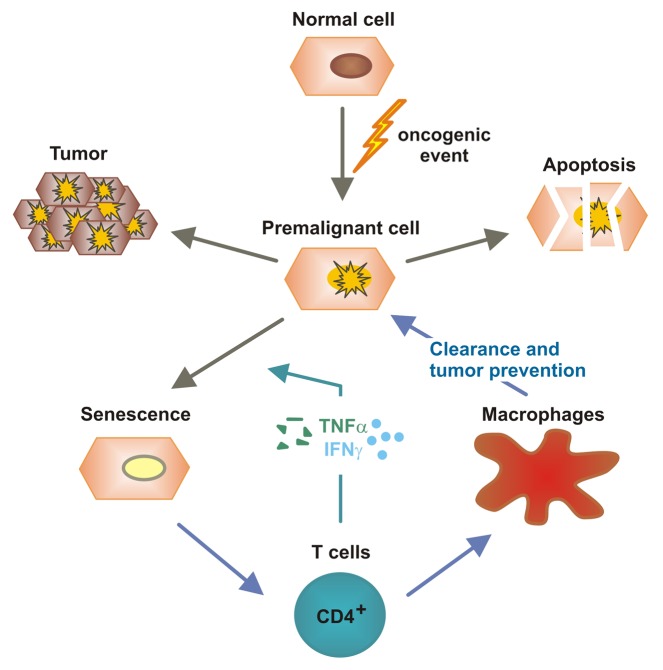
Figure 2. Immunosurveillance of senescent hepatocytes by CD4+ T cells and TH1 cytokines. Aberrant oncogene activation in hepatocytes as well as other oncogenic events can induce a state of cellular stress from which hepatocytes can develop tumors, die via apoptosis or undergo cell senescence. CD4+ T cells can sense cellular senescence and initiate an immune response that stimulates macrophages to clear senescent cells. Moreover, TH1 cytokines such as interferon γ (IFNγ) and tumor necrosis factor α (TNFα) promote the senescence of cancer cells. These mechanisms appear important for the suppression of hepatocarcinogenesis.,,

References

    1. Schütte K, Bornschein J, Malfertheiner P. Hepatocellular carcinoma--epidemiological trends and risk factors. Dig Dis. 2009;27:80–92. doi: 10.1159/000218339. - DOI - PubMed
    1. Hernandez-Gea V, Toffanin S, Friedman SL, Llovet JM. Role of the microenvironment in the pathogenesis and treatment of hepatocellular carcinoma. Gastroenterology. 2013;144:512–27. doi: 10.1053/j.gastro.2013.01.002. - DOI - PMC - PubMed
    1. El-Serag HB. Hepatocellular carcinoma. N Engl J Med. 2011;365:1118–27. doi: 10.1056/NEJMra1001683. - DOI - PubMed
    1. El-Serag HB, Marrero JA, Rudolph L, Reddy KR. Diagnosis and treatment of hepatocellular carcinoma. Gastroenterology. 2008;134:1752–63. doi: 10.1053/j.gastro.2008.02.090. - DOI - PubMed
    1. Iavarone M, Cabibbo G, Piscaglia F, Zavaglia C, Grieco A, Villa E, Cammà C, Colombo M, SOFIA (SOraFenib Italian Assessment) study group Field-practice study of sorafenib therapy for hepatocellular carcinoma: a prospective multicenter study in Italy. Hepatology. 2011;54:2055–63. doi: 10.1002/hep.24644. - DOI - PubMed

Publication types

LinkOut - more resources