


Evaluation of von Willebrand factor and von Willebrand factor propeptide in models of vascular endothelial cell activation, perturbation, and/or injury
- PMID: 24499802
- PMCID: PMC4222990
- DOI: 10.1177/0192623313518664
Evaluation of von Willebrand factor and von Willebrand factor propeptide in models of vascular endothelial cell activation, perturbation, and/or injury
Abstract
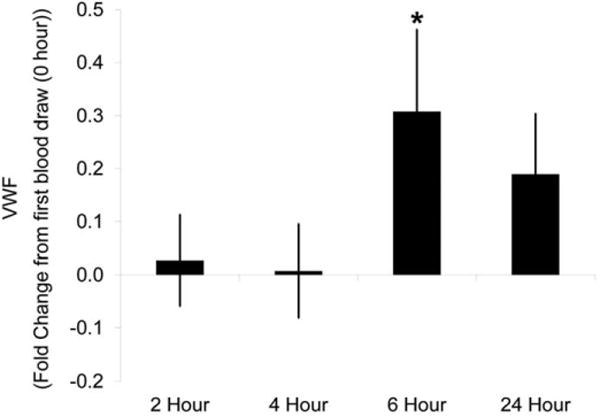
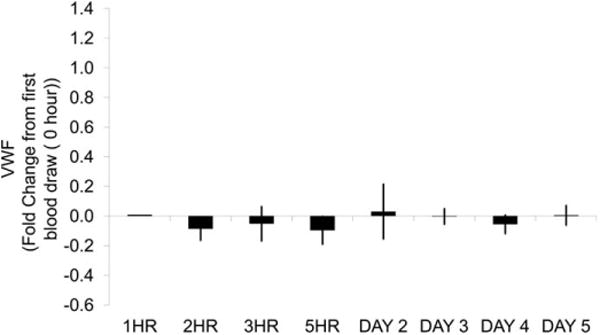
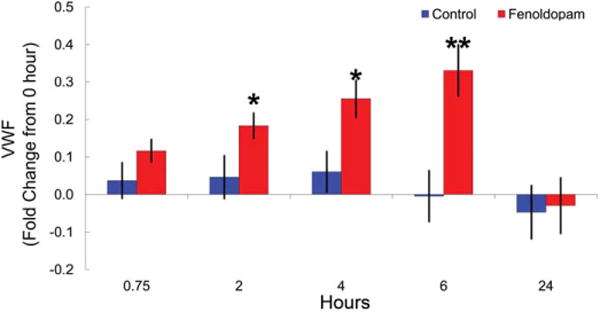
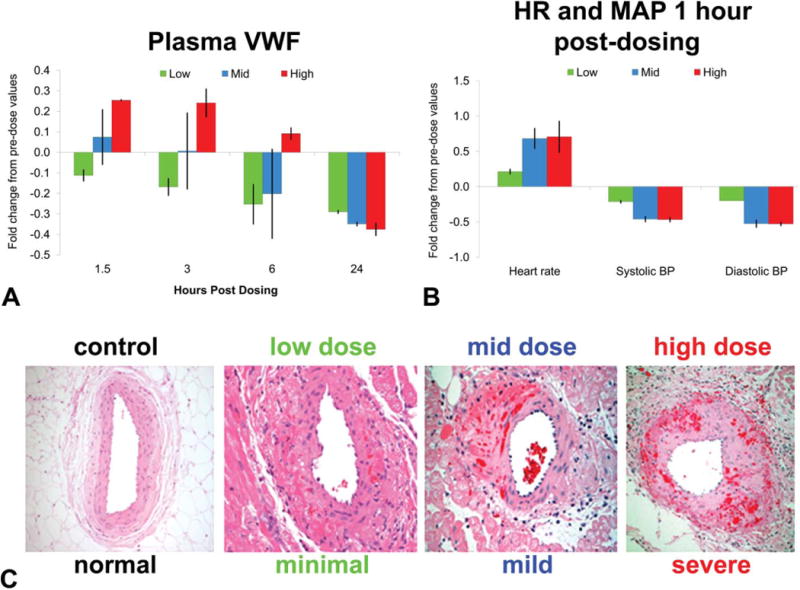
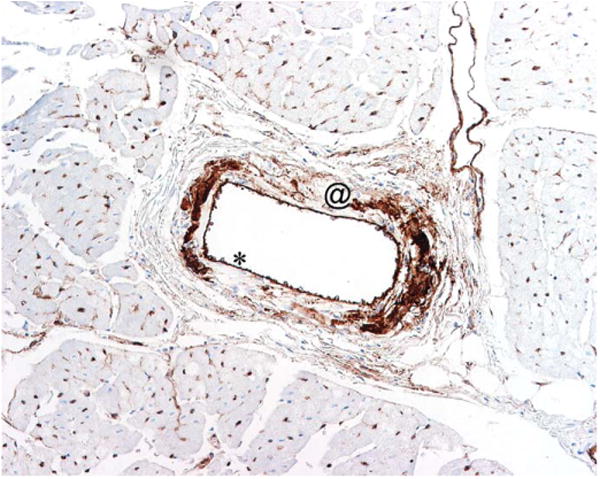
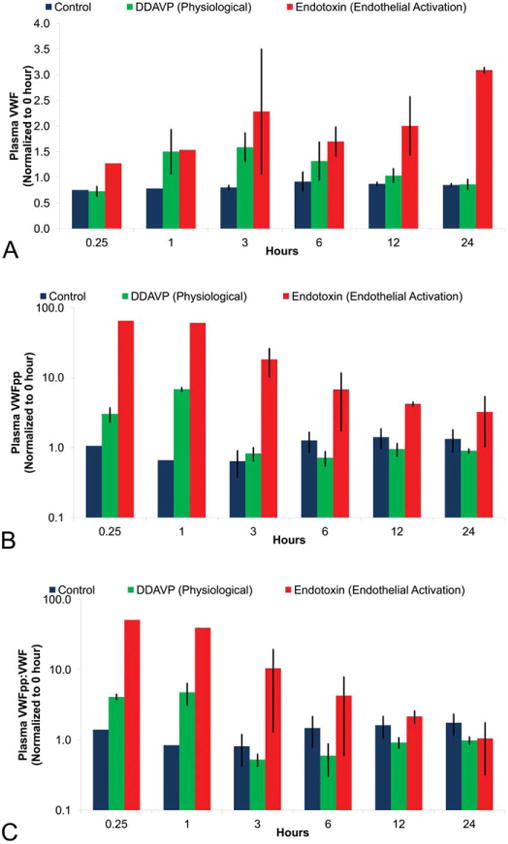
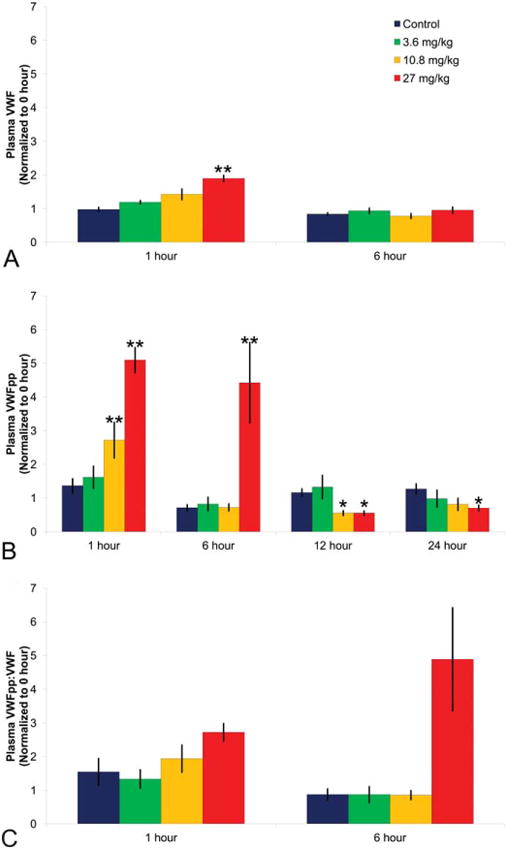
Pharmacologically, vasoactive agents targeting endothelial and/or smooth muscle cells (SMC) are known to cause acute drug-induced vascular injury (DIVI) and the resulting pathology is due to endothelial cell (EC) perturbation, activation, and/or injury. Alteration in EC structure and/or function may be a critical event in vascular injury and, therefore, evaluation of the circulatory kinetic profile and secretory pattern of EC-specific proteins such as VWF and VWFpp could serve as acute vascular injury biomarkers. In rat and dog models of DIVI, this profile was determined using pharmacologically diverse agents associated with functional stimulation/perturbation (DDAVP), pathological activation (lipopolysaccharide [LPS]/endotoxin), and structural damage (fenoldopam [FD], dopamine [DA], and potassium channel opener (PCO) ZD6169). In rats, FD caused moderate DIVI and time-related increase in plasma VWF levels ∼33% while in control rats VWF increased ∼5%. In dogs, VWF levels transiently increased ∼30% when there was morphologic evidence of DIVI by DA or ZD6169. However, in dogs, VWFpp increased >60-fold (LPS) and >6-fold (DDAVP), respectively. This was in comparison to smaller dynamic 1.38-fold (LPS) and 0.54-fold (DDAVP) increases seen in plasma VWF. Furthermore, DA was associated with a dose-dependent increase in plasma VWFpp. In summary, VWF and VWFpp can discriminate between physiological and pathological perturbation, activation, and injury to ECs.
Keywords: DDAVP.; DIVI; LPS; VWF; VWFpp; activation; biomarker; dog; endothelial cell; perturbation; rat.
© 2014 by The Author(s).
Conflict of interest statement
The author(s) declared no potential conflicts of interest with respect to the research, authorship, and/or publication of this article.
Figures
References
-
- Blann AD. Plasma von Willebrand factor, thrombosis, and the endothelium: The first 30 years. Thromb Haemost. 2006;95:49–55. - PubMed
-
- Borchiellini A, Fijnvandraat K, ten Cat JW, Pajkrt D, van Deventer SJ, Pasterkamp G, Meijer-Huizinga F, Zwart-Huinink L, Voorberg J, van Mourik JA. Quantitative analysis of von Willebrand factor propeptide release in vivo: Effect of experimental endotoxemia and administration of 1-deamino-8-D-arginine vasopressin in humans. Blood. 1996;88:2951–8. - PubMed
-
- Brott D, Gould S, Jones H, Schofield J, Prior H, Valentin JP, Bjurstrom S, Kenne K, Schuppe-Koistinen I, Katein A, Foster-Brown L, Betton G, Richardson R, Evans G, Louden C. Bio-markers of drug-induced vascular injury. Toxicol Appl Pharmacol. 2005;207:S441–S5. - PubMed
-
- Brott DA, Richardson RJ, Louden CS. Evidence for the nitric oxide pathway as a potential mode of action in fenoldopam-induced vascular injury. Toxicol Pathol. 2012;40:874–86. - PubMed
-
- Castro-Nŭnez L, Dienava-Verdoold I, Herczenik E, Mertens K, Meijer AB. Shear stress is required for the endocytic uptake of the factor VIII-von Willebrand factor complex by macrophages. J Thromb Haemost. 2012;10:1929–37. - PubMed
Publication types
MeSH terms
Substances
Grants and funding
LinkOut - more resources
Full Text Sources
Other Literature Sources
Miscellaneous
