. 2014 Jul 1;23(13):3456-66.
doi: 10.1093/hmg/ddu054. Epub 2014 Feb 5.

METTL23, a transcriptional partner of GABPA, is essential for human cognition

Affiliations

METTL23, a transcriptional partner of GABPA, is essential for human cognition

Rachel E Reiff et al. Hum Mol Genet. .

Abstract

Whereas many genes associated with intellectual disability (ID) encode synaptic proteins, transcriptional defects leading to ID are less well understood. We studied a large, consanguineous pedigree of Arab origin with seven members affected with ID and mild dysmorphic features. Homozygosity mapping and linkage analysis identified a candidate region on chromosome 17 with a maximum multipoint logarithm of odds score of 6.01. Targeted high-throughput sequencing of the exons in the candidate region identified a homozygous 4-bp deletion (c.169_172delCACT) in the METTL23 (methyltransferase like 23) gene, which is predicted to result in a frameshift and premature truncation (p.His57Valfs*11). Overexpressed METTL23 protein localized to both nucleus and cytoplasm, and physically interacted with GABPA (GA-binding protein transcription factor, alpha subunit). GABP, of which GABPA is a component, is known to regulate the expression of genes such as THPO (thrombopoietin) and ATP5B (ATP synthase, H+ transporting, mitochondrial F1 complex, beta polypeptide) and is implicated in a wide variety of important cellular functions. Overexpression of METTL23 resulted in increased transcriptional activity at the THPO promoter, whereas knockdown of METTL23 with siRNA resulted in decreased expression of ATP5B, thus revealing the importance of METTL23 as a regulator of GABPA function. The METTL23 mutation highlights a new transcriptional pathway underlying human intellectual function.


Figures

Figure 1.
Figure 1.
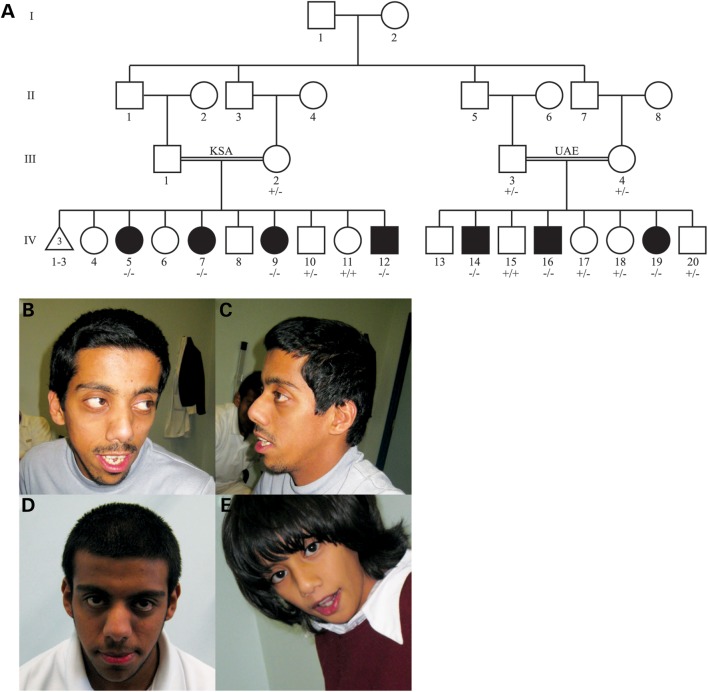
Family pedigree and overview of dysmorphic features. (A) Pedigree of the KSA (left) and UAE (right) branches of the studied family. Filled symbols denote affected individuals. Genotypes for all individuals sequenced for the identified METTL23 variant are indicated (+, wild-type allele; –, mutant allele). (BE) Facial features of the affected individuals. Individuals IV-14 (B and C), IV-16 (D) and IV-19 (E) show a flat occiput, large eyes, a depressed nasal bridge, a short upturned nose, a long philtrum and thin lips.
Figure 2.
Figure 2.
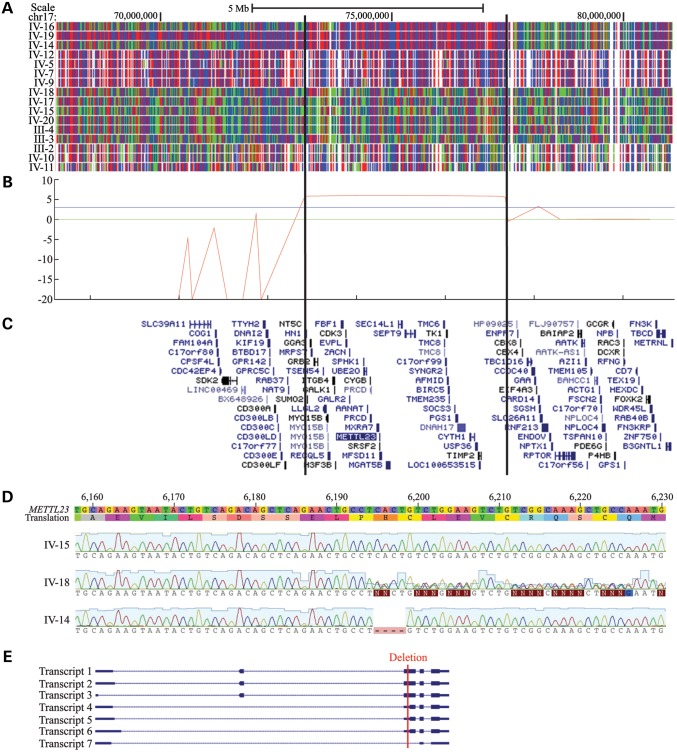
Mapping and sequencing of the causative mutation. (A) SNP genotyping results on chromosome 17. A block of homozygosity shared only by the affected individuals is evident and delineated by the vertical lines. Red and blue represent homozygous SNP markers and green represents heterozygous SNP markers. Individual ID numbers correspond to those in Figure 1. (B) logarithm of odds (LOD) score graph of the candidate region. A maximum multipoint LOD score of 6.01 was obtained. The blue horizontal line indicates a statistically significant LOD score of 3. (C) Genes within the candidate region, shown as the RefSeq track of the UCSC Genome Browser (GRCh build 37/hg19). Not all genes in the candidate region are shown. (D) Representative METTL23 chromatograms from wild-type, heterozygous, and homozygous affected individuals. IV-15 is a wild-type unaffected sibling, IV-18 is a heterozygous unaffected sibling and IV-14 is affected and homozygous for the deletion. A deletion of 4 bp corresponding to bases 74 729 144 through 74 729 147 on chromosome 17 (hg19) was identified in the affected individuals. (E) All seven known transcriptional variants of human METTL23 are shown, with the causative deletion indicated by a red line (Transcript 1 = NM_001080510.3, Transcript 2 = NM_001206983.1, Transcript 3 = NM_001206984.1, Transcript 4 = NM_001206985.1, Transcript 5 = NM_001206986.1, Transcript 6 = NM_001206987.1, Transcript 7 = NR_038193.1). Transcripts 1, 2 and 3 encode isoform 1, and transcripts 4, 5 and 6 encode isoform 2. According to the UCSC genome browser conventions, horizontal lines represent introns, thin blocks represent non-coding exons and thick blocks represent coding exons.
Figure 3.
Figure 3.
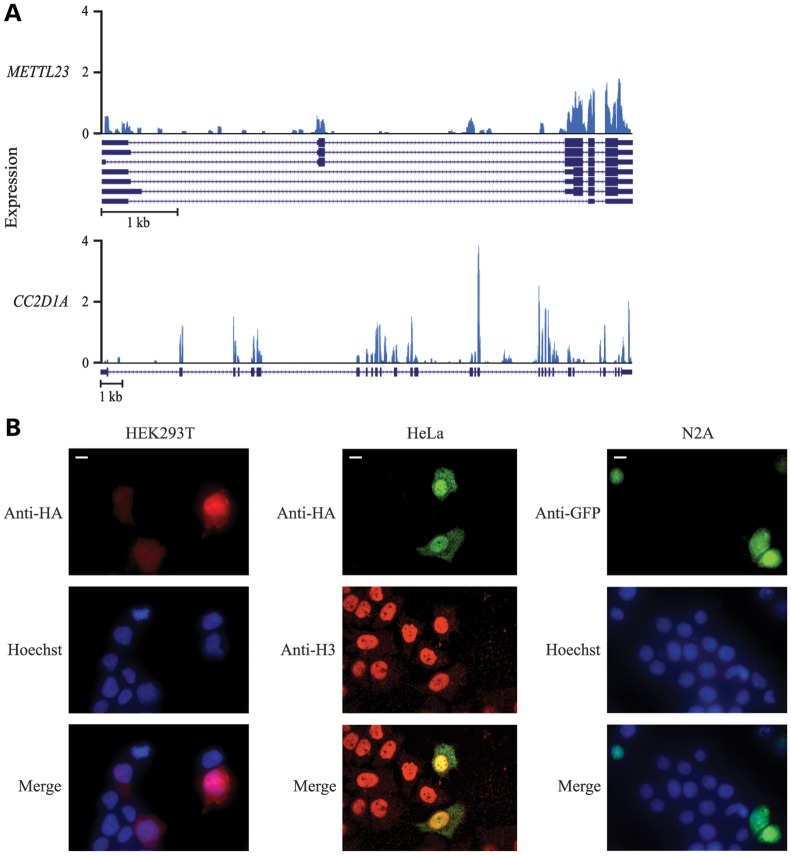
Expression of METTL23 in the developing human brain and subcellular localization. (A) Expression of METTL23 (top) and a comparable ID gene CC2D1A (bottom) in a Carnegie stage 18 developing human brain. Reference sequences of known variants are shown below each expression plot (METTL23 transcripts = NM_001080510.3, NM_001206983.1, NM_001206984.1, NM_001206985.1, NM_001206986.1, NM_001206987.1, NR_038193.1; CC2D1A = NM_017721.4). Low signals of initial exons are an artifact of reverse transcription from the 3′ end of mRNA. (B) Immunofluorescence of HEK293T cells (left), HeLa cells (middle) and N2A cells (right) expressing HA-tagged (HEK293T and HeLa) or GFP-tagged (N2A) METTL23 protein. HEK293T cells were stained for HA (red) and the nuclear marker Hoechst (blue), HeLa cells were stained for HA (green) and the nuclear marker histone H3 (red) and N2A cells were stained for GFP (green) and Hoechst (blue). METTL23 localized throughout the nucleus and cytoplasm and showed clear nuclear enrichment. Scale bar = 10 μm.
Figure 4.
Figure 4.
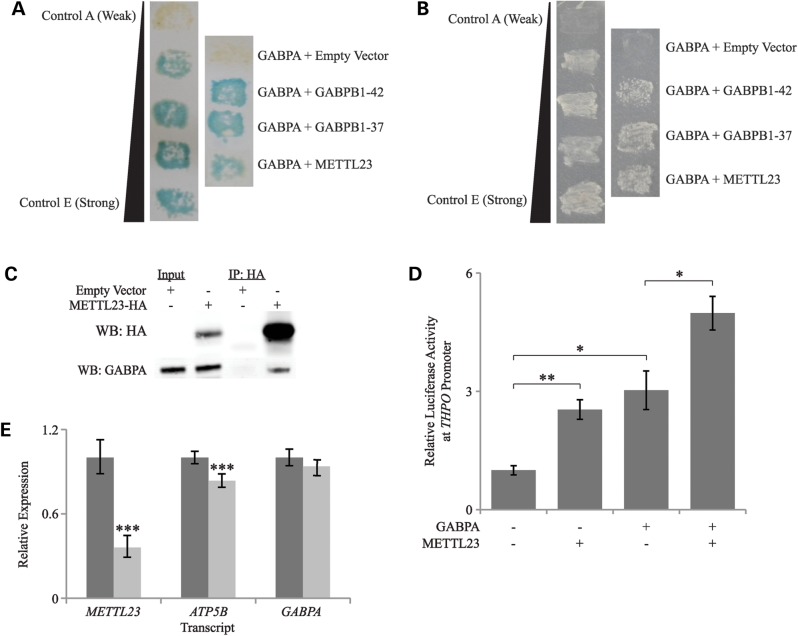
Interaction of METTL23 with GABPA and functional effects on THPO and ATP5B expression. (A) Yeast two-hybrid LacZ/β-galactosidase assay, showing positive interactions of GABPA with two GABPB isoforms (GABPB1–42 and GABPB1–37) and with METTL23. Colony growth with blue color represents a positive interaction. Control interactions in the left panel, as provided by Invitrogen in the ProQuest Two-Hybrid Gateway Kit, are A (empty vectors, no interaction), B (human RB/E2F1, weak interaction), C (Drosophila DP/E2F, moderately strong interaction), D (rat c-Fos/mouse c-Jun, strong interaction) and E (GAL4/none, very strong interaction). (B) Yeast two-hybrid HIS3 assay, showing a positive interaction between GABPA and METTL23. Colony growth represents a positive interaction. Controls are the same as in part A. (C) Co-immunoprecipitation of GABPA with HA-tagged METTL23 in N2A cells, suggesting a physical interaction between the two proteins. (D) Transcriptional activity at the THPO promoter was significantly increased in the presence of overexpressed METTL23, and the positive effects of overexpressed GABPA and METTL23 were additive. Values are represented as mean ± SEM. N = 3; *P < 0.05, **P < 0.01 (Student's two-tailed t-test). (E) Real-time qRT-PCR showed a significant decrease in ATP5B mRNA expression with METTL23 knockdown in HEK293T cells. GABPA mRNA expression levels were not affected. Darkly shaded bars represent negative control siRNA and lightly shaded bars represent METTL23 siRNA. Values are represented as the mean ± pooled standard deviation. N = 4–5 for each data point; ***P < 0.001 (Student's two-tailed t-test).

References

    1. Maulik P.K., Mascarenhas M.N., Mathers C.D., Dua T., Saxena S. Prevalence of intellectual disability: a meta-analysis of population-based studies. Res. Dev. Disabil. 2011;32:419–436. - PubMed
    1. Roeleveld N., Zielhuis G.A., Gabreels F. The prevalence of mental retardation: a critical review of recent literature. Dev. Med. Child Neurol. 1997;39:125–132. - PubMed
    1. Kaufman L., Ayub M., Vincent J.B. The genetic basis of non-syndromic intellectual disability: a review. J. Neurodev. Disord. 2010;2:182–209. - PMC - PubMed
    1. Ropers H.H. Genetics of early onset cognitive impairment. Annu. Rev. Genomics Hum. Genet. 2010;11:161–187. - PubMed
    1. Ropers H.H. X-linked mental retardation: many genes for a complex disorder. Curr. Opin. Genet. Dev. 2006;16:260–269. - PubMed

Publication types

MeSH terms

Substances