


Can soluble CD163 predict outcome of patients with acute respiratory distress from mechanical ventilation?: A pilot study
- PMID: 24501487
- PMCID: PMC3902570
- DOI: 10.4103/0972-5229.123445
Can soluble CD163 predict outcome of patients with acute respiratory distress from mechanical ventilation?: A pilot study
Abstract
Purpose: CD163 is a monocyte/macrophage-associated antigen which has recently been identified as a hemoglobin scavenger receptor and has also anti-inflammatory properties and an immunoregulatory role. This surface receptor undergoes ectodomain shedding upon an inflammatory stimulus, leading to increased fraction of soluble CD163 (sCD163). Hence, we hypothesized that the mechanical ventilation (MV) which is known to elicit inflammatory response may cause increased serum levels of sCD163 which can predict the outcome of patients from MV.
Subjects and methods: Thirty patients with acute respiratory distress aged >18 years who required MV were enrolled for the study. Serum levels of sCD163 were estimated using quantitative immunometric sandwich enzyme immunoassay technique from 3 mL of the venous blood sample which was collected immediately and at 24 h after the patient was connected to MV. On the basis of the outcome of the patient from MV, they were divided into two groups; survivors and nonsurvivors.
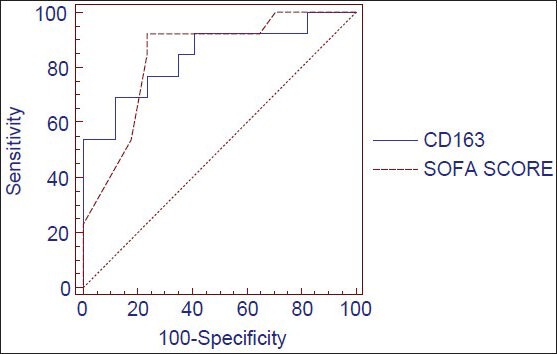
Results: Out of the 30 patients, 18 patients survived and 12 patients expired. Serum levels of sCD163 were significantly increased in nonsurvivors when compared with survivors (P < 0.01) at 24 h after connecting to MV. sCD163 > 1020 ng/mL at 24 h of MV increases the probability of mortality by factor 6. An increase of sCD163 by 1 ng/mL significantly increases the relative probability of mortality by a factor of 1.0017 (95% confidence interval, 1.0004-1.0030, P = 0.0005).
Conclusions: Elevated levels of sCD163 at 24 h of MV help in predicting the outcome of patients with acute respiratory failure from MV.
Keywords: Acute respiratory distress; mechanical ventilation; soluble CD163.
Conflict of interest statement
Figures
References
-
- Póvoa P, Almeida E, Moreira P, Fernandes A, Mealha R, Aragão A, et al. C-reactive protein as an indicator of sepsis. Intensive Care Med. 1998;24:1052–6. - PubMed
-
- Högger P, Dreier J, Droste A, Buck F, Sorg C. Identification of the integral membrane protein RM3/1 on human monocytes as a glucocorticoid-inducible member of the scavenger receptor cysteine-rich family (CD163) J Immunol. 1998;161:1883–90. - PubMed
-
- Kristiansen M, Graversen JH, Jacobsen C, Sonne O, Hoffman HJ, Law SK, et al. Identification of the haemoglobin scavenger receptor. Nature. 2001;409:198–201. - PubMed
-
- Zuwa³a-Jagie³³o J. Haemoglobin scavenger receptor: Function in relation to disease. Acta Biochim Pol. 2006;53:257–68. - PubMed
LinkOut - more resources
Full Text Sources
Other Literature Sources
Research Materials