


A multi-station proprioceptive exercise program in patients with bilateral knee osteoarthrosis: functional capacity, pain and sensoriomotor function. A randomized controlled trial
- PMID: 24501572
- PMCID: PMC3899676
A multi-station proprioceptive exercise program in patients with bilateral knee osteoarthrosis: functional capacity, pain and sensoriomotor function. A randomized controlled trial
Abstract
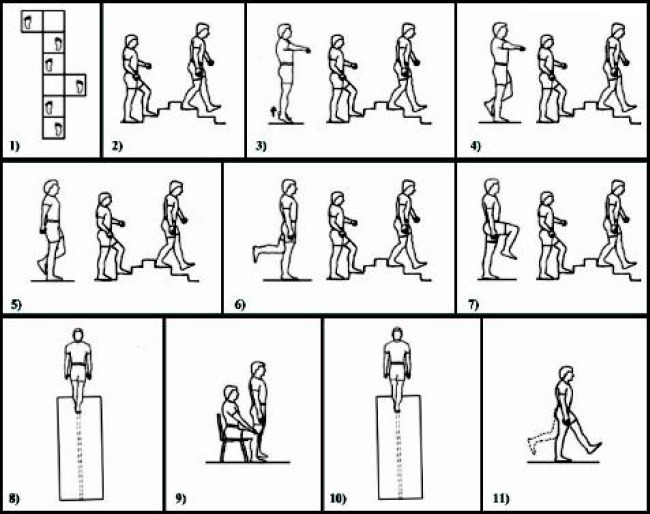
We investigated the effects of a multi-station proprioceptive exercise program on functional capacity, perceived knee pain, and sensoriomotor function. Twenty-two patients (aged 41-75 years) with grade 2-3 bilateral knee osteoarthrosis were randomly assigned to two groups: treatment (TR; n = 12) and non-treatment (NONTR; n = 10). TR performed 11 different balance/coordination and proprioception exercises, twice a week for 6 weeks. Functional capacity and perceived knee pain during rest and physical activity was measured. Also knee position sense, kinaesthesia, postural control, isometric and isokinetic knee strength (at 60, 120 and 180°·s(-1)) measures were taken at baseline and after 6 weeks of training. There was no significant difference in any of the tested variables between TR and NONTR before the intervention period. In TR perceived knee pain during daily activities and functional tests was lessened following the exercise program (p < 0.05). Perceived knee pain was also lower in TR vs. NONTR after training (p < 0.05). The time for rising from a chair, stair climbing and descending improved in TR (p < 0.05) and these values were faster compared with NONTR after training (p < 0.05). Joint position sense (degrees) for active and passive tests and for weight bearing tests improved in TR (p < 0.05) and the values were lower compared with NONTR after training (p < 0.05). Postural control ('eyes closed') also improved for single leg and tandem tests in TR (p < 0.01) and these values were higher compared with NONTR after training. The isometric quadriceps strength of TR improved (p < 0.05) but the values were not significantly different compared with NONTR after training. There was no change in isokinetic strength for TR and NONTR after the training period. The results suggest that using a multi-station proprioceptive exercise program it is possible to improve postural control, functional capacity and decrease perceived knee pain in patients with bilateral knee osteoarthrosis. Key PointsIt is possible to improve postural control, functional capacity and decrease perceived knee pain in patients with bilateral knee osteoarthrosis with a pure proprioceptive/ balance exercise program used in the present study.The exercise regime used in the present study was as effective as previous studies, but of much shorter duration and utilized unsophisticated, inexpensive equipment which is available in most physiotherapy departments.Therefore, the incorporation of this exercise program into clinical practice is readily feasible.
Keywords: Osteoarthrosis; balance; function; perceived knee pain; proprioception.
References
-
- Altman R., Asch E., Bloch D. (1986) The American College Rheumatology criteria for the classification and reporting of osteoarthritis of the knee. Arthritis and Rheumatism 29, 1039-1049 - PubMed
-
- Barret D.S., Cobb A.G., Bentley G. (1991) Joint proprioception in normal, osteoarthritic and replaced knees. The Journal of Bone and Joint Surgery (British Volume) 73B, 53-56 - PubMed
-
- Beals C.A., Lampman R.M., Banwell B.F., Braunstein E.M., Albers J.W., Castor C.W. (1985) Measurement of exercise tolerance in patients with rheumatoid arthritis and osteoarthritis. The Journal of Rheumatology, 12, 458-461 - PubMed
-
- Bijlsma J.W.J, Dekker J. (2005) A step forward for exercise in the management of osteoarthritis. Rheumatology 44, 5-6 - PubMed
LinkOut - more resources
Full Text Sources