


Virulence difference between the prototypic Schu S4 strain (A1a) and Francisella tularensis A1a, A1b, A2 and type B strains in a murine model of infection
- PMID: 24502661
- PMCID: PMC3923427
- DOI: 10.1186/1471-2334-14-67
Virulence difference between the prototypic Schu S4 strain (A1a) and Francisella tularensis A1a, A1b, A2 and type B strains in a murine model of infection
Abstract
Background: The use of prototypic strains is common among laboratories studying infectious agents as it promotes consistency for data comparability among and between laboratories. Schu S4 is the prototypic virulent strain of Francisella tularensis and has been used extensively as such over the past six decades. Studies have demonstrated virulence differences among the two clinically relevant subspecies of F. tularensis, tularensis (type A) and holarctica (type B) and more recently between type A subpopulations (A1a, A1b and A2). Schu S4 belongs to the most virulent subspecies of F. tularensis, subspecies tularensis.
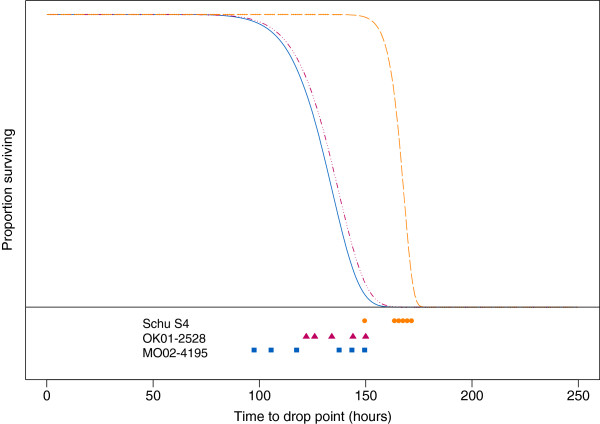
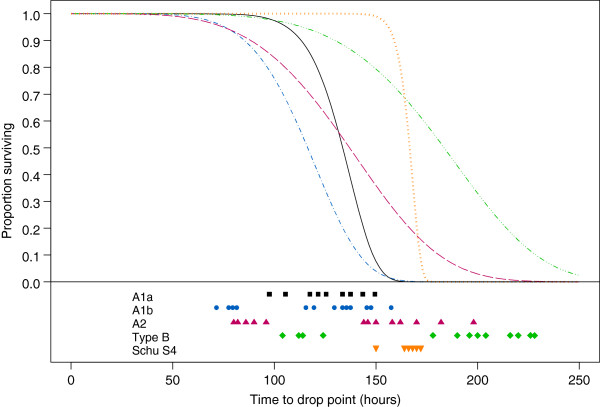
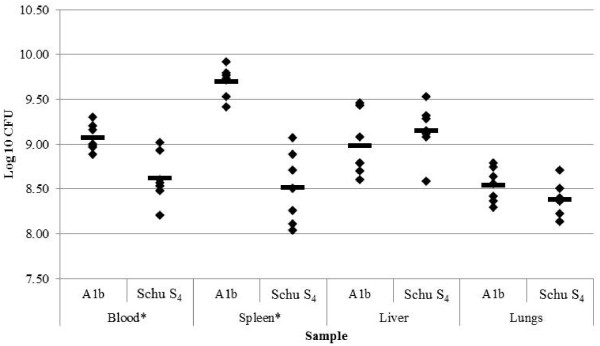
Methods: In this study, we investigated the relative virulence of Schu S4 in comparison to A1a, A1b, A2 and type B strains using a temperature-based murine model of infection. Mice were inoculated intradermally and a hypothermic drop point was used as a surrogate for death. Survival curves and the length of temperature phases were compared for all infections. Bacterial burdens were also compared between the most virulent type A subpopulation, A1b, and Schu S4 at drop point.
Results: Survival curve comparisons demonstrate that the Schu S4 strain used in this study resembles the virulence of type B strains, and is significantly less virulent than all other type A (A1a, A1b and A2) strains tested. Additionally, when bacterial burdens were compared between mice infected with Schu S4 or MA00-2987 (A1b) significantly higher burdens were present in the blood and spleen of mice infected with MA00-2987.
Conclusions: The knowledge gained from using Schu S4 as a prototypic virulent strain has unquestionably advanced the field of tularemia research. The findings of this study, however, indicate that careful consideration of F. tularensis strain selection must occur when the overall virulence of the strain used could impact the outcome and interpretation of results.
Figures
References
-
- Downs CM, Woodward JM. Studies on pathogenesis and immunity in tularemia III. Immunogenic properties for the white mouse of various strains of Bacterium tularense. J Immunol. 1949;14:147–163. - PubMed
-
- Olsufiev NG, Emelyanova OS, Dunayeva TN. Comparative study of strains of B. tularense in the old and new world and their taxonomy. J Hyg Epidemiol Microbiol Immunol. 1959;14:138–149. - PubMed
-
- Olsufyev NG, Emelyanova OS. Further studies of strains of tularemic bacteria of the old and new world. J Hyg Epidemiol Microbiol Immunol. 1962;14:193–205. - PubMed
Publication types
MeSH terms
Grants and funding
LinkOut - more resources
Full Text Sources
Other Literature Sources
Research Materials
Miscellaneous
