


A multidimensional home-based care coordination intervention for elders with memory disorders: the maximizing independence at home (MIND) pilot randomized trial
- PMID: 24502822
- PMCID: PMC4034346
- DOI: 10.1016/j.jagp.2013.12.175
A multidimensional home-based care coordination intervention for elders with memory disorders: the maximizing independence at home (MIND) pilot randomized trial
Abstract
Objectives: To assess whether a dementia care coordination intervention delays time to transition from home and reduces unmet needs in elders with memory disorders.
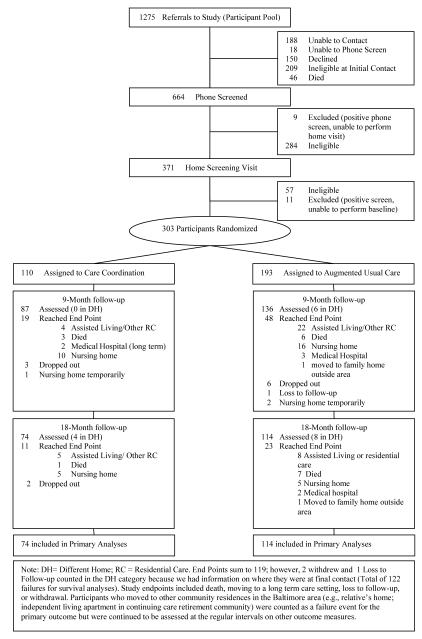
Design: 18-month randomized controlled trial of 303 community-living elders.
Setting: 28 postal code areas of Baltimore, MD.
Participants: Age 70+ years, with a cognitive disorder, community-living, English-speaking, and having a study partner available.
Intervention: 18-month care coordination intervention to systematically identify and address dementia-related care needs through individualized care planning; referral and linkage to services; provision of dementia education and skill-building strategies; and care monitoring by an interdisciplinary team.
Measurements: Primary outcomes were time to transfer from home and total percent of unmet care needs at 18 months.
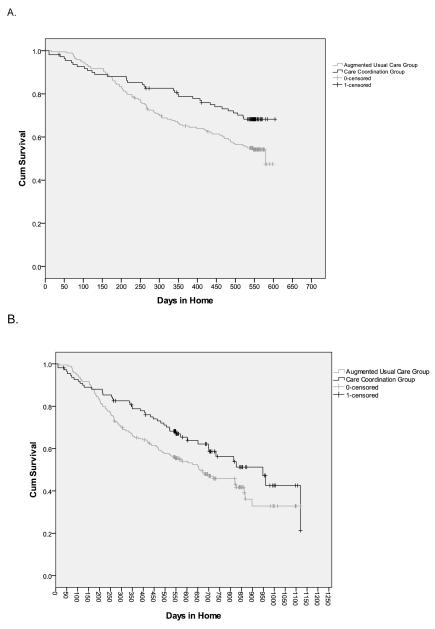
Results: Intervention participants had a significant delay in time to all-cause transition from home and the adjusted hazard of leaving the home was decreased by 37% (Hazard ratio: 0.63, 95% Confidence Interval: 0.42-0.94) compared with control participants. Although there was no significant group difference in reduction of total percent of unmet needs from baseline to 18 months, the intervention group had significant reductions in the proportion of unmet needs in safety and legal/advance care domains relative to controls. Intervention participants had a significant improvement in self-reported quality of life (QOL) relative to control participants. No group differences were found in proxy-rated QOL, neuropsychiatric symptoms, or depression.
Conclusions: A home-based dementia care coordination intervention delivered by non-clinical community workers trained and overseen by geriatric clinicians led to delays in transition from home, reduced unmet needs, and improved self-reported QOL.
Keywords: Dementia; care coordination; care management; community; intervention; memory disorders.
Copyright © 2014 American Association for Geriatric Psychiatry. Published by Elsevier Inc. All rights reserved.
Figures
References
-
- Alzheimer’s Association 2012 Alzheimer’s Disease Facts and Figures. Alzheimer’s & Dementia. 2012;8(2):131–168. - PubMed
-
- Black B, Rabins P, German P. Predictors of nursing home placement among elderly public housing residents. The Gerontologist. 1999;39(5):559–568. - PubMed
-
- Miller EA, Weissert WG. Predicting Elderly People’s Risk for Nursing Home Placement, Hospitalization, Functional Impairment, and Mortality: A Synthesis. Med Care Res Rev. 2000;57(3):259–297. - PubMed
-
- Hebert R, Dubois M-F, Wolfson C, Chambers L, Cohen C. Factors Associated With Long-term Institutionalization of Older People With Dementia: Data From the Canadian Study of Health and Aging. J Gerontol A Biol Sci Med Sci. 2001;56(11):M693–699. - PubMed
-
- Zhu CW, Scarmeas N, Torgan R, et al. Longitudinal study of effects of patient characteristics on direct costs in Alzheimer disease. Neurology. 2006;67(6):998–1005. - PubMed
Publication types
MeSH terms
Grants and funding
LinkOut - more resources
Full Text Sources
Other Literature Sources
Medical
