Review
. 2014 Mar;28(3):185-93.
doi: 10.1007/s40263-014-0144-8.

Neuroprotective properties of citicoline: facts, doubts and unresolved issues

Affiliations
Review

Neuroprotective properties of citicoline: facts, doubts and unresolved issues

Pawel Grieb. CNS Drugs. 2014 Mar.

Abstract

Citicoline is the generic name of the pharmaceutical substance that chemically is cytidine-5'-diphosphocholine (CDP-choline), which is identical to the natural intracellular precursor of phospholipid phosphatidylcholine. Following injection or ingestion, citicoline is believed to undergo quick hydrolysis and dephosphorylation to yield cytidine and choline, which then enter the brain separately and are used to resynthesize CDP-choline inside brain cells. Neuroprotective activity of citicoline has been repeatedly shown in preclinical models of brain ischaemia and trauma, but two recent, large, pivotal clinical trials have revealed no benefits in ischaemic stroke and traumatic brain injury. However, the substance seems to be beneficial in some slowly advancing neurodegenerative disorders such as glaucoma and mild vascular cognitive impairment. This paper critically discusses issues related to the clinical pharmacology of citicoline, including its pharmacokinetics/biotransformation and pharmacodynamics/mode of action. It is concluded that at present, there is no adequate description of the mechanism(s) of the pharmacological actions of this substance. The possibility should be considered and tested that, in spite of apparently fast catabolism, the intact citicoline molecule or the phosphorylated intermediate products of its hydrolysis, cytidine monophosphate and phosphocholine, are pharmacologically active.


Figures
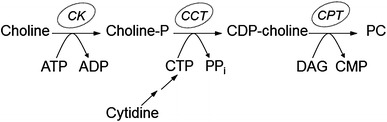
Fig. 1
Fig. 1
The cytidine-5′-diphosphocholine (CDP-choline) pathway of enzymatic synthesis of phosphatidylcholine. ADP adenosine diphosphate, ATP adenosine triphosphate, CCT choline phosphate cytidilyltransferase, CK cytidine kinase, CMP cytidine monophosphate, CPT CDP-choline:1,2-diacylglycerol choline phosphotransferase, CTP cytidine triphosphate, DAG 1,2-dicacylglycerol, PC phosphatidylcholine, PP i pyrophosphate
Fig. 2
Fig. 2
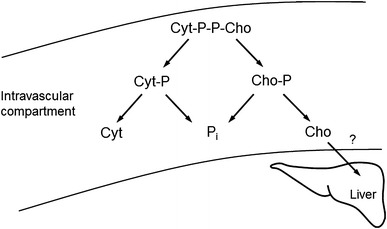
Presumed catabolism of citicoline (Cyt-P-P-Cho) in the rodent intravascular compartment. In the first step, hydrolysis of the pyrophosphate bridge takes place. In the second step, cytidine monophosphate (Cyt-P) and phosphocholine (Cho-P) are dephosphorylated to cytidine (Cyt) and choline (Cho), respectively; supposedly, a large part of the liberated choline is taken up by the liver (which may explain the unexpectedly low cholinergic toxicity of citicoline)

References

    1. Weiss SB, Smith SW, Kennedy EP. The enzymatic formation of lecithin from cytidine diphosphate choline and d-1,2-diglyceride. J Biol Chem. 1958;231:53–64. - PubMed
    1. Gibellini F, Smith TK. The Kennedy pathway—de novo synthesis of phosphatidylethanolamine and phosphatidylcholine. IUBMB Life. 2010;62:414–428. doi: 10.1002/iub.354. - DOI - PubMed
    1. Hunt AN, Clark GT, Attard GS, Postle AD. Highly saturated endonuclear phosphatidylcholine is synthesized in situ and colocated with CDP-choline pathway enzymes. J Biol Chem. 2001;276:8492–8499. doi: 10.1074/jbc.M009878200. - DOI - PubMed
    1. Kent C, Carman GM. Interactions among pathways for phosphatidylcholine metabolism, CTP synthesis and secretion through the Golgi apparatus. Trends Biochem Sci. 1999;24:146–150. doi: 10.1016/S0968-0004(99)01365-1. - DOI - PubMed
    1. Berger L, Gimenez WT. Crystallization of cytidine diphosphate choline from yeast. Science. 1956;124:81. - PubMed

MeSH terms

Substances