


Stigma, status, and population health
- PMID: 24507907
- PMCID: PMC4091623
- DOI: 10.1016/j.socscimed.2013.10.004
Stigma, status, and population health
Abstract
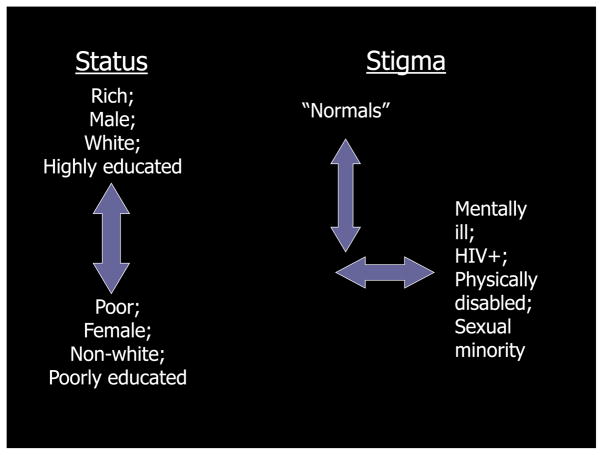
Stigma and status are the major concepts in two important sociological traditions that describe related processes but that have developed in isolation. Although both approaches have great promise for understanding and improving population health, this promise has not been realized. In this paper, we consider the applicability of status characteristics theory (SCT) to the problem of stigma with the goal of better understanding social systemic aspects of stigma and their health consequences. To this end, we identify common and divergent features of status and stigma processes. In both, labels that are differentially valued produce unequal outcomes in resources via culturally shared expectations associated with the labels; macro-level inequalities are enacted in micro-level interactions, which in turn reinforce macro-level inequalities; and status is a key variable. Status and stigma processes also differ: Higher- and lower-status states (e.g., male and female) are both considered normal, whereas stigmatized characteristics (e.g., mental illness) are not; interactions between status groups are guided by "social ordering schemas" that provide mutually agreed-upon hierarchies and interaction patterns (e.g., men assert themselves while women defer), whereas interactions between "normals" and stigmatized individuals are not so guided and consequently involve uncertainty and strain; and social rejection is key to stigma but not status processes. Our juxtaposition of status and stigma processes reveals close parallels between stigmatization and status processes that contribute to systematic stratification by major social groupings, such as race, gender, and SES. These parallels make salient that stigma is not only an interpersonal or intrapersonal process but also a macro-level process and raise the possibility of considering stigma as a dimension of social stratification. As such, stigma's impact on health should be scrutinized with the same intensity as that of other more status-based bases of stratification such as SES, race and gender, whose health impacts have been firmly established.
Keywords: Health implications; Status characteristics theory; Stigma.
Copyright © 2013 Elsevier Ltd. All rights reserved.
Figures
References
-
- Allport G. The nature of prejudice. Reading, MA: Addison Wesley; 1954.
-
- Balsa AI, McGuire TG. Statistical discrimination in health care. Journal of Health Economics. 2001;20:881–907. - PubMed
-
- Berger J, Fisek MH, Norman RZ, Zelditch M., Jr . Status characteristics and social interaction: An expectation states approach. New York: Elsevier; 1977.
-
- Berger J, Rosenholtz SJ, Zelditch M., Jr Status organizing processes. Annual Review of Sociology. 1980;6:479–508.
-
- Berger J, Webster M. Expectations, status, and behavior. In: Burke P, editor. Contemporary social psychological theories. Stanford: Stanford University Press; 2006. pp. 268–300.
Publication types
MeSH terms
Grants and funding
LinkOut - more resources
Full Text Sources
Other Literature Sources
Medical
Research Materials
