


Predicting functional performance and range of motion outcomes after total knee arthroplasty
- PMID: 24508937
- PMCID: PMC4350663
- DOI: 10.1097/PHM.0000000000000065
Predicting functional performance and range of motion outcomes after total knee arthroplasty
Abstract
Objective: The aim of this study was to assess the predictive value of functional performance and range of motion measures on outcomes after total knee arthroplasty.
Design: This is a secondary analysis of two pooled prospective randomized controlled trials. Sixty-four subjects (32 men and 32 women) with end-stage knee osteoarthritis scheduled to undergo primary total knee arthroplasty were enrolled. Active knee flexion and extension range of motion, Timed Up and Go (TUG) test time, and 6-min walk test distance were assessed.
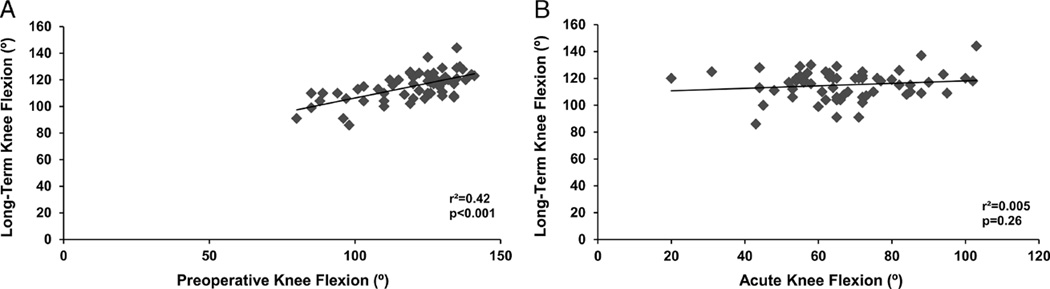
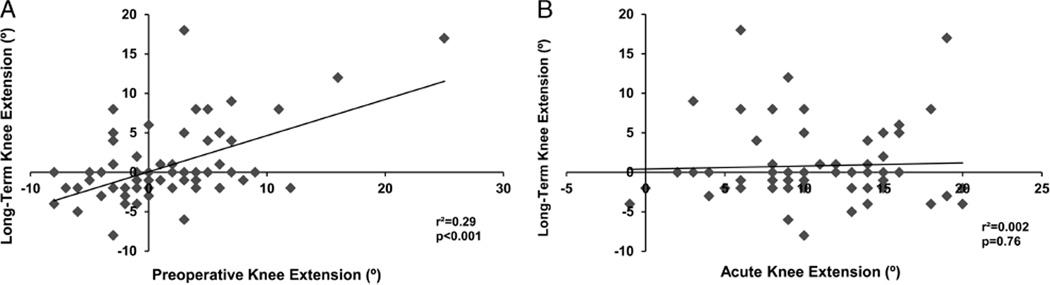
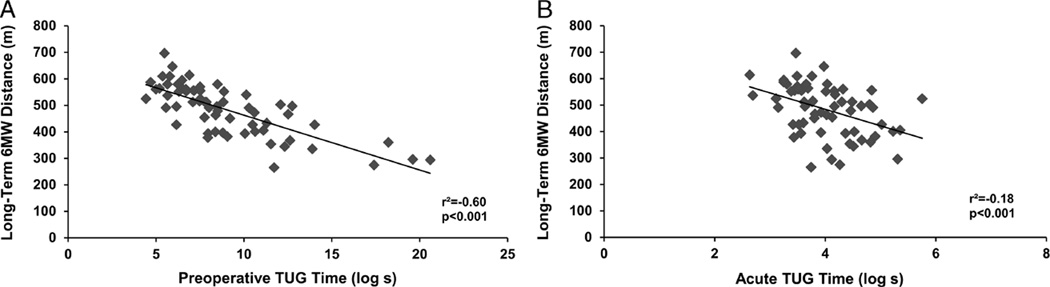
Results: Preoperative measures of knee flexion and extension were predictive of long-term flexion (β = 0.44, P < 0.001) and extension (β = 0.46, P < 0.001). Acute measures of knee flexion and extension were not predictive of long-term flexion (β = 0.09, P = 0.26) or extension (β = 0.04, P = 0.76). Preoperative TUG performance was predictive of long-term 6-min walk performance (β = -21, P < 0.001). Acute TUG performance was predictive of long-term functional performance on the 6-min walk test, after adjusting for the effects of sex and age (P = 0.02); however, once adjusted for preoperative TUG performance, acute TUG was no longer related to long-term 6-min walk performance (P = 0.65).
Conclusions: Acute postoperative measures of knee range of motion are of limited prognostic value, although preoperative measures have some prognostic value. However, acute measures of functional performance are of useful prognostic value, especially when preoperative functional performance data are unavailable.
Conflict of interest statement
Financial disclosure statements have been obtained, and no conflicts of interest have been reported by the authors or by any individuals in control of the content of this article.
Figures
Comment in
-
Publication primacy, "first and/or only the most recent!".Am J Phys Med Rehabil. 2015 Jan;94(1):e12. doi: 10.1097/PHM.0000000000000236. Am J Phys Med Rehabil. 2015. PMID: 25415399 No abstract available.
References
-
- Health Care Cost and Utilization Project: HCUP facts and figures: Statistics on hospital-based care in the United States 2008. [Accessed January 18, 2011]; Available at: http://www.hcup-us.ahrq.gov/reports/factsandfigures/2008/exhibit3_1.jsp.
-
- American Academy of Orthopaedic Surgeons: Most commonly performed musculoskeletal-related procedures. [Accessed June 27, 2009]; Available at: www.aaos.org/research/stats/top_hospitalization_visits.pdf.
-
- Kurtz S, Ong K, Lau E, et al. Projections of primary and revision hip and knee arthroplasty in the United States from 2005 to 2030. J Bone Joint Surg Am. 2007;89:780–785. - PubMed
-
- Lingard EA, Berven S, Katz JN. Management and care of patients undergoing total knee arthroplasty: Variations across different health care settings. Arthritis Care Res. 2000;13:129–136. - PubMed
-
- Fortin PR, Clarke AE, Joseph L, et al. Outcomes of total hip and knee replacement: Preoperative functional status predicts outcomes at six months after surgery. Arthritis Rheum. 1999;42:1722–1728. - PubMed
Publication types
MeSH terms
Grants and funding
LinkOut - more resources
Full Text Sources
Other Literature Sources
Medical
