


doi: 10.1038/nmeth.2840.
Epub 2014 Feb 9.
Isolation of single-base genome-edited human iPS cells without antibiotic selection
Affiliations
- PMID: 24509632
- PMCID: PMC4063274
- DOI: 10.1038/nmeth.2840
Item in Clipboard
Isolation of single-base genome-edited human iPS cells without antibiotic selection
Nat Methods.
2014 Mar.
Abstract
Precise editing of human genomes in pluripotent stem cells by homology-driven repair of targeted nuclease-induced cleavage has been hindered by the difficulty of isolating rare clones. We developed an efficient method to capture rare mutational events, enabling isolation of mutant lines with single-base substitutions without antibiotic selection. This method facilitates efficient induction or reversion of mutations associated with human disease in isogenic human induced pluripotent stem cells.
Conflict of interest statement
Figures
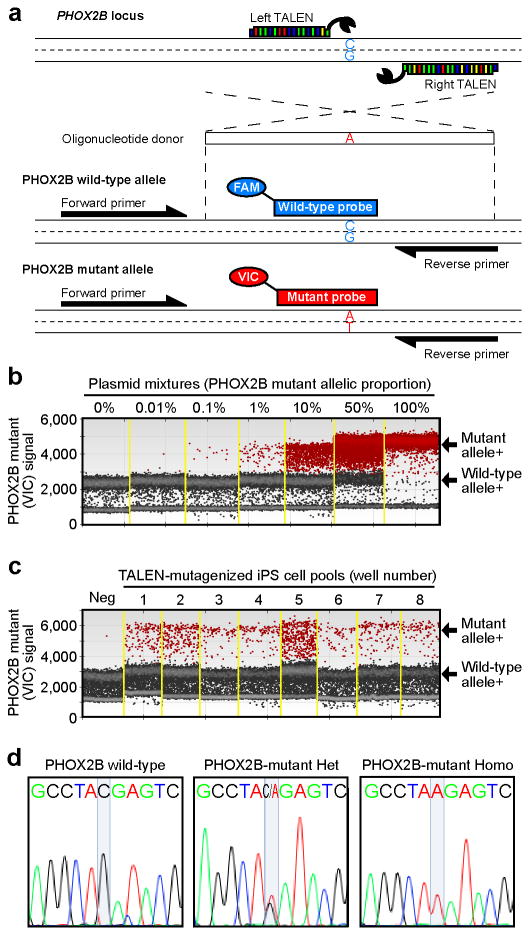
(a) Our mutagenesis and mutation detection strategy for PHOX2B is shown. We
designed a pair of TALENs that target the mutation site and a 60-nt
oligonucleotide DNA donor with the C→A substitution in the middle. The
position of a common primer pair and allele-specific probes conjugated with
different fluorophores are indicated. (b) ddPCR with plasmid mixtures. Mixtures
containing the indicated concentrations of the mutant allele in a wild-type
background were analyzed. Yellow lines indicate borders between different
samples. Red dots represent droplets containing the mutant allele. (c) ddPCR
with genomic DNA from iPS cells harboring the mutant allele induced by the
PHOX2B TALENs. The mutagenized iPS cells were plated in a 96-well plate and 8
wells were analyzed for the mutant and wild-type alleles. An unrelated TALEN
pair targeting the PRKAG2 locus was used as a negative control (Neg). (d)
Sequencing results of isolated clones after PHOX2B mutagenesis.
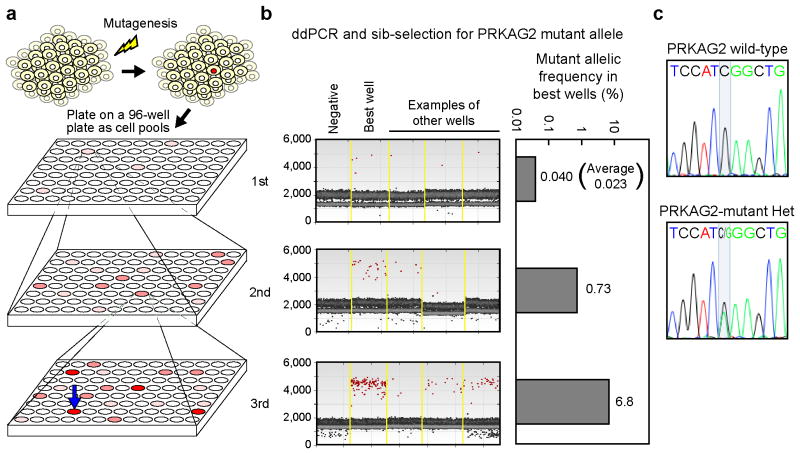
(a) Overview of the approach to isolate rare mutants. Cells transfected with a
TALEN pair and a donor oligonucleotide harboring the desired point mutation are
immediately plated into a 96-well plate. The plates are replicated so that one
96-well plate is cryopreserved, while the other is used for DNA analysis. The
mutant allelic frequency is measured from pooled cells from several wells by
ddPCR. The well with the highest mutant frequency identifies the well in the
cryopreserved plate that is used for re-plating into another 96-well plate for
sib-selection. This process can be repeated until the mutants are sufficiently
enriched for clonal isolation. iPS cell clones are isolated from the pool with
the greatest enrichment of mutated cells and genotyped. (b) Enrichment of PRKAG2
mutant cells by sib-selection. The mutant allelic frequency as measured by ddPCR
after the first, second, and third sib-selections is shown. On the left are
shown the raw droplet data for the negative controls, the best well, and three
random examples. Unrelated PHOX2B TALENs were used as negative controls for the
first sib-selection, whereas completely negative “sib” wells are
shown as the negative controls for the second and third sib-selections. The
calculated mutant allelic frequency from the best wells is shown on the right.
The average frequency after the first sib-selection is also shown. (c)
Sequencing results for a representative isolated heterozygous clone from the
sib-selection screen for the PRKAG2 mutant and a wild-type control.
Comment in
-
Genome editing 101: let's go digital.Nat Methods. 2014 Mar;11(3):248-9. doi: 10.1038/nmeth.2859. Nat Methods. 2014. PMID: 24577275 No abstract available.
References
Publication types
MeSH terms
Substances
Grants and funding
- R01 HL061689/HL/NHLBI NIH HHS/United States
- U01-HL098179/HL/NHLBI NIH HHS/United States
- R01-HL108677/HL/NHLBI NIH HHS/United States
- R01 HL060664/HL/NHLBI NIH HHS/United States
- U01-HL100406/HL/NHLBI NIH HHS/United States
- P01 HL089707/HL/NHLBI NIH HHS/United States
- U01 HL098179/HL/NHLBI NIH HHS/United States
- R01-HL060664/HL/NHLBI NIH HHS/United States
- U01-GM09614/GM/NIGMS NIH HHS/United States
- U01 HL100406/HL/NHLBI NIH HHS/United States
- R01 HL108677/HL/NHLBI NIH HHS/United States
- U01 GM094614/GM/NIGMS NIH HHS/United States
LinkOut - more resources
Full Text Sources
Other Literature Sources
Research Materials
