. 2014 Apr;80(8):2478-83.
doi: 10.1128/AEM.00080-14. Epub 2014 Feb 7.

Interspecific quorum sensing mediates the resuscitation of viable but nonculturable vibrios

Affiliations

Interspecific quorum sensing mediates the resuscitation of viable but nonculturable vibrios

Mesrop Ayrapetyan et al. Appl Environ Microbiol. 2014 Apr.

Abstract

Entry and exit from dormancy are essential survival mechanisms utilized by microorganisms to cope with harsh environments. Many bacteria, including the opportunistic human pathogen Vibrio vulnificus, enter a form of dormancy known as the viable but nonculturable (VBNC) state. VBNC cells can resuscitate when suitable conditions arise, yet the molecular mechanisms facilitating resuscitation in most bacteria are not well understood. We discovered that bacterial cell-free supernatants (CFS) can awaken preexisting dormant vibrio populations within oysters and seawater, while CFS from a quorum sensing mutant was unable to produce the same resuscitative effect. Furthermore, the quorum sensing autoinducer AI-2 could induce resuscitation of VBNC V. vulnificus in vitro, and VBNC cells of a mutant unable to produce AI-2 were unable to resuscitate unless the cultures were supplemented with exogenous AI-2. The quorum sensing inhibitor cinnamaldehyde delayed the resuscitation of wild-type VBNC cells, confirming the importance of quorum sensing in resuscitation. By monitoring AI-2 production by VBNC cultures over time, we found quorum sensing signaling to be critical for the natural resuscitation process. This study provides new insights into the molecular mechanisms stimulating VBNC cell exit from dormancy, which has significant implications for microbial ecology and public health.


Figures
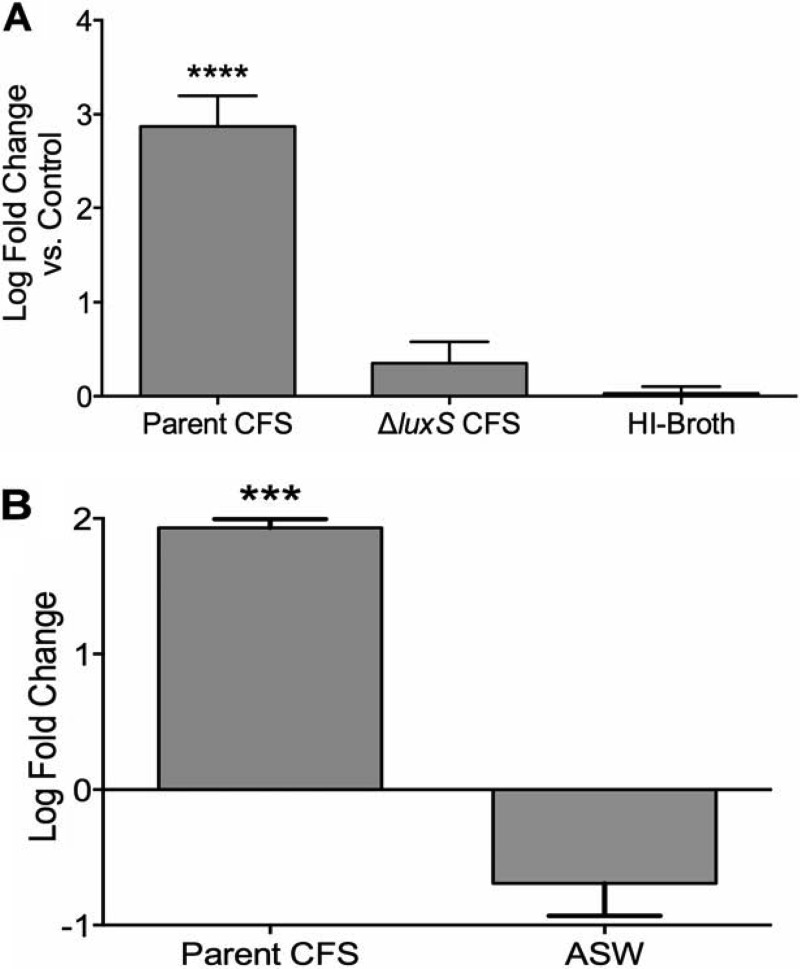
FIG 1
FIG 1
Increase in the culturability of Vibrio spp. in oysters and seawater upon addition of CFS. (A) Log fold change in culturability of Vibrio spp. in oyster tissues after 24 h of treatment with CFS from V. vulnificus C7184 (parent) or JDO1 (luxS mutant) relative to that of control oysters that received artificial seawater (ASW). Wild-type CFS significantly increased the culturability of Vibrio spp. in oysters (one-way ANOVA; P < 0.0001), whereas CFS from the luxS mutant did not. Since HI broth had little effect on culturability, nutrient addition did not affect the culturability of Vibrio spp. Error bars represent SD for 4 oysters. (B) Log fold change in levels of Vibrio spp. in NSW after 24 h (relative to that at 0 h) of treatment with either CFS from V. vulnificus C7184 or the ASW control (unpaired t test; P = 0.0004). Error bars represent SD for 3 NSW samples.
FIG 2
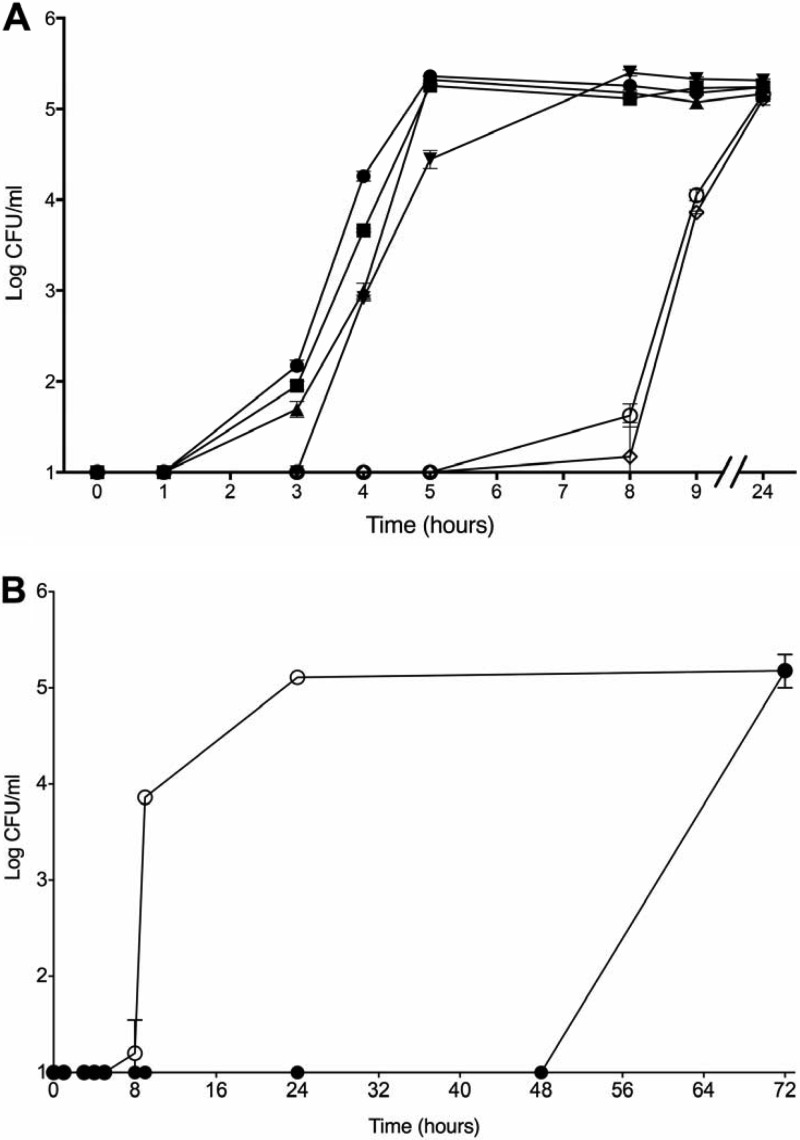
FIG 2
Resuscitation of VBNC V. vulnificus supplemented with CFS, synthetic AI-2, or cinnamaldehyde. (A) Culturability of V. vulnificus after temperature upshift and supplementation with CFS from V. vulnificus C7184 (parent; closed circles), JDO1 (luxS mutant; open circles), V. parahaemolyticus (closed squares), or E. coli (closed triangles) or with synthetic AI-2 (closed downward-facing triangles). Control cultures (open diamonds) received ASW. All wild-type CFS and synthetic AI-2 induced early resuscitation of VBNC cells, while CFS from the luxS mutant did not. Error bars represent SD for 3 replicates. (B) Culturability of V. vulnificus after a temperature upshift, with (closed circles) and without (open circles) 150 μM cinnamaldehyde. Error bars represent SD for 3 replicates.
FIG 3
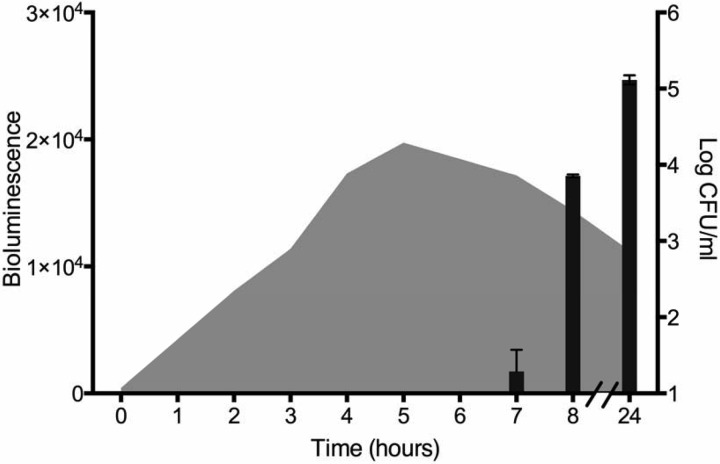
FIG 3
Production of AI-2 during temperature upshift-induced resuscitation from the VBNC state. The data depicted show the culturability of V. vulnificus cells (black bars) as they resuscitated from the VBNC state, with corresponding AI-2 levels (gray curve) in these cultures as measured by the AI-2 bioluminescence assay.
FIG 4
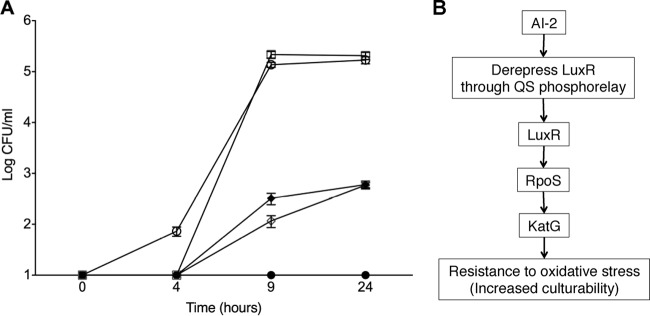
FIG 4
Resuscitation of V. vulnificus luxS and rpoS mutants during temperature upshift. (A) Culturability of luxS mutant (JDO1; closed circles), rpoS mutant (AH1; closed diamonds), and parent strain (C7184; open squares) after a resuscitation-inducing temperature upshift. JDO1 was unable to resuscitate within 24 h unless it was supplemented with exogenous AI-2 (open circles), indicating the requirement of AI-2 for the resuscitation of VBNC V. vulnificus. AH1 displayed a delayed ability to resuscitate, likely due to decreased survival at 4°C. Importantly, resuscitation of AH1 was not affected by the addition of AI-2 (open diamonds), indicating the importance of RpoS for AI-2-mediated resuscitation. (B) Proposed mechanism of resuscitation. An increase in AI-2 signaling causes the derepression of LuxR, a positive regulator of RpoS. Increased RpoS activity leads to an increase in production of catalase (KatG), which allows cells to be culturable on routine media containing H2O2.

References

    1. Pinto D, Santos MA, Chambel L. 12 July 2013. Thirty years of viable but nonculturable state research: unsolved molecular mechanisms. Crit. Rev. Microbiol. 10.3109/1040841X.2013.794127 - DOI - PubMed
    1. Oliver JD. 2010. Recent findings on the viable but nonculturable state in pathogenic bacteria. FEMS Microbiol. Rev. 34:415–425. 10.1111/j.1574-6976.2009.00200.x - DOI - PubMed
    1. Oliver JD. 2005. The viable but nonculturable state in bacteria. J. Microbiol. 43:93–100 http://www.ncbi.nlm.nih.gov/pubmed/15765062 - PubMed
    1. Nowakowska J, Oliver JD. 2013. Resistance to environmental stresses by Vibrio vulnificus in the viable but nonculturable state. FEMS Microbiol. Ecol. 84:213–222. 10.1111/1574-6941.12052 - DOI - PubMed
    1. Oliver JD, Bockian R. 1995. In vivo resuscitation, and virulence towards mice, of viable but nonculturable cells of Vibrio vulnificus. Appl. Environ. Microbiol. 61:2620–2623 - PMC - PubMed

Publication types

MeSH terms

LinkOut - more resources