


Factor XIII Val34Leu polymorphism and recurrent myocardial infarction in patients with coronary artery disease
- PMID: 24510702
- PMCID: PMC4295494
- DOI: 10.1007/s11239-014-1059-4
Factor XIII Val34Leu polymorphism and recurrent myocardial infarction in patients with coronary artery disease
Abstract
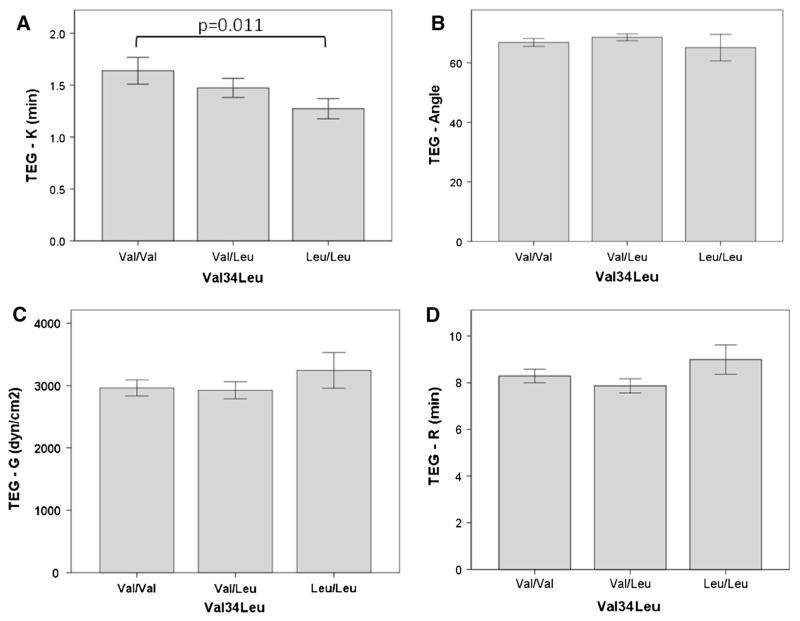
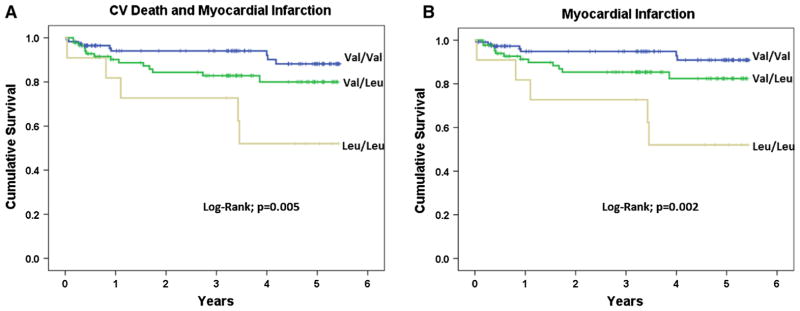
Factor XIII (FXIII) is necessary for cross linking of fibrin strands and generation of stable fibrin clot. FXIII Val34Leu is a common genetic single nucleotide polymorphism that has been associated with accelerated fibrin stabilization and reduced rate of fibrinolysis. The contribution of Val34Leu to long term risk of recurrent myocardial infarction (MI) in patients with coronary stenting has not been conclusively established. The objective of the study was to examine the effects of Val34Leu on fibrin generation, platelet aggregation, and long term clinical outcomes in patients with coronary artery disease treated with dual antiplatelet therapy. Patients with angiographically documented coronary artery disease who were treated with aspirin and clopidogrel were enrolled (n = 211). Light transmittance aggregometry and plasma fibrin clot formation using thrombelastography (TEG) were determined. Genotyping of Val34Leu was performed using Taqman assay. Clinical events during follow up were recorded. Homozygous carriers of 34 Leu variant had significantly shorter fibrin clot formation time as compared to wild type individuals (TEG K: 1.27 ± 0.3 vs. 1.68 ± 1.1 min, p = 0.011). The Val34Leu variant was associated with gene dose dependent increased risk of MI (log rank, p = 0.002) or occurrence of composite of MI and CV death (log rank, p = 0.005) with highest event rates observed in homozygous carriers of 34 Leu. In summary, FXIII Val34Leu polymorphism was associated with increased rate of fibrin stabilization in homozygous carriers of the variant and may increase risk of recurrent MI and death in patients with angiographically established coronary artery disease treated with dual antiplatelet therapy.
Conflict of interest statement
Figures
References
-
- Holmes DR, Jr, Kereiakes DJ, Garg S, Serruys PW, Dehmer GJ, Ellis SG, Williams DO, Kimura T, Moliterno DJ. Stent thrombosis. J Am Coll Cardiol. 2010;56:1357–1365. - PubMed
-
- Gurbel PA, Bliden KP, Guyer K, Cho PW, Zaman KA, Kreutz RP, Bassi AK, Tantry US. Platelet reactivity in patients and recurrent events post-stenting: results of the prepare post-stenting study. J Am Coll Cardiol. 2005;46:1820–1826. - PubMed
-
- Price MJ, Berger PB, Teirstein PS, Tanguay JF, Angiolillo DJ, Spriggs D, Puri S, Robbins M, Garratt KN, Bertrand OF, Stillabower ME, Aragon JR, Kandzari DE, Stinis CT, Lee MS, Manoukian SV, Cannon CP, Schork NJ, Topol EJ GRAVITAS Investigators. Standard- vs. high-dose clopidogrel based on platelet function testing after percutaneous coronary intervention: the GRAVITAS randomized trial. JAMA. 2011;305:1097–1105. - PubMed
-
- Jneid H, Anderson JL, Wright RS, Adams CD, Bridges CR, Casey DE, Jr, Ettinger SM, Fesmire FM, Ganiats TG, Lincoff AM, Peterson ED, Philippides GJ, Theroux P, Wenger NK, Zidar JP, Anderson JL. 2012 ACCF/AHA focused update of the guideline for the management of patients with unstable angina/Non-ST-elevation myocardial infarction (updating the 2007 guideline and replacing the 2011 focused update): a report of the American College of Cardiology Foundation/American Heart Association Task Force on practice guidelines. Circulation. 2012;26:875–910. - PubMed
Publication types
MeSH terms
Substances
Grants and funding
LinkOut - more resources
Full Text Sources
Other Literature Sources
Medical
