Review
. 2014:76:251-74.
doi: 10.1146/annurev-physiol-020911-153251.

The intestinal absorption of folates

Affiliations
Review

The intestinal absorption of folates

Michele Visentin et al. Annu Rev Physiol. 2014.

Abstract

The properties of intestinal folate absorption were documented decades ago. However, it was only recently that the proton-coupled folate transporter (PCFT) was identified and its critical role in folate transport across the apical brush-border membrane of the proximal small intestine established by the loss-of-function mutations identified in the PCFT gene in subjects with hereditary folate malabsorption and, more recently, by the Pcft-null mouse. This article reviews the current understanding of the properties of PCFT-mediated transport and how they differ from those of the reduced folate carrier. Other processes that contribute to the transport of folates across the enterocyte, along with the contribution of the enterohepatic circulation, are considered. Important unresolved issues are addressed, including the mechanism of intestinal folate absorption in the absence of PCFT and regulation of PCFT gene expression. The impact of a variety of ions, organic molecules, and drugs on PCFT-mediated folate transport is described.


Figures
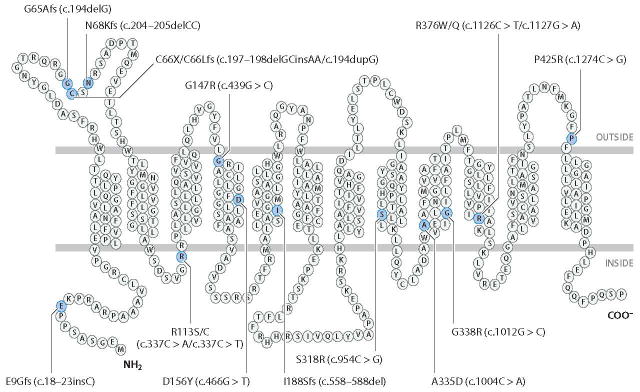
Figure 1
Figure 1
The confirmed secondary structure of the proton-coupled folate transporter. The sites of mutations identified in subjects with hereditary folate malabsorption are shown. Modified from Reference .
Figure 2
Figure 2
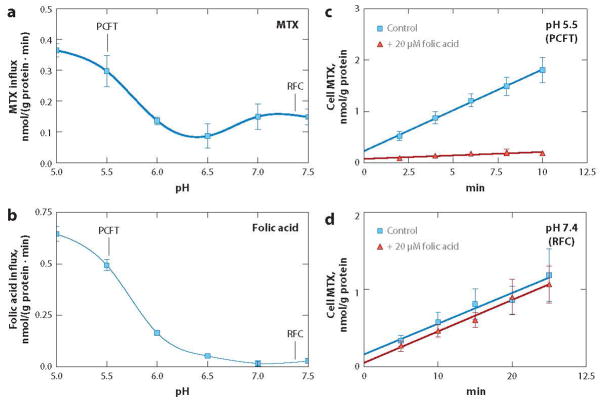
Distinguishing between reduced folate carrier (RFC)- and proton-coupled folate transporter (PCFT)-mediated transport into rat small intestinal epithelial cells. (a) Influx of [3H]methotrexate (MTX) as a function of pH. MTX has a high affinity for both PCFT, at low pH, and RFC, at neutral pH. The graph clearly distinguishes between the pH optima for these two processes, as indicated by the vertical lines. (b) Influx of [3H]folic acid as a function of pH. Folic acid has a high affinity for PCFT at low pH but a very low affinity for RFC at neutral pH. In this case, only the low pH activity is seen; transport at neutral pH is too low to be detected. Panels a and b illustrate the minimal overlap between these processes. (c) Influx of 0.5 μM MTX in the presence and absence of 20 μM folic acid at pH 5.5. At low pH, at which transport is mediated solely by PCFT, for which folic acid has high affinity, folic acid abolishes influx of MTX. (d) Influx of 0.5 μM MTX in the presence and absence of 20 μM folic acid at pH 7.4. Because MTX influx at pH 7.4 is mediated solely by RFC, and folic acid has a very low affinity for this transporter, folic acid has no impact on MTX influx. The data are from Reference .
Figure 3
Figure 3
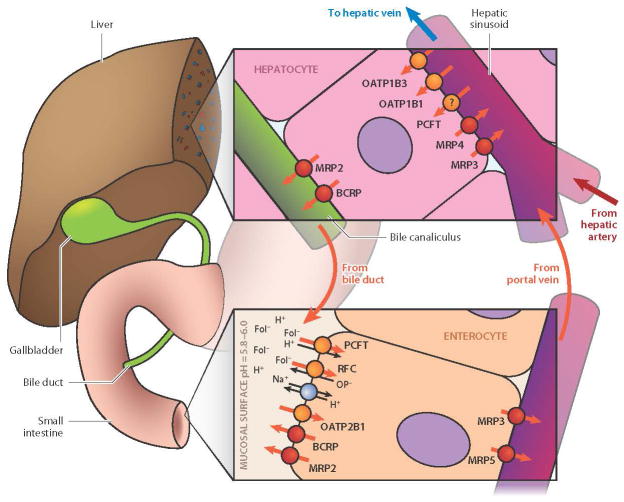
The intestinal absorption and enterohepatic circulation of folates. Shown are the transporters that are expressed in the apical brush-border and basolateral membranes of the enterocyte and that impact intestinal folate absorption. The primary role for the proton-coupled folate transporter (PCFT) in transport across the apical brush-border membrane of the enterocyte has been validated on the basis of the consequences of the loss-of-function mutations in this transporter in humans and mice that ingest physiological amounts of folates. Also shown is the enterohepatic circulation as folates from the intestine are delivered via the hepatic portal vein, and as systemic folates are delivered via the hepatic artery, to the hepatic sinusoid. From there, folates reach the systemic circulation via the hepatic veins or are transported into hepatocytes at the basolateral membrane. Folates are then stored as polyglutamate derivatives or are transported into the biliary system at the canalicular membrane. PCFT is expressed in the basolateral membrane, but its function there is not clear. RFC, an organic phosphate (OP) antiporter, is also expressed in hepatocytes, but its location and function have not been established. The acidic pH at the mucosal surface is generated by Na+/H+ exchangers.

References

    1. Tibbetts AS, Appling DR. Compartmentalization of mammalian folate-mediated one-carbon metabolism. Annu Rev Nutr. 2010;30:57–81. - PubMed
    1. Salbaum JM, Kappen C. Genetic and epigenomic footprints of folate. Prog Mol Biol Transl Sci. 2012;108:129–58. - PMC - PubMed
    1. Fox JT, Stover PJ. Folate-mediated one-carbon metabolism. Vitam Horm. 2008;79:1–44. - PubMed
    1. Diop-Bove N, Kronn D, Goldman ID. Hereditary folate malabsorption. In: Pagon RA, Bird TD, Dolan CR, Stephens K, editors. GeneReviews. Seattle: Univ. Wash; 2011.
    1. Geller J, Kronn D, Jayabose S, Sandoval C. Hereditary folate malabsorption: family report and review of the literature. Medicine. 2002;81:51–68. - PubMed

Publication types

MeSH terms

Substances

Supplementary concepts

LinkOut - more resources