. 2014 Dec;19(12):1275-1283.
doi: 10.1038/mp.2013.190. Epub 2014 Feb 11.

Stress and glucocorticoids promote oligodendrogenesis in the adult hippocampus

Affiliations

Stress and glucocorticoids promote oligodendrogenesis in the adult hippocampus

Sundari Chetty et al. Mol Psychiatry. 2014 Dec.

Abstract

Stress can exert long-lasting changes on the brain that contribute to vulnerability to mental illness, yet mechanisms underlying this long-term vulnerability are not well understood. We hypothesized that stress may alter the production of oligodendrocytes in the adult brain, providing a cellular and structural basis for stress-related disorders. We found that immobilization stress decreased neurogenesis and increased oligodendrogenesis in the dentate gyrus (DG) of the adult rat hippocampus and that injections of the rat glucocorticoid stress hormone corticosterone (cort) were sufficient to replicate this effect. The DG contains a unique population of multipotent neural stem cells (NSCs) that give rise to adult newborn neurons, but oligodendrogenic potential has not been demonstrated in vivo. We used a nestin-CreER/YFP transgenic mouse line for lineage tracing and found that cort induces oligodendrogenesis from nestin-expressing NSCs in vivo. Using hippocampal NSCs cultured in vitro, we further showed that exposure to cort induced a pro-oligodendrogenic transcriptional program and resulted in an increase in oligodendrogenesis and decrease in neurogenesis, which was prevented by genetic blockade of glucocorticoid receptor (GR). Together, these results suggest a novel model in which stress may alter hippocampal function by promoting oligodendrogenesis, thereby altering the cellular composition and white matter structure.


Figures
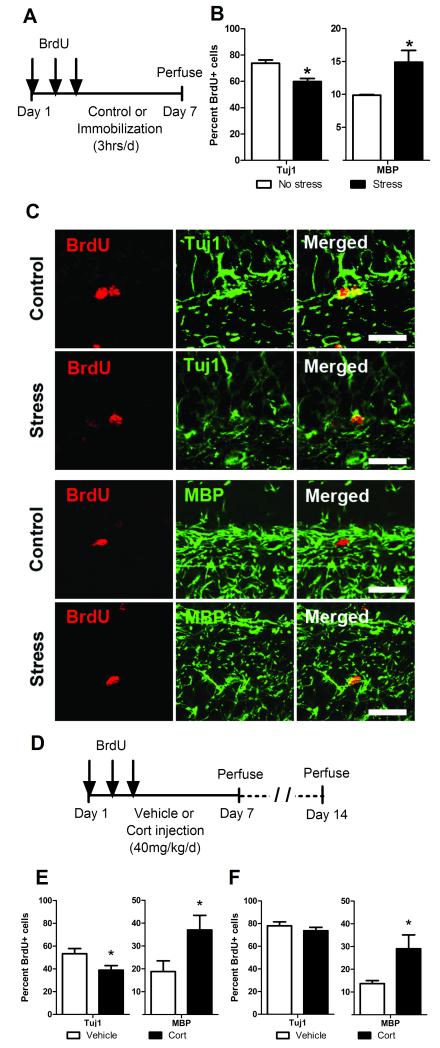
Figure 1
Figure 1
Immobilization stress or cort injections increase hippocampal oligodendrogenesis. (a) BrdU-injected adult male rats were subjected to either 1 week of daily immobilization stress or no stress (n=5 no stress control, n=6 stress). (b) IHC analysis of cell fate, quantified as the percentage of BrdU positive cells that co-label as neurons (Tuj1) or oligodendrocytes (MBP) shows that stress decreases neurogenesis and increases oligodendrogenesis. (c) Representative images of confocal analysis represents cells identified as positive for co-localization of BrdU and Tuj1 or MBP; scale bar=10 μM. (d) BrdU-injected adult male rats received daily cort or vehicle injections for 1 week and were perfused on day 7 (n=6 vehicle injected, n=6 cort injected) or day 14 (n=7 vehicle injected, n=6 cort injected). (e) IHC analysis of cell fate at day 7 shows that exposure to stress hormones (cort) decreases neurogenesis and increases oligodendrogenesis. (f) IHC analysis of cell fate at day 14 (1 week after recovery from cort treatment) shows that while neurogenesis is restored to control levels, the effects of increased oligodendrogenesis persist in cort injected animals. *p < 0.05 (mean ± SEM).
Figure 2
Figure 2
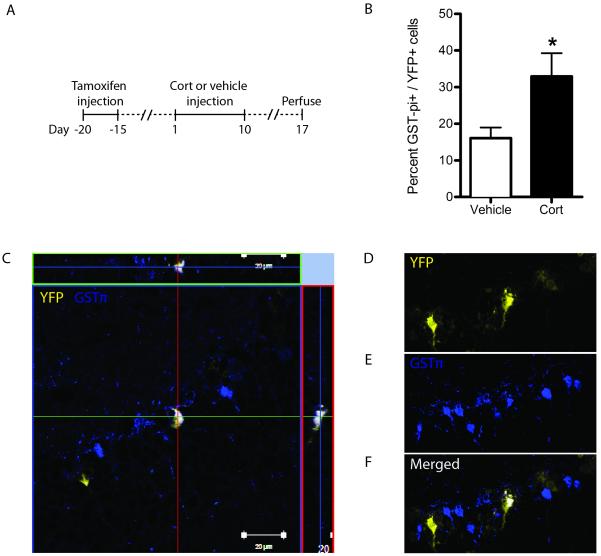
Cort increases hippocampal oligodendrogenesis from nestin lineage NSCs in vivo. (a) Nestin-Cre ERT2/RosaYFP mice were injected with tamoxifen to induce YFP reporter gene expression, injected with cort or vehicle for 10 days, and perfused 7 days later for IHC analysis. (b) Cort injection increased the percentage of YFP-labeled cells that co-labeled with the oligodendrocytic marker GST-π; n=8. (c) Representative image of an orthogonal slice of a YFP+/GST-π+ co-labeled cell as well as 3D reconstruction of an image stack of the same cell (d-f). *p < 0.05 (mean ± SEM).
Figure 3
Figure 3
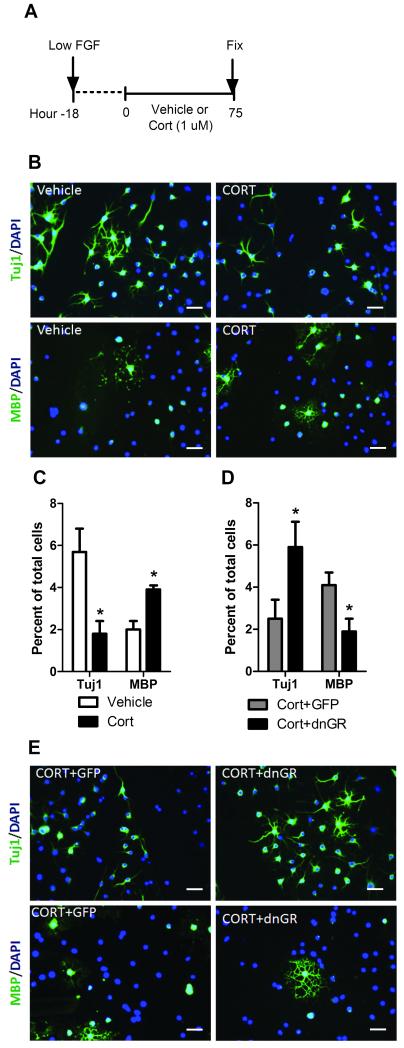
Cort treatment increases the oligodendrogenic potential of NSCs. (a) NSC cultures were treated with cort or vehicle for 75 h. (b) Representative images of ICC analysis, scale bar = 50 μm. (c) ICC analysis of cell fate, quantified as total number of cells labeling as neurons (Tuj1) or oligodendrocytes (MBP). (d, e) ICC analysis of cell fate of NSCs transfected with dnGR or GFP (control) and treated with cort. *p < 0.05 (mean ± SEM); n≥3.
Figure 4
Figure 4
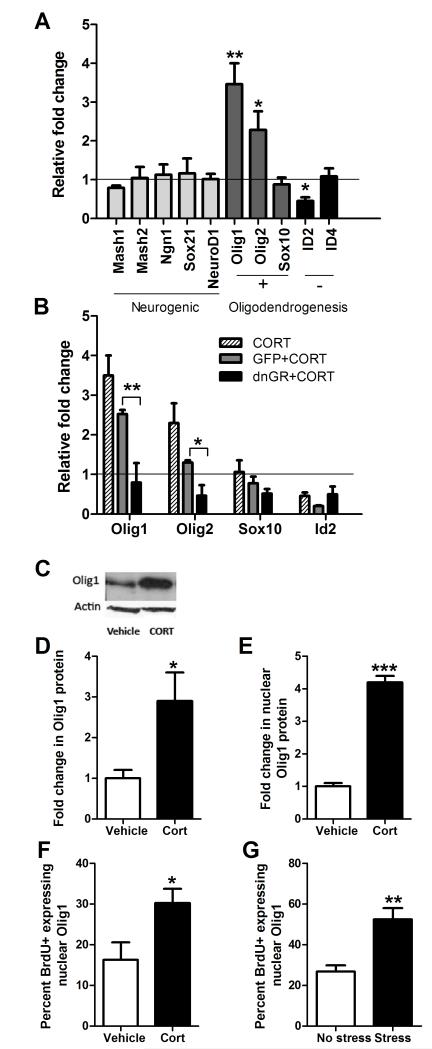
Cort treatment induces a pro-oligodendrogenic transcriptional program in NSCs. (a) Fold change in mRNA expression of genes regulating neurogenic and oligodendrogenic fate in cort-treated NSCs, relative to vehicle-treated controls, including genes that promote (+) and inhibit (−) oligodendrogenesis. (b) Fold change in mRNA expression of oligodendrogenic regulatory genes in NSCs transfected with dnGR or GFP (control) vectors, or no vector, and treated with cort, relative to vehicle-treated controls; n≥3. (c) Representative image of Western blot for Olig1 protein in NSCs treated with cort or vehicle. (d) Densitometric analysis of Western blot for total protein fraction and (e) the isolated nuclear fraction of treated NSCs; n=3. (f) IHC analysis of the percent of BrdU positive cells expressing nuclear-localized Olig1 in the hilus of adult rats after 1 week of daily cort injections; n=6 vehicle injected, n=6 cort injected (g) or after 1 week of daily immobilization stress; n=5 no stress control, n=6 stress. *p < 0.05, **p<0.005, ***p < 0.0001 (mean ± SEM).

References

    1. Heim C, Nemeroff CB. The role of childhood trauma in the neurobiology of mood and anxietydisorders: preclinical and clinical studies. Biol Psychiatry. 2001;49(12):1023–1039. - PubMed
    1. McEwen BS. Physiology and neurobiology of stress and adaptation: central role of the brain. Physiol Rev. 2007;87(3):873–904. - PubMed
    1. de Kloet ER, Karst H, Joels M. Corticosteroid hormones in the central stress response: quick-and-slow. Front Neuroendocrinol. 2008;29(2):268–272. - PubMed
    1. Gillespie CF, Phifer J, Bradley B, Ressler KJ. Risk and resilience: genetic and environmental influences on development of the stress response. Depress Anxiety. 2009;26(11):984–992. - PMC - PubMed
    1. Francis D, Diorio J, Liu D, Meaney MJ. Nongenomic transmission across generations of maternal behavior and stress responses in the rat. Science. 1999;286(5442):1155–1158. - PubMed

Publication types

MeSH terms