. 2014 Apr;196(4):1217-26.
doi: 10.1534/genetics.113.160069. Epub 2014 Feb 10.

The fates of mutant lineages and the distribution of fitness effects of beneficial mutations in laboratory budding yeast populations

Affiliations

The fates of mutant lineages and the distribution of fitness effects of beneficial mutations in laboratory budding yeast populations

Evgeni M Frenkel et al. Genetics. 2014 Apr.

Abstract

The outcomes of evolution are determined by which mutations occur and fix. In rapidly adapting microbial populations, this process is particularly hard to predict because lineages with different beneficial mutations often spread simultaneously and interfere with one another's fixation. Hence to predict the fate of any individual variant, we must know the rate at which new mutations create competing lineages of higher fitness. Here, we directly measured the effect of this interference on the fates of specific adaptive variants in laboratory Saccharomyces cerevisiae populations and used these measurements to infer the distribution of fitness effects of new beneficial mutations. To do so, we seeded marked lineages with different fitness advantages into replicate populations and tracked their subsequent frequencies for hundreds of generations. Our results illustrate the transition between strongly advantageous lineages that decisively sweep to fixation and more moderately advantageous lineages that are often outcompeted by new mutations arising during the course of the experiment. We developed an approximate likelihood framework to compare our data to simulations and found that the effects of these competing beneficial mutations were best approximated by an exponential distribution, rather than one with a single effect size. We then used this inferred distribution of fitness effects to predict the rate of adaptation in a set of independent control populations. Finally, we discuss how our experimental design can serve as a screen for rare, large-effect beneficial mutations.

Keywords: Saccharomyces cerevisiae; beneficial mutations; clonal interference; distribution of fitness effects; experimental evolution.


Figures
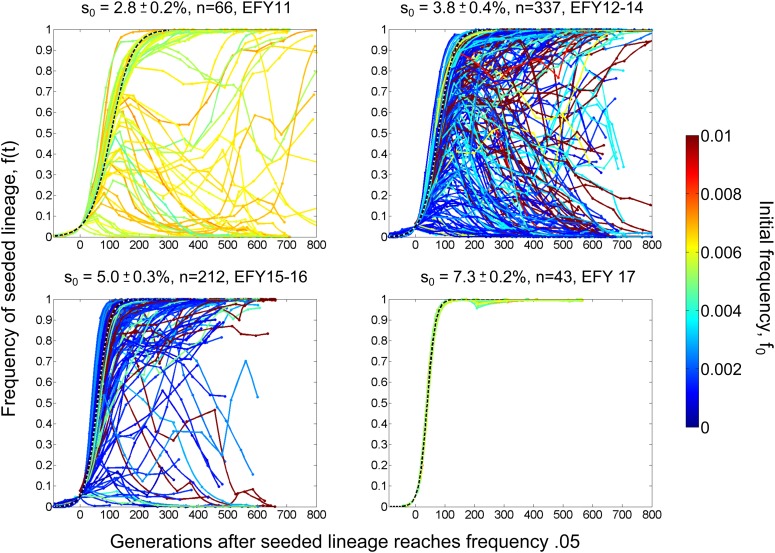
Figure 1
Figure 1
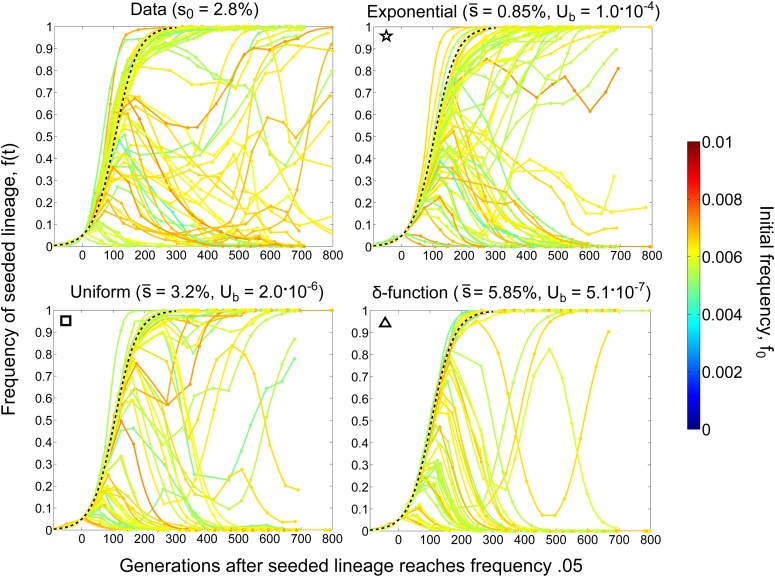
Trajectories of seeded lineages. Each line represents the frequency over time of a marked lineage with fitness advantage s0 seeded into a replicate resident population. Colors correspond to the initial frequency f0 of the seeded lineage according to the legend at right. Time is measured in generations, with t = 0 defined as the time at which each trajectory reached frequency 0.05. The dashed curves show the expected trajectories in the absence of new beneficial mutations (i.e., without clonal interference). (Note that the seeded lineages for s0 ≈ 4 and 5% consisted of multiple strains; see Materials and Methods.)
Figure 2
Figure 2
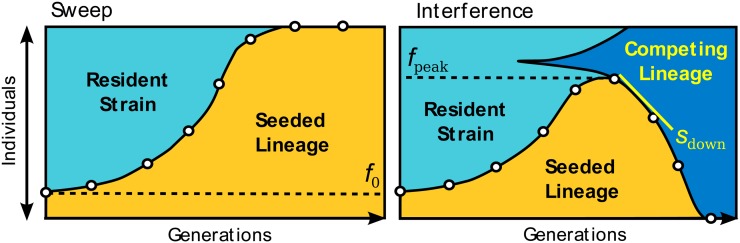
The fates of seeded lineages. We classified the trajectory of each seeded lineage according to whether it increased monotonically to fixation (a selective sweep, shown left) or peaked and subsequently declined in frequency (clonal interference, shown right). Each clonal interference event implies that the resident adapted fast enough to overtake the seeded lineage in fitness. These cases were further classified by the seeded lineage’s peak frequency, fpeak, and relative fitness after this peak, sdown, as indicated in the right scheme.
Figure 3
Figure 3
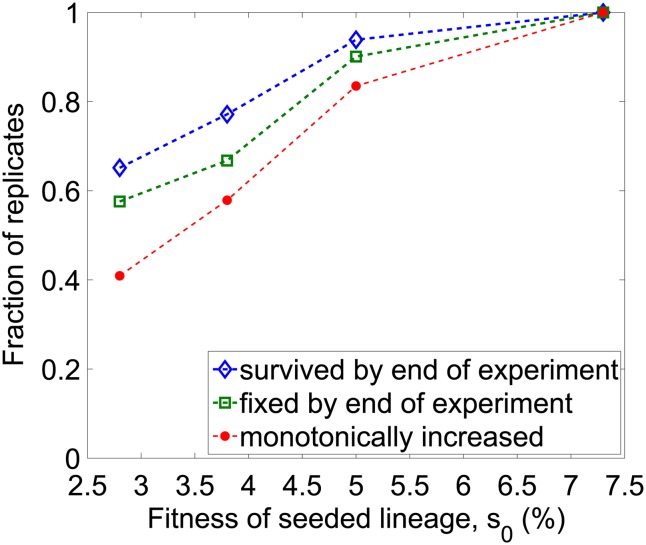
The fates of seeded lineages as a function of their fitness. We show the fraction of replicate populations in which the seeded lineage had the indicated fate.
Figure 4
Figure 4
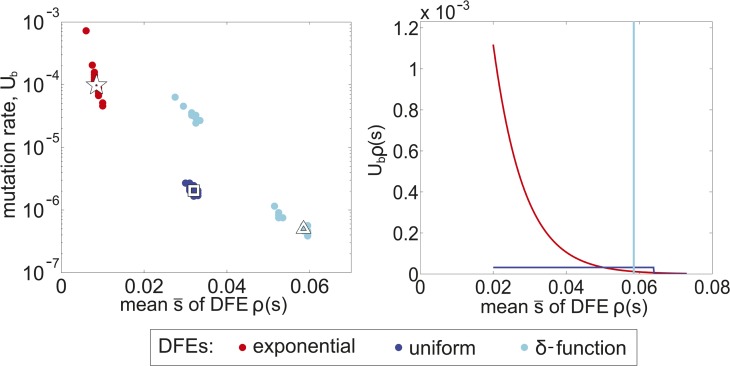
Inferred DFE parameters. Left: The most-likely parameters Ub and s¯ for DFEs ρ(s) given by exponential (star), uniform (square), and δ-function (triangle) distributions. Shaded circles indicate 1% confidence ranges of these parameters as estimated by bootstrapping (see Appendix). Right: The shapes of these distributions shown for s ≥ 2% given their most-likely parameters.
Figure 5
Figure 5
Lineage dynamics data and simulations for s0 = 2.8%. The trajectories of seeded lineages with initial fitness s0 = 2.8% are shown as observed in the experiment (top left) and as reproduced by simulations assuming the DFE parameters indicated above each part.
Figure 6
Figure 6
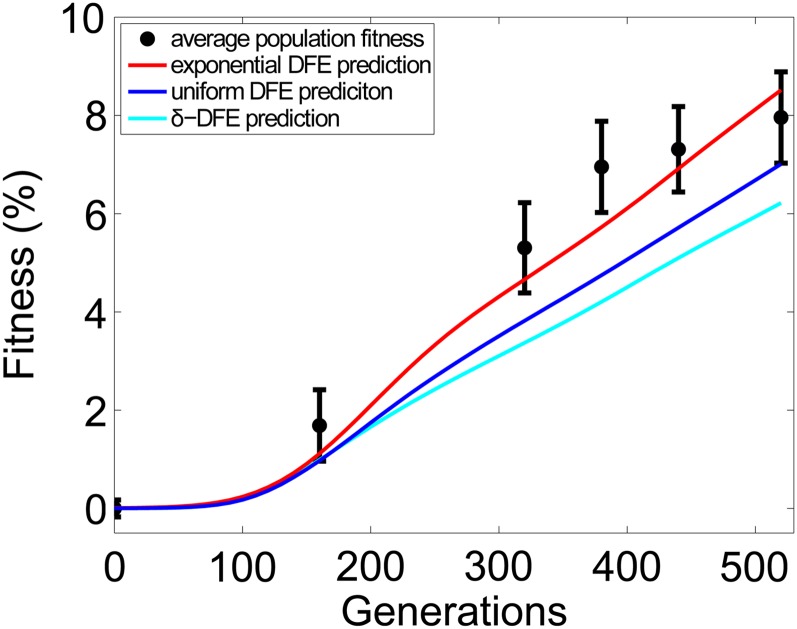
The rate of adaptation. The average fitness over time of 16 experimental control populations (± 1 SEM) is shown in black. Solid curves are the predictions of these data given the most-likely exponential, uniform, and δ-function DFEs. The fitnesses of individual populations are shown in Figure S4.
Figure 7
Figure 7
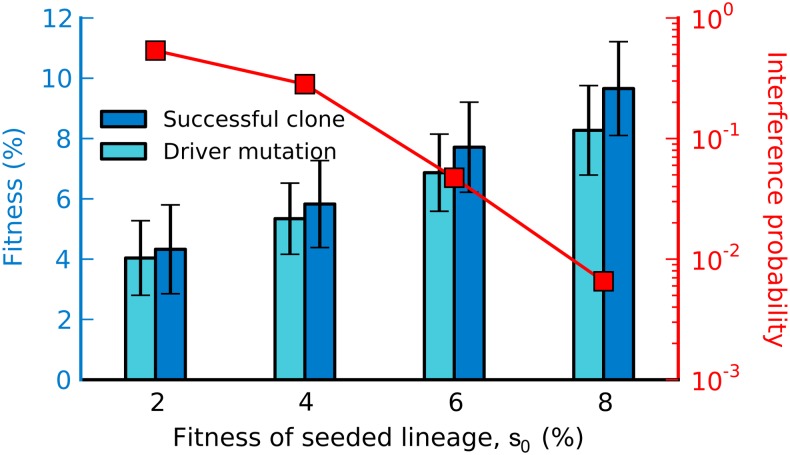
A screen for beneficial mutations. We simulated the evolutionary dynamics for a range of seeded lineages and then simulated picking a single clone at random from the resident population immediately after a clonal interference event. The bars indicate the average fitness of this clone and its largest effect mutation (±1 SD, scale at left). We also show the fraction of replicate populations in our simulations in which clonal interference occurs (scale at right). The simulations assumed the most-likely exponential DFE inferred in the study.

References

    1. Adams J., Oeller P., 1986. Structure of evolving populations of Saccharomyces cerevisiae: adaptive changes are frequently associated with sequence alterations involving mobile elements belonging to the Ty family. Proc. Natl. Acad. Sci. USA 83: 7124–7127. - PMC - PubMed
    1. Atwood K., Schneider L., Ryan F., 1951. Periodic selection in Escherichia coli. Proc. Natl. Acad. Sci. USA 37: 146. - PMC - PubMed
    1. Barrett R. D., MacLean R. C., Bell G., 2006. Mutations of intermediate effect are responsible for adaptation in evolving Pseudomonas fluorescens populations. Biol. Lett. 2: 236–238. - PMC - PubMed
    1. Barrick J., Kauth M., Strelioff C., Lenski R., 2010. Escherichia coli rpoB mutants have increased evolvability in proportion to their fitness defects. Mol. Biol. Evol. 27: 1338–1347. - PMC - PubMed
    1. Bataillon T., Zhang T., Kassen R., 2011. Cost of adaptation and fitness effects of beneficial mutations in Pseudomonas fluorescens. Genetics 189: 939–949. - PMC - PubMed

Publication types

LinkOut - more resources