A cross-sectional study on intestinal parasitic infections in rural communities, northeast Thailand
- PMID: 24516280
- PMCID: PMC3916464
- DOI: 10.3347/kjp.2013.51.6.727
A cross-sectional study on intestinal parasitic infections in rural communities, northeast Thailand
Abstract
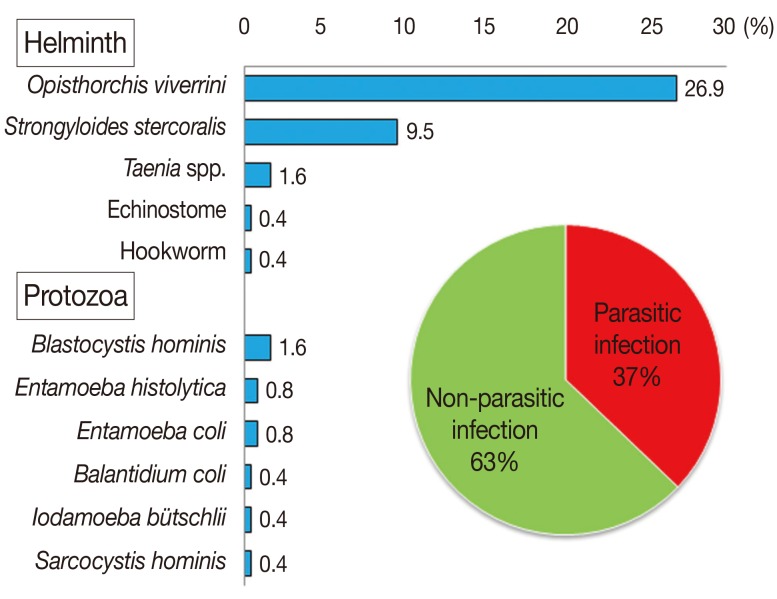
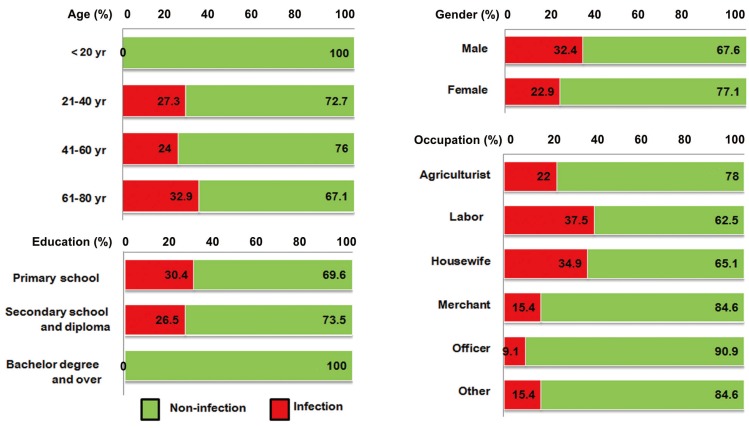
Despite the existence of effective anthelmintics, parasitic infections remain a major public health problem in Southeast Asia, including Thailand. In rural communities, continuing infection is often reinforced by dietary habits that have a strong cultural basis and by poor personal hygiene and sanitation. This study presents a survey of the prevalence of intestinal parasitic infections among the people in rural Thailand. The community-based cross-sectional study was conducted in villages in Khon Kaen Province, northeastern Thailand, from March to August 2013. A total of 253 stool samples from 102 males and 140 females, aged 2-80 years, were prepared using formalin-ethyl acetate concentration methods and examined using light microscopy. Ninety-four individuals (37.2%) were infected with 1 or more parasite species. Presence of parasitic infection was significantly correlated with gender (P=0.001); nearly half of males in this survey (49.0%) were infected. Older people had a higher prevalence than younger members of the population. The most common parasite found was Opisthorchis viverrini (26.9%), followed by Strongyloides stercoralis (9.5%), Taenia spp. (1.6%), echinostomes (0.4%), and hookworms (0.4%). The prevalence of intestinal protozoa was Blastocystis hominis 1.6%, Entamoeba histolytica 0.8%, Entamoeba coli 0.8%, Balantidium coli 0.4%, Iodamoeba bütschlii 0.4%, and Sarcocystis hominis 0.4%. Co-infections of various helminths and protozoa were present in 15.9% of the people. The present results show that the prevalence of parasitic infections in this region is still high. Proactive education about dietary habits, personal hygiene, and sanitation should be provided to the people in this community to reduce the prevalence of intestinal parasite infections. Moreover, development of policies and programs to control parasites is needed.
Keywords: Blastocystis hominis; Opisthorchis viverrini; Strongyloides stercoralis; Taenia sp.; Thailand; echinostome; hookworm; intestinal parasite; parasitosis; prevalence.
Figures
References
-
- Robertson LJ, van der Giessen JW, Batz MB, Kojima M, Cahill S. Have foodborne parasites finally become a global concern? Trends Parasitol. 2013;29:101–103. - PubMed
-
- de Silva NR, Brooker S, Hotez PJ, Montresor A, Engels D, Savioli L. Soil-transmitted helminth infections: updating the global picture. Trends Parasitol. 2003;19:547–551. - PubMed
-
- WHO. Control of Tropical Diseases. Geneva, Switzwerland: WHO; 1998.
-
- Songserm N, Promthet S, Wiangnon S, Sithithaworn P. Prevalence and co-infection of intestinal parasites among Thai rural residents at high-risk of developing cholangiocarcinoma: a cross-sectional study in a prospective Cohort study. Asian Pac J Cancer Prev. 2012;13:6175–6179. - PubMed
Publication types
MeSH terms
LinkOut - more resources
Full Text Sources
Other Literature Sources
Miscellaneous