. 2013 Dec 24:7:25-35.
doi: 10.2147/JPR.S52195. eCollection 2014.

A comparison of DigiGait™ and TreadScan™ imaging systems: assessment of pain using gait analysis in murine monoarthritis

Affiliations

A comparison of DigiGait™ and TreadScan™ imaging systems: assessment of pain using gait analysis in murine monoarthritis

Christopher W Dorman et al. J Pain Res. .

Abstract

Purpose: Carrageenan-induced arthritis is a painful acute arthritis model that is simple to induce, with peak pain and inflammation occurring at about 3 hours. This arthritis model can be evaluated using semiquantitative evoked or non-evoked pain scoring systems. These measures are subjective and are often time- and labor-intensive. It would be beneficial to utilize quantitative, nonsubjective evaluations of pain with rapid assessment tools. We sought to compare the DigiGait™ and TreadScan™ systems and to validate the two gait analysis platforms for detection of carrageenan-induced monoarthritis pain and analgesic response through changes in gait behavior.

Methods: Non-arthritic mice and carrageenan-induced arthritic mice with and without analgesia were examined. A painful arthritic knee was produced by injection of 3% carrageenan into the knee joint of adult mice. Analgesic-treated mice were injected subcutaneously with 0.015 mg/mL (0.5 mg/kg) buprenorphine. Five-second videos were captured on the DigiGait™ or TreadScan™ system and, after calculating gait parameters, were compared using student's unpaired t-test.

Results: We found the DigiGait™ system consistently measured significantly longer stride measures (swing time, stance time, and stride time) than did TreadScan™. Both systems' measures of variability were equal. Reproducibility was inconsistent on both systems. While both systems detected alterations in some gait measures after carrageenan injection, none of the alterations were seen with both systems. Only the TreadScan™ detected normalization of gait measures after analgesia, but the system could not detect normalization across all measures that altered due to arthritis pain. Time spent on analysis was dependent on operator experience.

Conclusion: Neither the DigiGait™ nor TreadScan™ system was useful for measuring changes in pain behaviors or analgesic responses in acute inflammatory monoarthritic mice.

Keywords: arthritis; mouse; video.


Figures
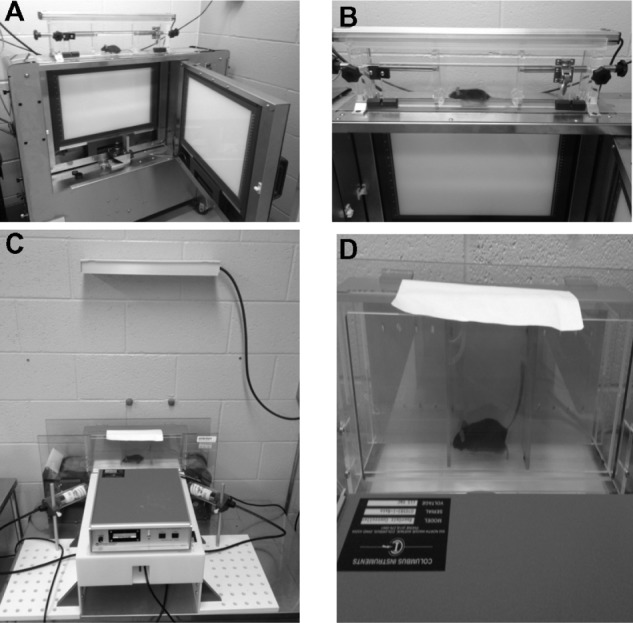
Figure 1
Figure 1
TreadScan™ and DigiGait™ gait analysis systems. Notes: (A) DigiGait™ system (Mouse Specifics, Inc, Quincy, MA, USA) with a mouse in the running chamber and the light panel door open to show high-speed digital camera and two fluorescent lights. (B) A close-up of a mouse in the DigiGait™ running chamber with overhead light. (C) TreadScan™ system (Cleversys Inc, Reston, VA, USA) with a mouse inside the running chamber with two external compact fluorescent lights and overhead fluorescent light. (D) A close-up of a mouse in the TreadScan™ running chamber.
Figure 2
Figure 2
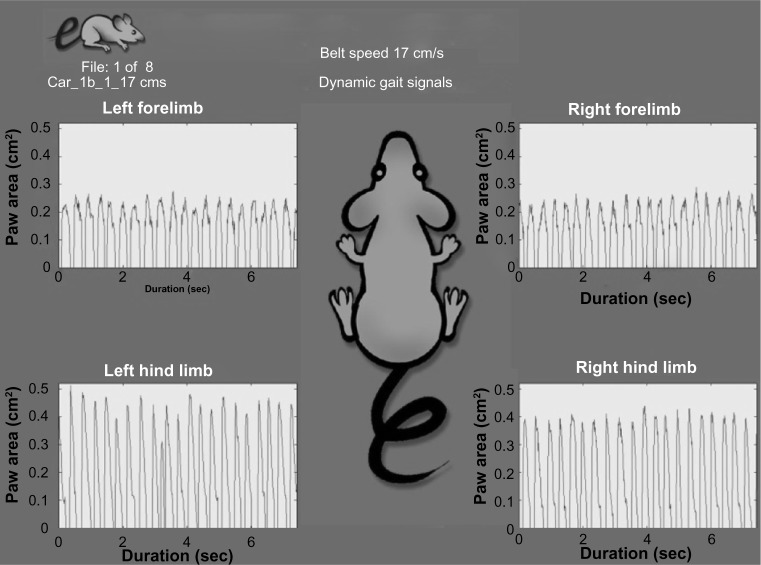
DigiGait™ periodic waveforms. Notes: Screen-captured image of DigiGait™ (with permission from Mouse Specifics, Inc, Quincy, MA, USA) periodic waveforms representing stance and swing phases of stride. The curve represents each limb’s identified foot while in contact with the treadmill. Abbreviation: sec, seconds.
Figure 3
Figure 3
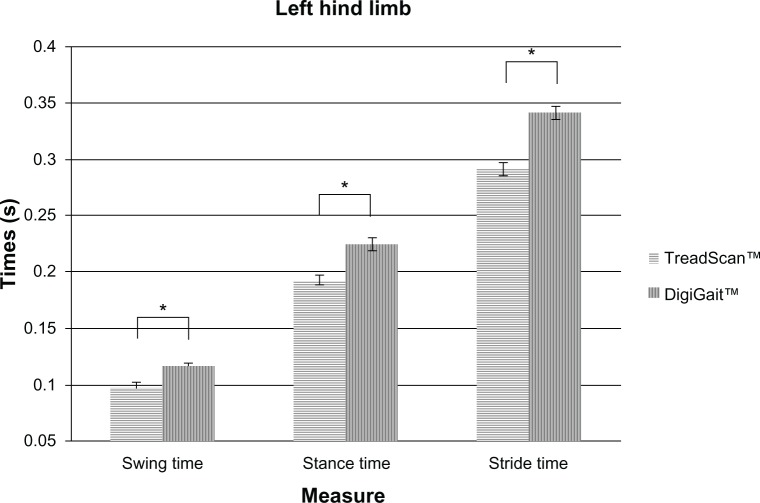
Comparison of TreadScan™ and DigiGait™ gait measurements in the left hind paw in two groups of non-arthritic mice. Notes: Data show significant differences between swing, stance, and stride times of normal mice comparing TreadScan™ (CleverSys Inc, Reston, VA, USA) to DigiGait™ (Mouse Specifics, Inc, Quincy, MA, USA) (P<0.05). TreadScan™ n=14 and DigiGait™ n=14. *P<0.001. Abbreviation: s, seconds.
Figure 4
Figure 4
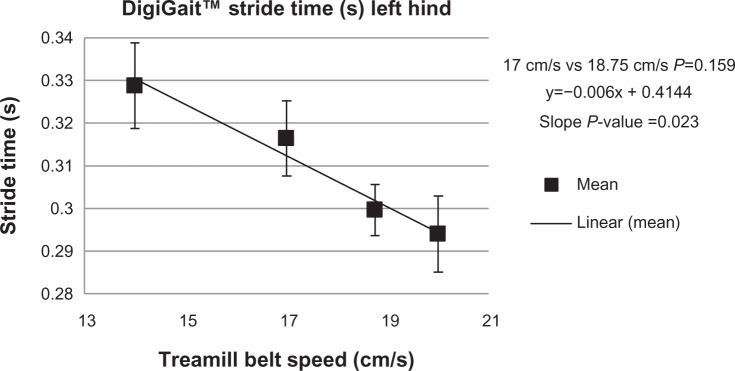
The effect of DigiGait™ belt speed on left hind limb stride time in non-arthritic mice. Notes: Six mice were run on the DigiGait™ system (Mouse Specifics, Inc, Quincy, MA, USA) at 14 cm/second (n=4 evaluated videos), 17 cm/second (n=5), 18.75 cm/second (n=5), and 20 cm/second (n=4). Stride time was inversely correlated with treadmill speed but not statistically significant by analysis of variance (ANOVA) (R2=0.973, P=0.105). The slope for hind limb measures, except swing time, was significantly different from zero. Ad hoc comparison of left hind limb stride time at 17.0 cm/second and 18.75 cm/second using student’s t-test also showed no significant differences. Abbreviation: s, seconds.

References

    1. Hansra P, Moran EL, Fornasier VL, Bogoch ER. Carrageenan-induced arthritis in the rat. Inflammation. 2000;24(2):141–155. - PubMed
    1. Neugebauer V, Han JS, Adwanikar H, Fu Y, Ji G. Techniques for assessing knee joint pain in arthritis. Mol Pain. 2007;3:8. - PMC - PubMed
    1. Vincelette J, Xu Y, Zhang LN, et al. Gait analysis in a murine model of collagen-induced arthritis. Arthritis Res Ther. 2007;9(6):R123. - PMC - PubMed
    1. Anderson S, Krug H, Dorman C, McGarraugh P, Frizelle S, Mahowald M. Analgesic effects of inter-articular botulinum toxin Type B in a murine model of chronic degenerative knee arthritis pain. J Pain Res. 2010;3:161–168. - PMC - PubMed
    1. Chester VL, Biden EN, Tingley M. Gait analysis. Biomed Instrum Technol. 2005;39(1):64–74. - PubMed

LinkOut - more resources