. 2014 Feb 7;9(2):e88099.
doi: 10.1371/journal.pone.0088099. eCollection 2014.

New findings in cleavage sites variability across groups, subtypes and recombinants of human immunodeficiency virus type 1

Affiliations

New findings in cleavage sites variability across groups, subtypes and recombinants of human immunodeficiency virus type 1

Esther Torrecilla et al. PLoS One. .

Abstract

Background: Polymorphisms at cleavage sites (CS) can influence Gag and Pol proteins processing by the viral protease (PR), restore viral fitness and influence the virological outcome of specific antiretroviral drugs. However, data of HIV-1 variant-associated CS variability is scarce.

Methods: In this descriptive research, we examine the effect of HIV-1 variants on CS conservation using all 9,028 gag and 3,906 pol HIV-1 sequences deposited in GenBank, focusing on the 110 residues (10 per site) involved at 11 CS: P17/P24, P24/P2, P2/P7, P7/P1, P1/P6 (gag) , NC/TFP, TFP/P6 (pol), P6 (pol) /PR, PR/RT(p51), RT(p51)/RT(p66) and RT(p66)/IN. CS consensus amino acid sequences across HIV-1 groups (M, O, N, P), group M 9 subtypes and 51 circulating recombinant forms (CRF) were inferred from our alignments and compared to the HIV-1 consensus-of-consensuses sequence provided by GenBank.

Results: In all HIV-1 variants, the most conserved CS were PR/RT(p51), RT(p51)/RT(p66), P24/P2 and RT(p66)/IN and the least P2/P7 and P6 (pol) /PR. Conservation was significantly lower in subtypes vs. recombinants in P2/P7 and TFP/P6 (pol) and higher in P17/P24. We found a significantly higher conservation rate among Group M vs. non-M Groups HIV-1. The late processing sites at Gag (P7/P1) and GagPol precursors (PR/RT(p51)) presented a significantly higher conservation vs. the first CS (P2/P7) in the 4 HIV-1 groups. Here we show 52 highly conserved residues across HIV-1 variants in 11 CS and the amino acid consensus sequence in each HIV-1 group and HIV-1 group M variant for each 11 CS.

Conclusions: This is the first study to describe the CS conservation level across all HIV-1 variants and 11 sites in one of the largest available sequence HIV-1 dataset. These results could help other researchers for the future design of both novel antiretroviral agents acting as maturation inhibitors as well as for vaccine targeting CS.


Conflict of interest statement

Competing Interests: The authors have declared that no competing interests exist.

Figures

Figure 1
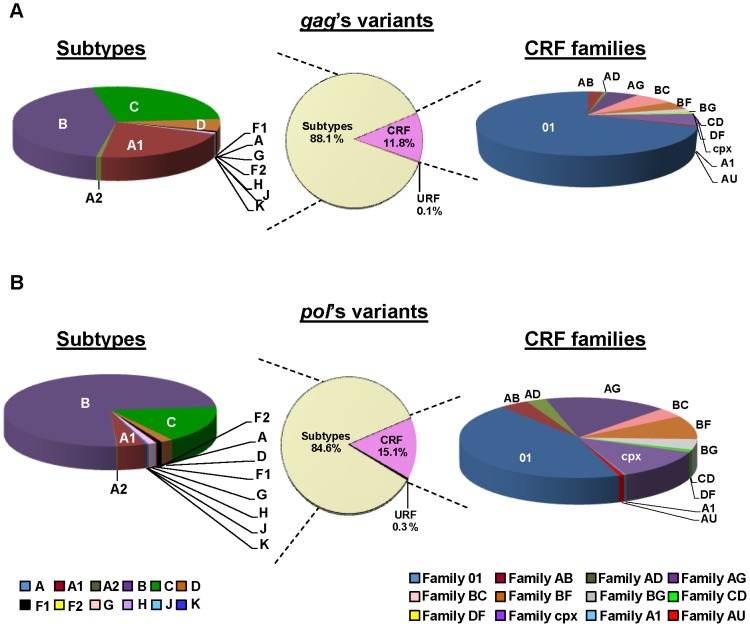
Figure 1. Distribution of HIV-1 Group M subtypes and CRF families.
A total of 12,848 HIV-1 Group M sequences were retrieved from GenBank: 8,985 gag (A) and 3,863 pol (B) sequences.
Figure 2
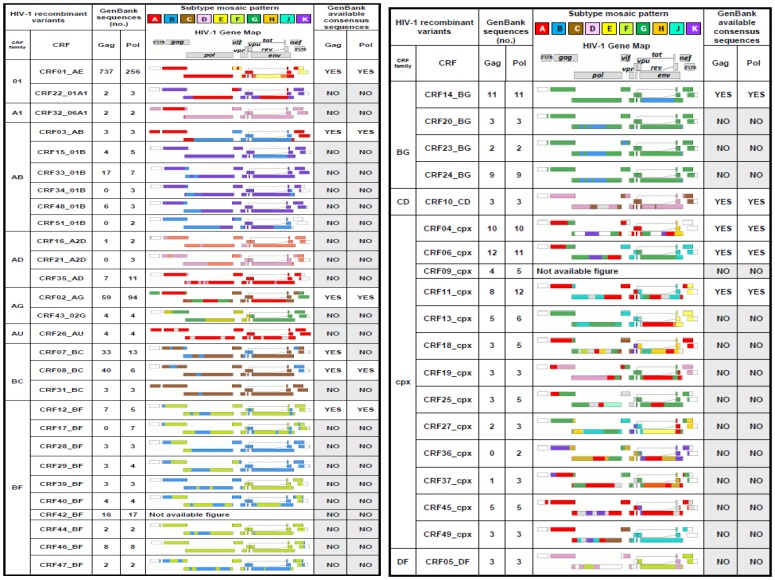
Figure 2. Gag and Pol HIV-1 recombinants sequences grouped by families. Availability of consensus sequences at GenBank.
CRF sequences were grouped in 12 recombinant families; no, number; CRF, circulating recombinant forms http://www.hiv.lanl.gov/content/sequence/HIV/CRFs/CRFs.html; URF, unique recombinant forms. Other variants with consensus sequences from GenBank were: A1, A2, B, C, D, F1, G, H and K subtypes for gag and: A1, A2, B, C, D, F1, F2, G and H subtypes for pol. http://www.hiv.lanl.gov/content/sequence/NEWALIGN/align.html.
Figure 3
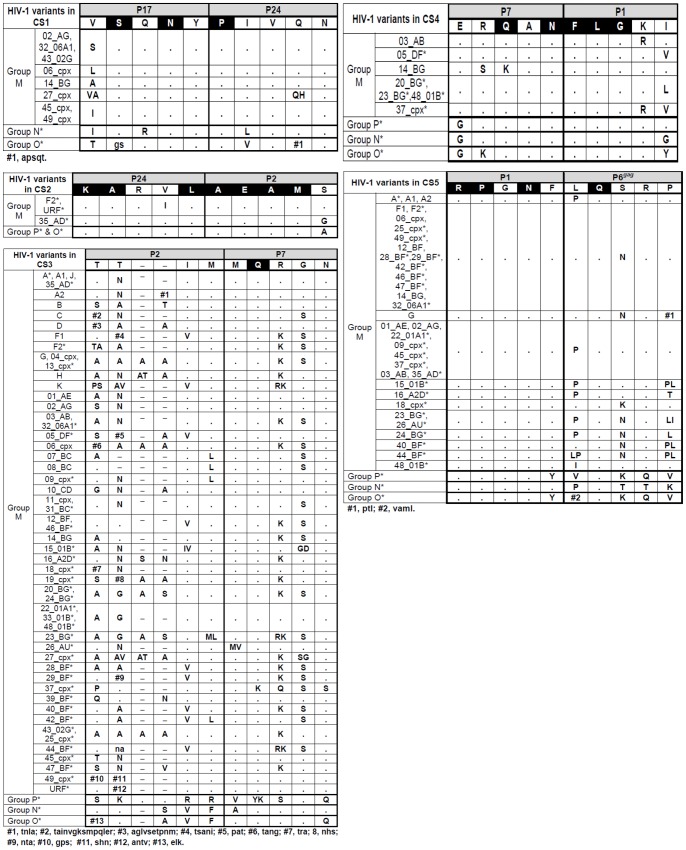
Figure 3. HIV-1 variants showing differences in CS1–CS5 amino acid vs. consensus-of-consensuses sequence from GenBank.
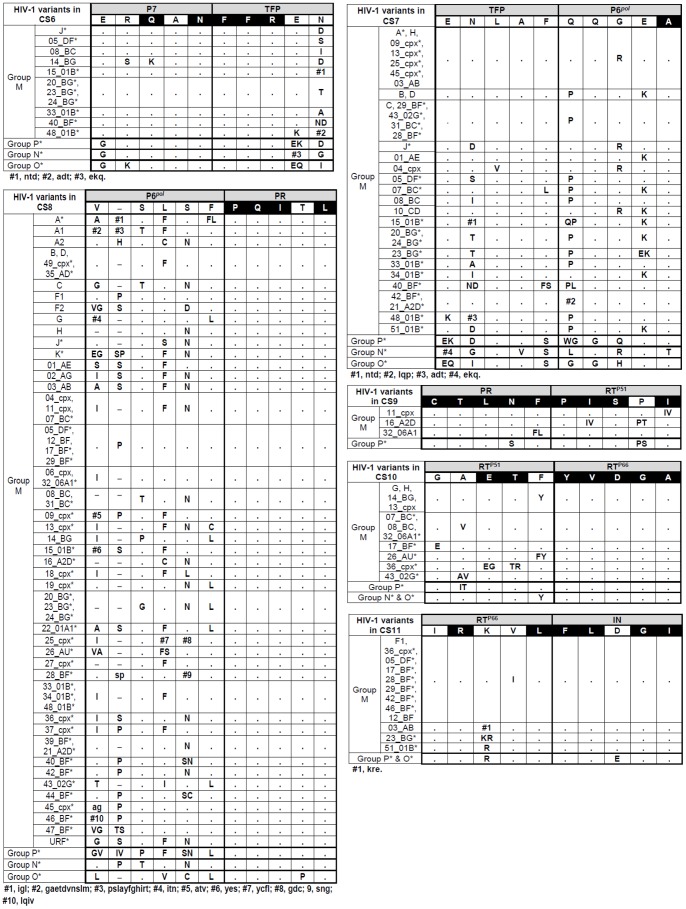
Changes are only indicated when they appeared in a specific position in at least 50% of the GenBank downloaded sequences in order to compare them with the GenBank consensus-of-consensuses sequence. Asterisks indicate the HIV-1 variants shown in Figure 2 with non available consensus sequence in GenBank. Black represents highly conserved amino acid residues and present in more than 99% of the 9,028 Gag and 3,906 GagPol HIV-1 sequences with respect to the consensus-of-consensuses sequence. When two residues within the analyzed sequences from each HIV-1 variant showed a conservation of 50% the two code letters were written in the upper case. When 3 or more residues appear in the same position and none presented a conservation of more than 50%, they were shown in lower case letters, which represented higher to lower conservation.
Figure 4
Figure 4. HIV-1 variants showing differences in CS6-CS11 amino acid vs. consensus-of-consensuses sequence from GenBank.
See legend of Figure 3 .
Figure 5
Figure 5. Amino acids CS conservation located in Gag and GagPol precursors in all HIV-1 variants.
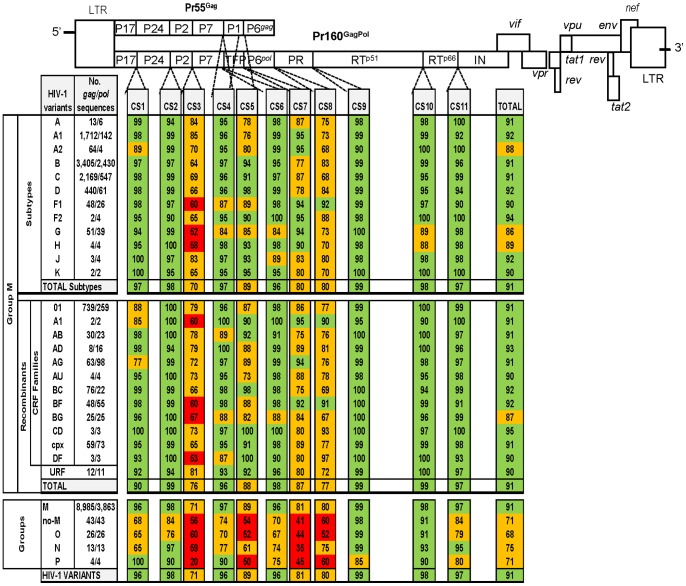
The conservation was determined by comparing our inferred consensus sequences with sequences from each HIV-1 variant vs. consensus-of-consensuses sequence retrieved from GenBank. Coloured boxes indicate the CS conservation rate at amino acid level: green (≥90%), orange (51–89%) and red (≤50%). The number in each coloured box shows the rate of conserved amino acid in each CS in all sequences of the corresponding HIV-1 variant. CS, cleavage site; P17, matrix; P24, capsid; P2, spacer peptide 1; P7, nucleocapside; P1, space peptide 2; TFP, transframe protein; PR, protease; RT, retrotranscriptase; IN, integrase; CRF, circulant recombinant form; URF, unique recombinant form.
Figure 6
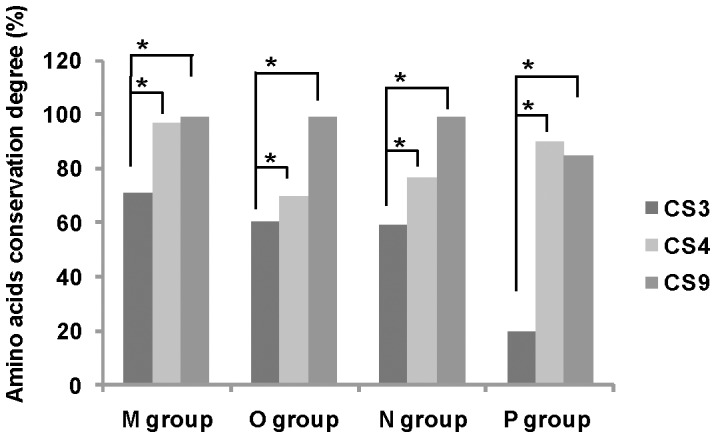
Figure 6. Conservation of the first and late processing sites at Gag and GagPol precursors.
Late processing sites at Gag (CS4, P7/P1) and GagPol (CS9, PR/RTp51) precursors and first CS site (CS3, P2/P7) according to the CS order previously described , , . *Significant difference, p<0.01.

References

    1. Swanstrom R, Wills J (1997) Retroviral gene expression. II. Synthesis, processing, and assembly of viral proteins. In: Coffin JM, Hughes SH, Varmus HE, editors. Retroviruses. New York: Cold Spring Harbor Laboratory. pp. 263–334.
    1. Tessmer U, Kräusslich HG (1998) Cleavage of HIV-1 proteinase from the N-terminally adjacent p6* protein is essential for efficient Gag polyprotein processing and viral infectivity. J Virol 72: 3459–3463. - PMC - PubMed
    1. de Oliveira T, Engelbrecht S, Janse van Rensburg E, Gordon M, Bishop K, et al. (2003) Variability at HIV-1 subtype C protease cleavage sites: an indication of viral fitness? J Virol 77: 9422–9430. - PMC - PubMed
    1. Waheed AA, Freed EO (2012) HIV type 1 Gag as a target for antiviral therapy. AIDS Res Hum Retroviruses 28: 54–75. - PMC - PubMed
    1. Fun A, Wensing AM, Verheyen J, Nijhuis M (2012) Human immunodeficiency virus Gag and protease: partners in resistance. Retrovirology 9: 63. - PMC - PubMed

Publication types