


Disease and predation: sorting out causes of a bighorn sheep (Ovis canadensis) decline
- PMID: 24516623
- PMCID: PMC3917862
- DOI: 10.1371/journal.pone.0088271
Disease and predation: sorting out causes of a bighorn sheep (Ovis canadensis) decline
Abstract
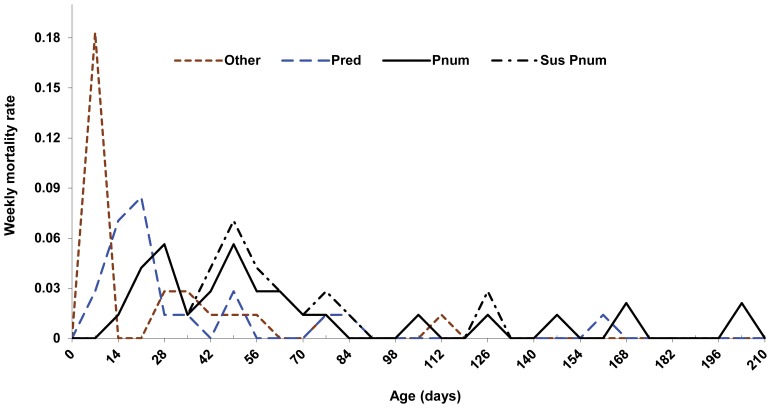
Estimating survival and documenting causes and timing of mortality events in neonate bighorn sheep (Ovis canadensis) improves understanding of population ecology and factors influencing recruitment. During 2010-2012, we captured and radiocollared 74 neonates in the Black Hills, South Dakota, of which 95% (70) died before 52 weeks of age. Pneumonia (36%) was the leading cause of mortality followed by predation (30%). We used known fate analysis in Program MARK to estimate weekly survival rates and investigate the influence of intrinsic variables on 52-week survival. Model {S1 wk, 2-8 wks, >8 wks} had the lowest AIC c (Akaike's Information Criterion corrected for small sample size) value, indicating that age (3-stage age-interval: 1 week, 2-8 weeks, and >8 weeks) best explained survival. Weekly survival estimates for 1 week, 2-8 weeks, and >8 weeks were 0.81 (95% CI = 0.70-0.88), 0.86 (95% CI = 0.81-0.90), and 0.94 (95% CI = 0.91-0.96), respectively. Overall probability of surviving 52 weeks was 0.02 (95% CI = 0.01-0.07). Of 70 documented mortalities, 21% occurred during the first week, 55% during weeks 2-8, and 23% occurred >8 weeks of age. We found pneumonia and predation were temporally heterogeneous with lambs most susceptible to predation during the first 2-3 weeks of life, while the greatest risk from pneumonia occurred from weeks 4-8. Our results indicated pneumonia was the major factor limiting recruitment followed by predation. Mortality from predation may have been partly compensatory to pneumonia and its effects were less pronounced as alternative prey became available. Given the high rates of pneumonia-caused mortality we observed, and the apparent lack of pneumonia-causing pathogens in bighorn populations in the western Black Hills, management activities should be geared towards eliminating contact between diseased and healthy populations.
Conflict of interest statement
Figures
References
-
- Buechner HK (1960) The bighorn sheep in the United States, its past, present, and future. Wildl Monogr 4: 1–174.
-
- Singer FJ, Zeigenfuss LC, Spicer L (2001) Role of patch size, disease, and movement in rapid extinction of bighorn sheep. Conserv Biol 15: 1347–1354.
-
- Wehausen JD, Kelley ST, Ramey RR (2011) Domestic sheep, bighorn sheep, and respiratory disease: a review of the experimental evidence. California Fish and Game 97: 7–24.
-
- Fitzsimmons NN, Buskirk SW, Smith MH (1995) Population history, genetic variability, and horn growth in bighorn sheep. Conserv Biol 9: 314–323.
-
- Gaillard JM, Festa-Bianchet M, Yoccoz NG, Loison A, Toigo C (2000) Temporal variation in fitness components and population dynamics of large herbivores. Annu Rev Ecol Syst 31: 367–393.
Publication types
MeSH terms
LinkOut - more resources
Full Text Sources
Other Literature Sources
