Review
. 2014 Jan;3(1):15-29.
doi: 10.3978/j.issn.2225-319X.2014.01.03.

A systematic review of surgical ablation versus catheter ablation for atrial fibrillation

Affiliations
Review

A systematic review of surgical ablation versus catheter ablation for atrial fibrillation

Katherine Kearney et al. Ann Cardiothorac Surg. 2014 Jan.

Abstract

Background: Atrial fibrillation (AF) is an increasingly prevalent condition in the ageing population, with significantly associated morbidity and mortality. Surgical and catheter ablative strategies both aim to reduce mortality and morbidity through freedom from AF. This review consolidates all currently available comparative data to evaluate these two interventions.

Methods: A systematic search was conducted across MEDLINE, PubMed, Embase, Cochrane Central Register of Controlled Trials and the Cochrane Database of Systematic Reviews from January 2000 until August 2013. All studies were critically appraised and only those directly comparing surgical and catheter ablation were included.

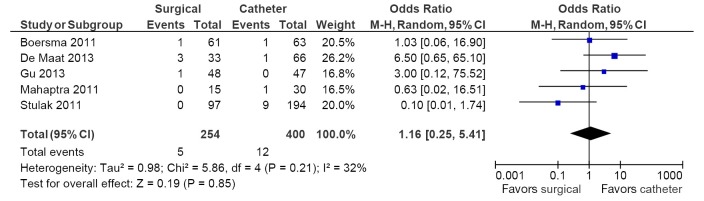
Results: Seven studies were deemed suitable for analysis according to the inclusion criteria. Freedom from AF was significantly higher in the surgical ablation group versus the catheter ablation group at 6-month, 12-month and study endpoint follow-up periods. Subgroup analysis demonstrated similar trends, with higher freedom from AF in the surgical ablation group for paroxysmal AF patients. The incidence of pacemaker implantation was higher, while no difference in stroke or cardiac tamponade was demonstrated for the surgical versus catheter ablation groups.

Conclusions: Current evidence suggests that epicardial ablative strategies are associated with higher freedom from AF, higher pacemaker implantation rates and comparable neurological complications and cardiac tamponade incidence to catheter ablative treatment. Other complications and risks were poorly reported, which warrants further randomized controlled trials (RCTs) of adequate power and follow-up duration.

Keywords: Atrial fibrillation (AF); catheter ablation; endocardial ablation; epicardial ablation; surgical ablation.


Figures
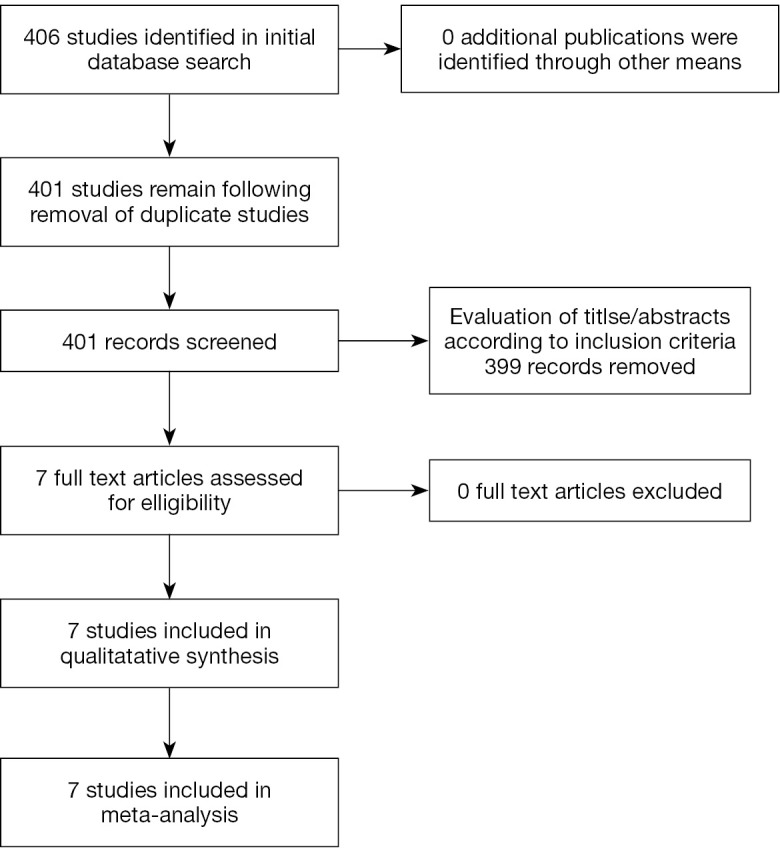
Figure 1
Figure 1
PRISMA flow chart.
Figure 2
Figure 2
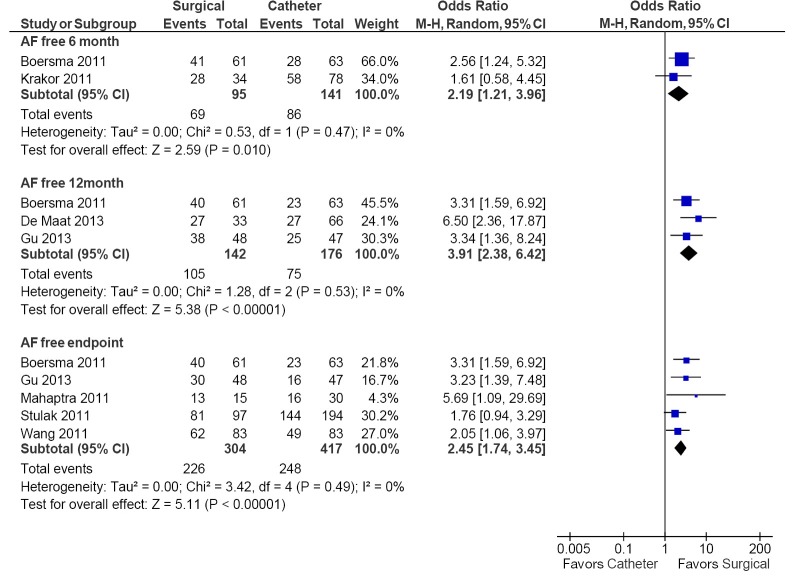
Forest plot of the odds ratio (OR) of freedom from AF at 6 months, 12 months and endpoint in AF patients undergoing surgical or catheter ablation. The estimate of the OR of each trial corresponds to the middle of the squares and the horizontal line shows the 95% confidence interval (CI). On each line, the number of events as a fraction of the total number randomized is shown for both treatment and control groups. For each subgroup, the sum of the statistics, along with the summary OR, is represented by the middle of the solid diamonds. A test of heterogeneity between the trials within a subgroup is given below the summary statistics. AF, atrial fibrillation; M-H, Mantel-Haenszel.
Figure 3
Figure 3
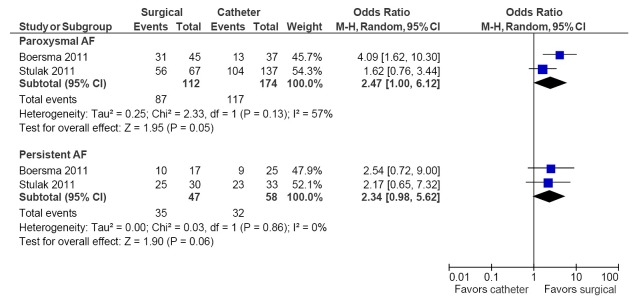
Forest plot of the odds ratio (OR) of freedom from AF for paroxysmal versus persistent AF patients undergoing surgical or catheter ablation. The estimate of the OR of each trial corresponds to the middle of the squares, and the horizontal line shows the 95% confidence interval (CI). On each line, the number of events as a fraction of the total number randomized is shown for both treatment and control groups. For each subgroup, the sum of the statistics, along with the summary OR, is represented by the middle of the solid diamonds. A test of heterogeneity between the trials within a subgroup is given below the summary statistics. AF, atrial fibrillation; M-H, Mantel-Haenszel.
Figure 4
Figure 4
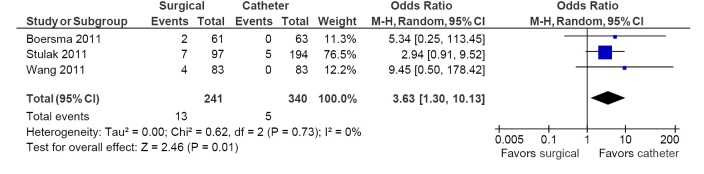
Forest plot of the odds ratio (OR) of pacemaker implantations in AF patients undergoing surgical versus catheter ablation. The estimate of the OR of each trial corresponds to the middle of the squares and the horizontal line shows the 95% confidence interval (CI). On each line, the number of events as a fraction of the total number randomized is shown for both treatment and control groups. For each subgroup, the sum of the statistics, along with the summary OR, is represented by the middle of the solid diamonds. A test of heterogeneity between the trials within a subgroup is given below the summary statistics. AF, atrial fibrillation; M-H, Mantel-Haenszel.
Figure 5
Figure 5
Forest plot of the odds ratio (OR) of strokes/TIA in AF patients undergoing surgical versus catheter ablation. The estimate of the OR of each trial corresponds to the middle of the squares and the horizontal line shows the 95% confidence interval (CI). On each line, the number of events as a fraction of the total number randomized is shown for both treatment and control groups. For each subgroup, the sum of the statistics, along with the summary OR, is represented by the middle of the solid diamonds. A test of heterogeneity between the trials within a subgroup is given below the summary statistics. AF, atrial fibrillation; M-H, Mantel-Haenszel.
Figure 6
Figure 6
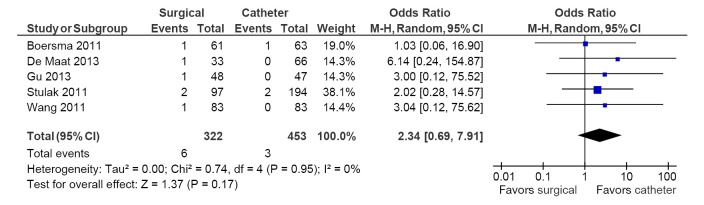
Forest plot of the odds ratio (OR) of cardiac tamponade or pericardial effusion in AF patients undergoing surgical versus catheter ablation. The estimate of the OR of each trial corresponds to the middle of the squares and the horizontal line shows the 95% confidence interval (CI). On each line, the number of events as a fraction of the total number randomized is shown for both treatment and control groups. For each subgroup, the sum of the statistics, along with the summary OR, is represented by the middle of the solid diamonds. A test of heterogeneity between the trials within a subgroup is given below the summary statistics. AF, atrial fibrillation; M-H, Mantel-Haenszel.

References

    1. European Heart Rhythm Association , European Association for Cardio-Thoracic Surgery, Camm AJ, et al. Guidelines for the management of atrial fibrillation: the Task Force for the Management of Atrial Fibrillation of the European Society of Cardiology (ESC). Eur Heart J 2010;31:2369-429 - PubMed
    1. Stewart S, Hart CL, Hole DJ, et al. Population prevalence, incidence, and predictors of atrial fibrillation in the Renfrew/Paisley study. Heart 2001;86:516-21 - PMC - PubMed
    1. Wilber DJ, Pappone C, Neuzil P, et al. Comparison of antiarrhythmic drug therapy and radiofrequency catheter ablation in patients with paroxysmal atrial fibrillation: a randomized controlled trial. JAMA 2010;303:333-40 - PubMed
    1. Calkins H, Reynolds MR, Spector P, et al. Treatment of atrial fibrillation with antiarrhythmic drugs or radiofrequency ablation: two systematic literature reviews and meta-analyses. Circ Arrhythm Electrophysiol 2009;2:349-61 - PubMed
    1. Weerasooriya R, Khairy P, Litalien J, et al. Catheter ablation for atrial fibrillation: are results maintained at 5 years of follow-up? J Am Coll Cardiol 2011;57:160-6 - PubMed