


Exploring dimensionality of effortful control using hot and cool tasks in a sample of preschool children
- PMID: 24518050
- PMCID: PMC4349403
- DOI: 10.1016/j.jecp.2013.11.013
Exploring dimensionality of effortful control using hot and cool tasks in a sample of preschool children
Abstract
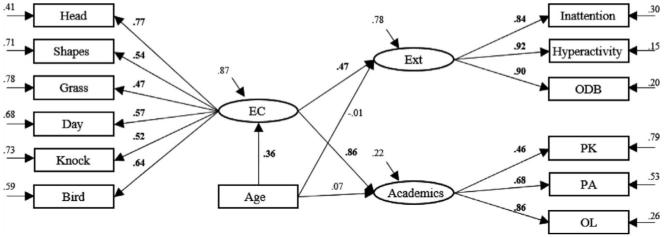
Effortful control (EC) is an important developmental construct associated with academic performance, socioemotional growth, and psychopathology. EC, defined as the ability to inhibit or delay a prepotent response typically in favor of a subdominant response, undergoes rapid development during children's preschool years. Research involving EC in preschool children can be aided by ensuring that the measured model of EC matches the latent structure of EC. Extant research indicates that EC may be multidimensional, consisting of hot (affectively salient) and cool (affectively neutral) dimensions. However, there are several untested assumptions regarding the defining features of hot EC. Confirmatory factor analysis was used in a sample of 281 preschool children (Mage=55.92months, SD=4.16; 46.6% male and 53.4% female) to compare a multidimensional model composed of hot and cool EC factors with a unidimensional model. Hot tasks were created by adding affective salience to cool tasks so that hot and cool tasks varied only by this aspect of the tasks. Tasks measuring EC were best described by a single factor and not distinct hot and cool factors, indicating that affective salience alone does not differentiate between hot and cool EC. EC shared gender-invariant associations with academic skills and externalizing behavior problems.
Keywords: Academics; Confirmatory factor analysis; Effortful control; Externalizing; Preschool children; Structural equation modeling.
Copyright © 2013 Elsevier Inc. All rights reserved.
Figures
References
-
- Allan NP, Hume LE, Allan DM, Farrington AL, Lonigan CJ. Relations between self-regulation and the development of academic skills in preschool and kindergarten: A meta-analysis. Florida State University; 2014. Unpublished manuscript. - PubMed
-
- Bassett HH, Denham S, Wyatt TM, Warren-Khot HK. Refining the Preschool Self-Regulation Assessment for use in preschool classrooms. Infant and Child Development. 2012;21:596–616.
-
- Blair C, Razza RP. Relating effortful control, executive function, and false belief understanding to emerging math and literacy ability in kindergarten. Child Development. 2007;78:647–663. - PubMed
-
- Brock LL, Rimm-Kaufman SE, Nathanson L, Grimm KJ. The contributions of “hot” and “cool” executive function to children’s academic achievement, learning-related behaviors, and engagement in kindergarten. Early Childhood Research Quarterly. 2009;24:337–349.
Publication types
MeSH terms
Grants and funding
LinkOut - more resources
Full Text Sources
Other Literature Sources
