. 2014 May;24(5):831-8.
doi: 10.1101/gr.164400.113. Epub 2014 Feb 11.

Widespread and frequent horizontal transfers of transposable elements in plants

Affiliations

Widespread and frequent horizontal transfers of transposable elements in plants

Moaine El Baidouri et al. Genome Res. 2014 May.

Abstract

Vertical, transgenerational transmission of genetic material occurs through reproduction of living organisms. In addition to vertical inheritance, horizontal gene transfer between reproductively isolated species has recently been shown to be an important, if not dominant, mechanism in the evolution of prokaryotic genomes. In contrast, only a few horizontal transfer (HT) events have been characterized so far in eukaryotes and mainly concern transposable elements (TEs). Whether these are frequent and have a significant impact on genome evolution remains largely unknown. We performed a computational search for highly conserved LTR retrotransposons among 40 sequenced eukaryotic genomes representing the major plant families. We found that 26 genomes (65%) harbor at least one case of horizontal TE transfer (HTT). These transfers concern species as distantly related as palm and grapevine, tomato and bean, or poplar and peach. In total, we identified 32 cases of HTTs, which could translate into more than 2 million among the 13,551 monocot and dicot genera. Moreover, we show that these TEs have remained functional after their transfer, occasionally causing a transpositional burst. This suggests that plants can frequently exchange genetic material through horizontal transfers and that this mechanism may be important in TE-driven genome evolution.


Figures
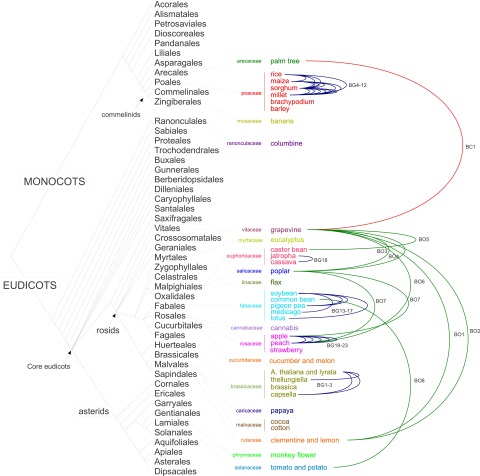
Figure 1.
Figure 1.
Horizontal transposon transfers (HTTs) identified in our survey of 40 fully sequenced plant genomes. The 40 species used in this study together with the color-coded families to which they belong are positioned in the monocot/dicot phylogenetic tree obtained from APG3 (http://www.mobot.org/MOBOT/research/APweb/) (see Supplemental Table 1 for details). Each HTT is represented by a line connecting the species involved (red line, transfer between classes [BC]; green line, transfer between orders [BO]; blue line, transfer between genera [BG]).
Figure 2.
Figure 2.
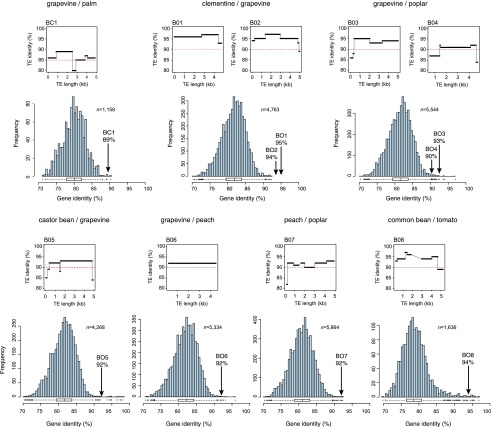
Comparison between the sequence identity of LTR-RTs and the genomic distance between the species involved in BC and BO transfers. In each panel, the top graph represents the sequence identity along the complete length of the LTR-RTs involved in the transfer in both species as indicated, with the red line representing the detection threshold (85% and 90% identity for BC and BO HTTs, respectively). The histogram (in blue) represents the distribution of pairwise gene identity based on CDS comparisons (see Methods). Numbers of CDS pairs analyzed are as indicated (n). Arrows correspond to average sequence identity between the transferred LTR-RTs.
Figure 3.
Figure 3.
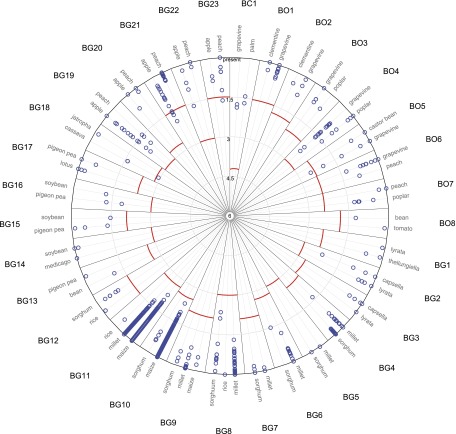
Transpositional activity of horizontally transferred LTR-RTs. Concentric circles represent the time scale for insertion dates: from 6 My (center) to present (outer circle). For each HTT, the red line illustrates the estimated date of the transfer (based on percent identity between the LTR-RTs involved in the transfer). For each species, the insertion date of each element (illustrated by the percent identity between both its LTR sequences) is represented as blue circles. Graphs are plotted with R (library plotrix) and edited with Illustrator.
Figure 4.
Figure 4.
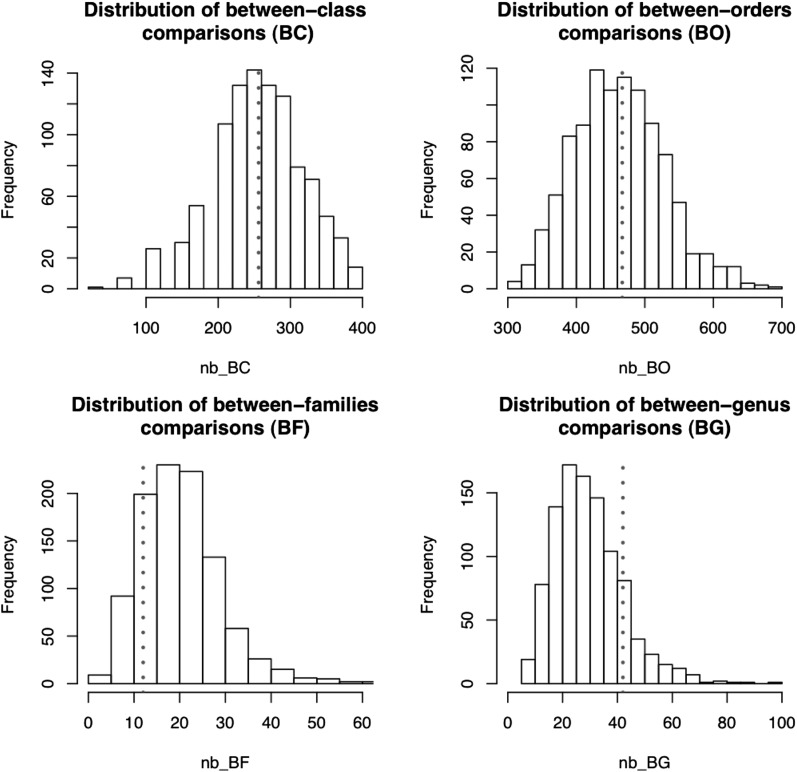
Distributions of the four types of comparisons based on the simulation of 1000 random draws of 36 genera. The dotted lines represent the number of each of the comparison types in our sample of 36 genera from which sequenced genomes were analyzed.

References

    1. The Angiosperm Phylogeny Group. 2009. An update of the Angiosperm Phylogeny Group classification for the orders and families of flowering plants: APG III. Bot J Linn Soc 161: 105–121
    1. Bennetzen JL 2000. Transposable element contributions to plant gene and genome evolution. Plant Mol Biol 42: 251–269 - PubMed
    1. Diao X, Freeling M, Lisch D 2006. Horizontal transfer of a plant transposon. PLoS Biol 4: e5. - PMC - PubMed
    1. Eickbush TH, Malik HS 2002. Origin and evolution of retrotransposons. In Mobile DNA II (ed. Craig NL, et al.), pp. 1111–1144. ASM Press, Washington DC
    1. El Baidouri M, Panaud O 2013. Comparative genomic paleontology across plant kingdom reveals the dynamics of TE-driven genome evolution. Genome Biol Evol 5: 954–965 - PMC - PubMed

Publication types