Review
. 2014 Jul;21(7):823-836.
doi: 10.1177/1933719114522550. Epub 2014 Feb 11.

Advances in the Pathogenesis of Adhesion Development: The Role of Oxidative Stress

Affiliations
Review

Advances in the Pathogenesis of Adhesion Development: The Role of Oxidative Stress

Awoniyi O Awonuga et al. Reprod Sci. 2014 Jul.

Abstract

Over the past several years, there has been increasing recognition that pathogenesis of adhesion development includes significant contributions of hypoxia induced at the site of surgery, the resulting oxidative stress, and the subsequent free radical production. Mitochondrial dysfunction generated by surgically induced tissue hypoxia and inflammation can lead to the production of reactive oxygen and nitrogen species as well as antioxidant enzymes such as superoxide dismutase, catalase, and glutathione peroxidase which when optimal have the potential to abrogate mitochondrial dysfunction and oxidative stress, preventing the cascade of events leading to the development of adhesions in injured peritoneum. There is a significant cross talk between the several processes leading to whether or not adhesions would eventually develop. Several of these processes present avenues for the development of measures that can help in abrogating adhesion formation or reformation after intraabdominal surgery.

Keywords: adhesion markers; hypoxia; oxidative stress; postoperative adhesions.


Conflict of interest statement

Declaration of Conflicting Interests: The author(s) declared no potential conflicts of interest with respect to the research, authorship, and/or publication of this article.

Figures

Figure 1.
Figure 1.
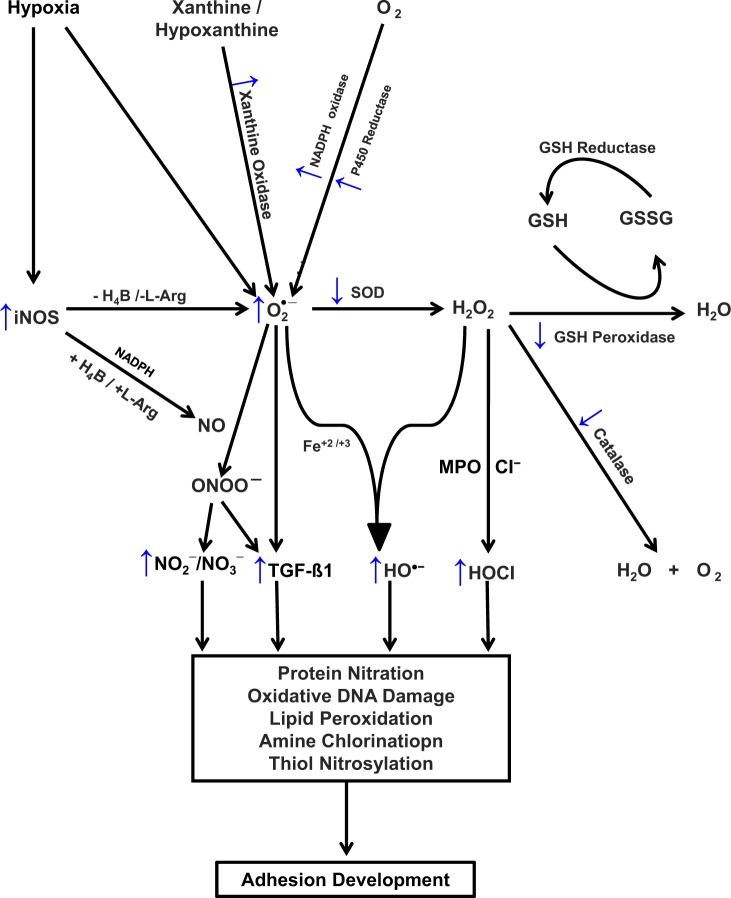
Proposed scheme for redox balance in postoperative adhesions development. ↑ denotes an increase; ↓, a decrease; Cl, chloride ion; Fe+2 and Fe+3, elemental iron; GSH, glutathione; GSSG, glutathione disulfide; H2O, water; H4B, tetrahydrobiopterin; H2O2, hydrogen peroxide; HOCI, hypochlorous acid; l-Arg, l-arginine; MPO, myeloperoxidase; O2, molecular oxygen; O2 •–, superoxide anion; HO, hydroxyl radical; ONOO, peroxynitrite; NADPH, nicotine adenine dinucleotide phosphate; NO, nitric oxide; NO2 , nitrite; NO3 , nitrate; iNOS, inducible nitric oxide synthase; ROS, reactive oxygen species; SOD, superoxide dismutase; TGF-β, transforming growth factor β.
Figure 2.
Figure 2.
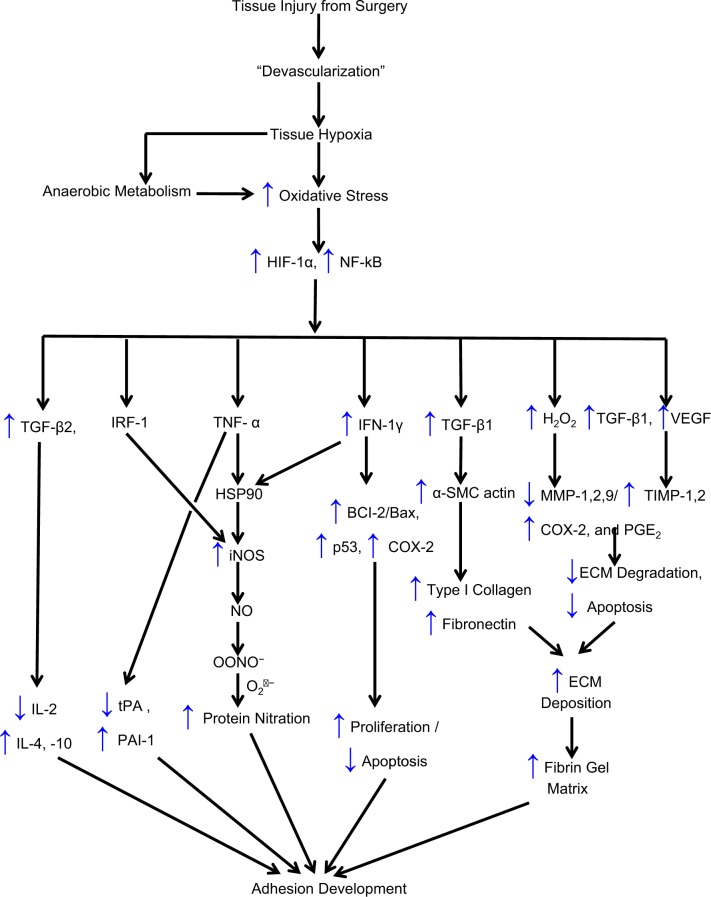
Proposed chain of events that lead to postoperative adhesion development: tissue injury, hypoxia, oxidative stress, and transcription factors and their role in the development of postoperative adhesions. ↑ denotes an increase; ↓, a decrease; BCl-2, B-cell CLL/lymphoma 2; BAX, BCl2-associated X; COX-2, cyclooxygenase 2; ECM, extracellular matrix; HIF, hypoxia-induced factor; IFN-γ, interferon γ; IL, interleukin; iNOS, inducible nitrous oxide synthase; MMP, matrix metalloproteinases; NADP, nicotine adenine dinucleotide phosphate; NO, nitric oxide; NOS, nitric oxide synthase; NF-κB, nuclear factor κB; P53, tumor protein 53; PAI-1, plasminogen activator inhibitor; TGF-β1, transforming growth factor β; TIMP, tissue inhibitor of matrix metalloproteinases; tPA, tissue plasminogen activator; VEGF, vascular endothelial growth factor.
Figure 3.
Figure 3.
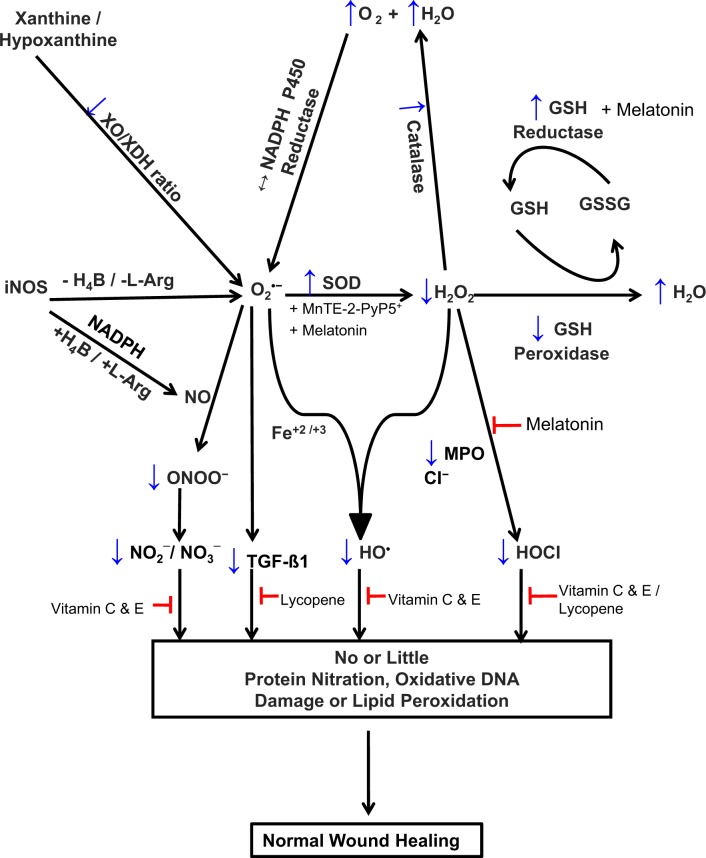
Proposed scheme for potential targets for the prevention of postoperative adhesion development. ↑ denotes an increase; ↓, a decrease; Cl, chloride ion; Fe+2 and Fe+3, elemental iron; GSH, glutathione; GSSG, glutathione disulfide; H2O, water; H4B, tetrahydrobiopterin; H2O2, hydrogen peroxide; HOCI, hypochlorous acid; l-Arg, l-arginine; MPO, myeloperoxidase; O2, molecular oxygen; O2 •–, superoxide anion; HO, hydroxyl radical; ONOO, peroxynitrite; NADPH, nicotine adenine dinucleotide phosphate; NO, nitric oxide; NO2 , nitrite; NO3 , nitrate; iNOS, inducible nitric oxide synthase; ROS, reactive oxygen species; SOD, superoxide dismutase; TGF-β, transforming growth factor β; XO, xanthine oxidase; XDH, xanthine dehydrogenase.

References

    1. Agarwal A, Allamaneni SS. Role of free radicals in female reproductive diseases and assisted reproduction. Reprod Biomed Online. 2004;9(3):338–347 - PubMed
    1. Halliwell BG, John Gutteridge, eds. Free Radicals in Biology and Medicine. Oxford: Clarendon; 1989:1–20
    1. Valko M, Leibfritz D, Moncol J, Cronin MT, Mazur M, Telser J. Free radicals and antioxidants in normal physiological functions and human disease. Int J Biochem Cell Biol. 2007;39(1):44–84 - PubMed
    1. Yung LM, Leung FP, Yao X, Chen ZY, Huang Y. Reactive oxygen species in vascular wall. Cardiovasc Hematol Disord Drug Targets. 2006;6(1):1–19 - PubMed
    1. Crimi E, Ignarro LJ, Napoli C. Microcirculation and oxidative stress. Free Radic Res. 2007;41(12):1364–1375 - PubMed

LinkOut - more resources