


The effect of the cognitive behavioral therapy and pharmacotherapy on infertility stress: a randomized controlled trial
- PMID: 24520487
- PMCID: PMC3914487
The effect of the cognitive behavioral therapy and pharmacotherapy on infertility stress: a randomized controlled trial
Abstract
Background: Infertility has been described as creating a form of stress leading to a variety of psychological problems. Both psychotherapy and pharmacotherapy are effective treatments for infertility stress. The aim of this study was to evaluate the effectiveness of cognitive behavioral therapy along with fluoxetine for improvement infertility stress in infertile women.
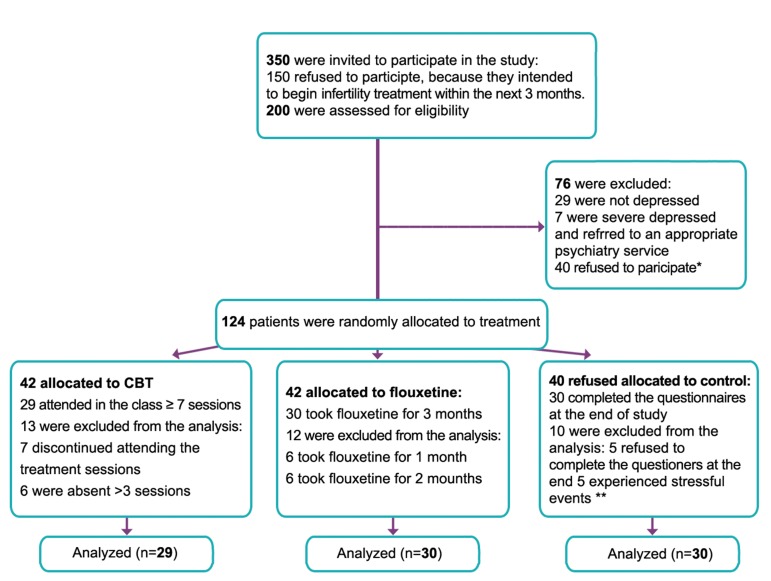
Materials and methods: :In a randomized controlled clinical trial, 89 infertile women with mild to moderate depression (Beck scores 10-47) were recruited into the following three groups: i. cognitive behavior therapy (CBT), ii. antidepressant therapy, and iii. control group. Twenty-nine participants in the CBT method received gradual relaxation training, restructuring, and eliminating of negative automatic thoughts and dysfunctional attitudes to infertility for 10 sessions. Thirty participants in the pharmacotherapy group took 20 mg fluoxetine daily for 90 days. Thirty individuals in control group did not receive any intervention. All participants completed fertility problem inventory (FPI) and the Beck Depression Inventory (BDI) at the beginning and end of the study. We applied Chi-square paired t test, ANOVA and Turkey's test to analyze the data.
Results: THE MEAN OF THE INFERTILITY STRESS SCORES IN CBT, FLUOXETINE, AND CONTROL GROUPS AT THE BEGINNING AND END OF THE STUDY WERE AS FOLLOWS, RESPECTIVELY: 3.5 ± 0.62 vs.2.7 ± 0.62 (p<0.05), 3.5 ± 0.53 vs.3.2 ± 4.4 (p<0.05), and 3.4 ± 0.55 vs. 3.5 ± 0.48. In CBT group, the mean scores of social concern, sexual concern, marital concern, rejection of child-free lifestyle, and need for parenthood decreased meaningfully compared to those before starting the therapy. But in fluoxetine group, mean score of women sexual concern out of those five main problems of infertility reduced significantly. Also, fluoxetine and CBT reduced depression compared to the control group.
Conclusion: CBT improved the social concerns, sexual concerns, marital concerns, rejection of child-free lifestyle, and need for parenthood more than floxitine group. Thus, CBT was not only a reliable alternative to pharmacotherapy, but also superior to fluoxetine in resolving and reducing of infertility stress (Registration Number: IRCT2012061710048N1).
Keywords: Cognitive Behavior Therapy; Fluoxetine; Infertility; Stress.
Figures
References
-
- Cousineau TM, Domar AD. Psychological impact of infertility. Best Pract Res Clin Obstet Gynaecol. 2007;21(2):293–308. - PubMed
-
- Guerra D, Llobera A, Veiga A, Barri PN. Psychiatric morbidity in couples attending a fertility service. Hum Reprod. 1998;13(6):1733–1736. - PubMed
-
- Gallinelli A, Roncaglia R, Matteo ML, Ciaccio I, Volpe A, Facchinetti F. Immunological changes and stress are associated with different implantation rates in patients undergoing in vitro fertilization-embryo transfer. Fertil Steril. 2001;76(1):85–91. - PubMed
-
- Gourounti K, Anagnostopoulos F, Vaslamatzis G. Psychometric properties and factor structure of the Fertility Problem Inventory in a sample of infertile women undergoing fertility treatment. Midwifery. 2011;27(5):660–667. - PubMed
-
- Lancastle D, Boivin J. Dispositional optimism, trait anxiety, and coping: unique or shared effects on biological response to fertility treatment? Health Psychol. 2005;24(2):171–178. - PubMed
LinkOut - more resources
Full Text Sources
Medical