


Aiming to be a breastfeeding mother in a neonatal intensive care unit and at home: a thematic analysis of peer-support group discussion in social media
- PMID: 24521232
- PMCID: PMC6860251
- DOI: 10.1111/mcn.12108
Aiming to be a breastfeeding mother in a neonatal intensive care unit and at home: a thematic analysis of peer-support group discussion in social media
Abstract
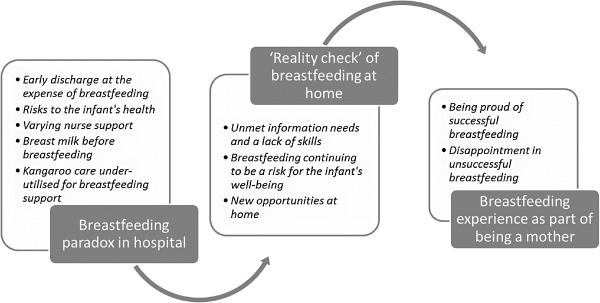
Preterm infants are usually breastfed less than full-term infants, and successful breastfeeding requires a supportive environment and special efforts from their mothers. A breastfeeding peer-support group, utilising social media, was developed for these mothers in order to support them in this challenge. Mothers were able to discuss breastfeeding and share experiences. The purpose of this study was to describe the perceptions of breastfeeding mothers of preterm infants based on the postings in peer-support group discussions in social media. The actively participating mothers (n = 22) had given birth <35 gestational weeks. They were recruited from one university hospital in Finland. The social media postings (n = 305) were analysed using thematic analysis. A description of the process of breastfeeding a preterm infant from the point of view of a mother was created. The process consisted of three main themes: the breastfeeding paradox in hospital, the 'reality check' of breastfeeding at home and the breastfeeding experience as part of being a mother. The mothers encountered paradoxical elements in the support received in hospital; discharge was promoted at the expense of breastfeeding and pumping breast milk was emphasised over breastfeeding. After the infant's discharge, the over-optimistic expectations of mothers often met with reality - mothers did not have the knowledge or skills to manage breastfeeding at home. Successful breastfeeding was an empowering experience for the mothers, whereas unsuccessful breastfeeding induced feelings of disappointment. Therefore, the mothers of preterm infants need evidence-based breastfeeding counselling and systematic support in a neonatal intensive care unit (NICU) and at home.
Keywords: breast milk; breastfeeding; mother support group; preterm infant; qualitative methods.
© 2014 John Wiley & Sons Ltd.
Conflict of interest statement
The authors declare that they have no conflicts of interest.
Figures
References
-
- Ahmed A.H. & Sands L.P. (2010) Effect of pre‐ and postdischarge interventions on breastfeeding outcomes and weight gain among premature infants. Journal of Obstetric, Gynecologic and Neonatal Nursing 39, 53–63. - PubMed
-
- Andersson J.W., Johnstone B.M. & Remley D.T. (1999) Breast‐feeding and cognitive development: a meta‐analysis. American Journal of Clinical Nutrition 70, 525–535. - PubMed
-
- Berger I., Weintraub V., Dollberg S., Kopolovitz R. & Mandel D. (2009) Energy expenditure for breastfeeding and bottle‐feeding preterm infants. Pediatrics 124, e1149–e1152. - PubMed
-
- Bernaix L.W. (2000) Nurses' attitudes, subjective norms, and behavioral intentions toward support of breastfeeding mothers. Journal of Human Lactation 16, 201–209. - PubMed
-
- Bonet M., Blondel B., Agostino R., Combier E., Maier R.F., Cuttini M. et al (2011) Variations in breastfeeding rates for very preterm infants between regions and neonatal units in Europe: results from the MOSAIC cohort. Archives of Disease in Childhood. Fetal and Neonatal Edition 96, F450–F452. - PubMed
Publication types
MeSH terms
LinkOut - more resources
Full Text Sources
Other Literature Sources
Medical
Miscellaneous
